

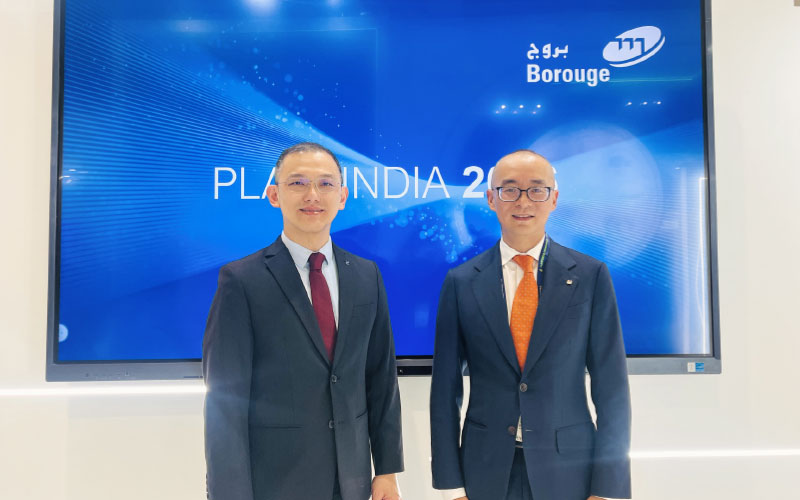
At Plast India 2026, Borouge highlighted its expanding role in India’s fast-growing wire and cable segment, backed by global capacity expansion and deeper local investments. In this interaction with Wire & Cable India, Mr. Eddie Wang, SVP, Region Asia South and Mr. Jong William, Asia South Commercial VP of Energy & Infrastructure, Borouge, discuss their recent financial performance, innovation focus, India strategy, and outlook for the wire and cable industry.
Wire & Cable India: Borouge has recently delivered a USD 1.1 billion net profit in 2025. Could you share the driving factors behind this and the challenges you had to overcome along the way?
Eddie Wang: First of all, we are very proud of our results for 2025. The industry has been facing challenges over the past few years, with a lot of uncertainty arising from geopolitics and trade conflicts. We had to manage a lot of dynamics.
If you look at our results, the key success factors behind our delivery are, first of all, maintaining what we are really good at, which is operational excellence. Our production units have been running very well. Also, commercial excellence has been important. We have stayed committed to our key principle of differentiation at scale and value-based selling, as well as providing application-driven solutions. This is part of Borouge’s DNA.
At the same time, having a resilient feedstock position has been another key factor. Last but not least, cost discipline helped us navigate the situation.
Most importantly, this delivery is about the people. We have a very strong team with a common objective, keeping our eyes on the goal and working together. In India, we also have a very strong local team as part of our global organisation, contributing to this proud result.
Watch: Top Cable Companies in India
WCI: Is there one challenge which you would like to share, which you overcame and are proud of?
EW: The market is very volatile, and we had to deal with price volatility because of excess capacity. We had to be very agile in driving value creation through innovation and application-based solutions, and by working closely with customers who recognise the value of our products.
From a commercial perspective, this has been one of the key success factors.
WCI: What are you showcasing here at Plast India 2026? How has your experience been so far? How is it different from the last time?
EW: The event has been great. This is day two, and we are seeing a lot of back-to-back meetings with key customers.
We are presenting many innovative solutions across various segments, including infrastructure, energy, advanced packaging, healthcare, and agriculture. We have also brought a couple of new products to the Indian market for the first time.
Compared to the previous edition, the event has become bigger and more mature. I remember three years ago when I was here, this facility was newly established. Today, it is much more well organised. We are very pleased to be here.
WCI: How does India fit into Borouge’s broader South Asia growth strategy, and how do you view the long-term potential of India’s wire and cable industry?
EW: India is a very important market for Borouge. We operate in growth markets, and India is clearly a growth market within those growth markets. If you look at GDP growth, it has been strong, at around 6 to 8 percent. Polyolefin demand typically grows a couple of percentage points faster than GDP, so long-term growth will be strong.
Volume growth is important, but for Borouge, it is equally important to focus on the quality of the business, the appreciation of value creation, and the differentiation of products across various segments.
For example, the recently published budget includes many pro-growth and infrastructure investments. This will drive demand for differentiated polyolefin products.
Let me give you a couple of examples. One example is within the manufacturing focus of the budget, where pharmaceutical and healthcare products are important elements. In healthcare, we have historically been relying on supply from our parent company, Borealis. This time, we have introduced products for applications such as IV bottles and syringes to support the Indian market.
On the infrastructure side, data centres are an important growth area. They require high-performance (dust-free) piping solutions that ensure clean operating environments and long product life. These are examples of how differentiated solutions fit into India’s growth.
Specifically, the wire and cable industry is one of the fastest-growing segments aligned with our growth strategy. Borouge is a leader in providing energy solutions for the wire and cable industry, including XLPE insulation, jacketing materials, and semiconductive compounds.
We believe India is at a tipping point for high growth over the next 10 to 20 years. This growth is driven by urbanisation, rising income levels, and increasing electricity consumption. Renewable energy expansion is also a key driver.
India has a target of 500 gigawatts of renewable energy by 2030, and current capacity is roughly at half of that. This requires major investments in transmission and distribution.
India is also shifting from overhead to underground cables, which require higher-quality and higher-voltage materials to reduce energy losses. All these factors make the wire and cable segment very important for our growth strategy.

India is a very important market for Borouge with a strong GDP growth at around 6 to 8 percent. We believe India is at a tipping point for high growth over the next 10 to 20 years.
WCI: Borouge has strengthened its footprint in India through new offices and a warehouse in Chennai. Why did you choose Chennai, and how do these investments improve supply reliability and responsiveness?
EW: I think our footprint growth in India reflects our very long history here. Borouge is a young company with about 25–26 years as a company, and we have been in India almost from day one. In fact, we started from Mumbai, with our headquarters office in Mumbai.
In 2013, we added Delhi as the second office. We also have a commercial footprint, with home-based teams in other parts of India.
As we grow, we find that one of the important values for our customers in the Indian market is supply chain flexibility and resilience. Customers value this a lot.
Especially in the southern part of India, Chennai allows us to strengthen our presence, where historically our footprint was relatively weaker. This helps us improve service levels to our customers. It also enables us to supply small and medium-sized customers who may require local currency sales, which helps us expand our capabilities. Of course, Chennai is one of the first locations where we have established a logistics hub in the Indian market, but it will not be the last one. As we continue to grow, we will keep exploring the feasibility of expanding into other areas based on customer needs.
WCI: What application-led innovations is Borouge bringing specifically for the wire and cable sector?
Jong William: Yes. Innovation is in the DNA of Borouge and Borealis. There are two key innovations we want to share in this context.
One key innovation is in high-voltage cable insulation, which reduces transmission losses and supports long-distance transmission, both on land and subsea.
Another important area is fibre optic cables. With the growth of data centres and future telecom technologies, there is increasing demand for micro-fibre solutions.
We have developed low-shrinkage jacketing solutions that enable smaller cable sizes and lower material usage while maintaining performance. These innovations are important for the future of the industry.
Also Read: Mixer S.p.A. Compounds for ESP Systems Shaping the Reliability of Cables
WCI: Looking ahead, what changes will shape material selection in the wire and cable industry?
JW: Market demand will be the key driver. India’s growing power demand, infrastructure expansion, and data centre growth will increase cable demand.
Power plants are often located far from consumption centres, requiring long-distance transmission and higher-voltage cables.
Transport infrastructure will also drive significant demand. Airways, including new and expanding airports, will require reliable wire and cable solutions. For example, Mumbai was one of the airports where we contributed by providing wire and cable material solutions.
At the same time, railways, including metro and upcoming high-speed rail projects, will also require substantial cable infrastructure to support safe and efficient operations.
WCI: Could you share insights into your key strategic initiatives and your biggest learning from India?
EW: We are expanding our XLPE capacity in the UAE, which will significantly increase our ability to supply the wire and cable industry.
We are also expanding our polyethylene capacity by 1.4 million tonnes, increasing total capacity to approximately 6.4 million tonnes.
In India, we continue to invest in commercial and logistics infrastructure.
As for your second question on my biggest learning from India, I would say it is optimism. Despite global uncertainty, we see strong confidence among customers and partners. This optimism will drive India’s growth over the next 10, 20, and 30 years and create opportunities for companies like us.
The wire and cable industry is one of the fastest-growing segments aligned with our growth strategy. Borouge is a leader in providing energy solutions for the wire and cable industry, including XLPE insulation, jacketing materials, and semiconductive compounds.