


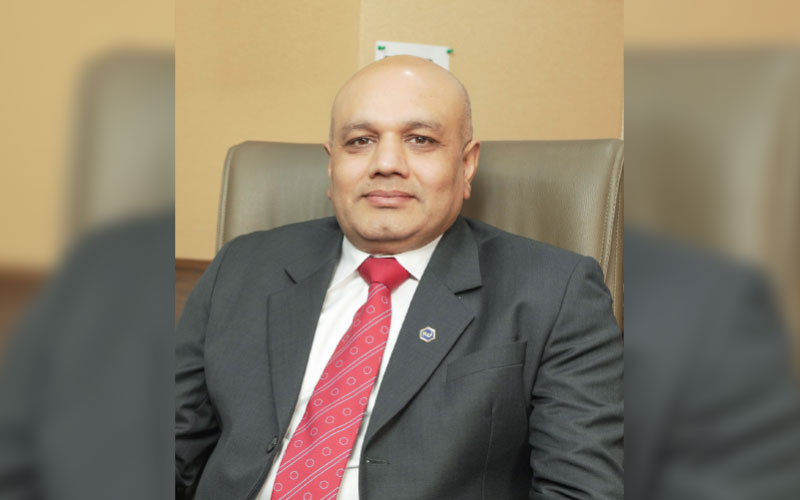
In an exclusive interaction with Wire & Cable India, Mr. Kamal Jain, Director, KLJ Group, highlights that India today delivers advanced engineering solutions that address complex global applications and demanding operating environments, underscoring the country’s expanding role in co-development and innovation-led partnerships. KLJ Group contributes to this partnership by offering comprehensive, end-to-end capabilities across the wire and cable value chain, supported by high levels of automation, digitally integrated quality systems, international certifications, and robust R&D and customization, aligned with stringent global quality standards.
Wire & Cable India: What will you showcase at WIRE Düsseldorf to highlight India’s technological capabilities and manufacturing excellence to a global audience?
Kamal Jain: At WIRE Düsseldorf, we will showcase India’s end-to-end capabilities across the wire and cable value chain, demonstrating how Indian manufacturers combine advanced engineering, cost competitiveness, and global-quality standards.
The key highlights will include next-generation wire and cable solutions for power transmission, renewable energy, EVs, railways, and infrastructure; advanced manufacturing technologies, including automation, precision tooling, and digital quality control, aligned with global certifications (IEC, ASTM, ISO); innovation-led materials and processes, such as high-performance alloys, specialty conductors, and sustainable, low-carbon manufacturing practices; scalable manufacturing excellence, showcasing India’s ability to deliver high volumes with consistency, reliability, and supply-chain resilience; and collaborative R&D and customization capabilities, underscoring India’s readiness to partner with global OEMs and EPC players. Together, these elements position India not just as a competitive manufacturing base, but as a trusted global technology partner capable of delivering innovation, quality, and scale to international markets.
Watch: Top Cable Companies in India
WCI: International trade fairs play a crucial role in shaping industry collaborations. How do platforms like WIRE Düsseldorf help Indian manufacturers connect with global markets and customers?
KJ: Platforms like WIRE Düsseldorf play a pivotal role in bridging Indian manufacturers with global markets by serving as a high-impact meeting point for technology, business, and collaboration. Such international trade fairs help Indian companies by providing direct access to global buyers and decision-makers, including OEMs, EPC contractors, distributors, and technology partners from across Europe, the Americas, and Asia.
These fairs also enhance global visibility and credibility, allowing Indian manufacturers to demonstrate compliance with international standards and position themselves as reliable, long-term partners.
It facilitates technology exchange and partnerships, through exposure to global innovations, best practices, and opportunities for joint ventures, licensing, and co-development. Further, it enables market intelligence and trend awareness, helping Indian companies understand evolving customer expectations, regulatory requirements, and future technology directions. It accelerates export growth, by shortening sales cycles through face-to-face engagement, trust-building, and real-time technical discussions. Overall, platforms like WIRE Düsseldorf act as powerful catalysts, helping Indian manufacturers move beyond transactional exports to build strategic, sustainable global relationships.
India is firmly positioned as a global manufacturing and engineering base to support expansions with scale, speed, and reliability.
WCI: From your participation at WIRE Düsseldorf, what key global market insights are you hoping to gain and bring back to strengthen India’s wire and cable manufacturing ecosystem?
KJ: From our participation at WIRE Düsseldorf, we aim to gain actionable global insights that can be translated into tangible improvements across India’s wire and cable manufacturing ecosystem. The key insights include identifying emerging technology trends, such as advanced conductor materials, high-voltage and ultra-high-voltage solutions, and smart cables integrated with digital monitoring.
Further, it helps to analyze evolving sustainability expectations, including low-carbon manufacturing, recyclable materials, energy-efficient processes, and stricter ESG compliance demanded by global customers. One can witness the shift in global demand, particularly driven by renewable energy, EV infrastructure, data centers, railways, and grid modernization.
It provides insight into international quality and certification benchmarks, helping Indian manufacturers further align with and exceed the global performance and safety standards. It also helps in understanding the best practices in automation and Industry 4.0, covering predictive maintenance, real-time quality analytics, and digitally integrated supply chains.
By integrating these learnings, India’s wire and cable industry can accelerate innovation, enhance sustainability, and strengthen its global competitiveness, reinforcing India’s position as a future-ready manufacturing hub.
WCI: Over the years, how have you seen India’s representation evolve at international trade fairs, and how do you contribute to strengthening India’s image as a global engineering hub?
KJ: Over the years, India’s representation at international trade fairs such as WIRE Düsseldorf has evolved significantly—from being largely cost-driven to becoming technology-led, quality-focused, and innovation-oriented.
Earlier, Indian participation was often viewed through the lens of price competitiveness. Today, Indian exhibitors present advanced engineering solutions that meet complex global applications and demanding operating conditions. It also showcases world-class manufacturing practices, backed by automation, digital quality systems, international certifications, and strong R&D and customization capabilities, reflecting India’s growing role in co-development and innovation partnerships. Indian exhibitors set a clear sustainability narrative, aligned with global ESG expectations and responsible manufacturing goals.
Our contribution to strengthening India’s image as a global engineering hub includes showcasing high-value, technology-intensive products rather than commodity offerings; engaging in technical and strategic dialogues with global customers, not just commercial discussions; building long-term partnerships based on trust, reliability, and consistent performance; and representing India as a solution provider, capable of innovation, scale, and speed. Collectively, these efforts reinforce India’s transition from a manufacturing destination to a globally respected engineering and technology powerhouse.
India supports expansions through scalable manufacturing capacity, engineering-driven customization, global certifications and compliance, cost-efficient, high-quality production, and supply-chain resilience and speed.
WCI: What core Indian manufacturing strengths differentiate you on the global stage? For what turnkey solutions is the world looking at India?
KJ: India’s differentiation on the global stage comes from a rare combination of scale, engineering depth, adaptability, and cost-efficient innovation. These are the strengths that only a few manufacturing ecosystems can offer together. As a result, India is increasingly viewed not just as a supplier, but as a turnkey solutions partner.
The core Indian manufacturing strengths lie in end-to-end capability, engineering-led problem solving, scalable and resilient manufacturing, global quality at competitive cost, speed and flexibility, faster development cycles, shorter lead times, and agility in responding to changing global demand, and growing sustainability focus.
The turnkey solutions for which the world is looking to India are: wire and cable systems for power transmission, renewables, EV charging, railways, metros, and smart infrastructure; complete electrical and connectivity solutions, including conductors, accessories, and system integration; infrastructure-ready manufacturing, covering engineering support, testing, certification, logistics, and after-sales service; customized industrial and specialty solutions for harsh environments, high performance, and long lifecycle applications; and OEM and EPC partnerships, where Indian manufacturers act as long-term technology and supply-chain partners. Together, these strengths position India as a trusted global hub for turnkey, future-ready manufacturing solutions, capable of delivering quality, innovation, scale, and reliability in equal measure.
WCI: Technology partnerships and acquisitions are critical today. How are Indo-global collaborations helping reinforce India’s engineering leadership?
KJ: Indo-global collaborations are playing a decisive role in reinforcing India’s position as a center of engineering excellence, by combining global technology leadership with India’s scale, talent, and manufacturing strength.
These partnerships are strengthening India’s engineering leadership in several ways such as technology infusion and co-development, acceleration of innovation cycles, upgradation of manufacturing standards, integration into global supply chains, and capability building and talent development.
Collaborations with global leaders enable access to advanced materials, automation systems, and process know-how, while Indian teams contribute value engineering and application adaptation. Joint R&D, licensing, and selective acquisitions help compress development timelines and bring globally competitive products to market faster.
Exposure to international best practices elevates quality systems, safety norms, and sustainability benchmarks across Indian facilities. Indo-global alliances position Indian manufacturers as preferred long-term partners within multinational sourcing and production networks. Knowledge transfer, training, and cross-border engineering teams strengthen India’s human capital and technical depth.
Together, these Indo-global partnerships are transforming India from a manufacturing base into a globally networked engineering hub, where innovation, scale, and execution converge to deliver world-class solutions for global markets.
Indo-global partnerships are transforming India from a manufacturing base into a globally networked engineering hub, where innovation, scale, and execution converge to deliver world-class solutions for global markets.
WCI: Which international regions do you see as strategic growth markets, and how is India positioned as your global manufacturing base to support these expansions?
KJ: We see multiple international regions emerging as strategic growth markets, driven by infrastructure investment, energy transition, and modernization of power and connectivity systems. At the same time, India is firmly positioned as a global manufacturing and engineering base to support these expansions with scale, speed, and reliability.
Some of the strategic growth regions are Europe, the Middle East, Africa, Southeast Asia and North America.
India supports these expansions through scalable manufacturing capacity, engineering-driven customization, global certifications and compliance, cost-efficient, high-quality production, and supply-chain resilience and speed. By leveraging India as our manufacturing and engineering backbone, we are able to serve global markets efficiently while remaining agile, competitive, and future-ready, making India a cornerstone of our international growth strategy.
WCI: How are cost pressures across raw materials, energy, or logistics being managed without compromising product reliability or compliance?
KJ: Managing cost pressures while maintaining product reliability, safety, and global compliance requires a disciplined, engineering-led approach rather than short-term cost cutting. We address rising costs across raw materials, energy, and logistics through a combination of strategy, technology, and scale.
By value engineering and material optimization, we redesign products to improve performance-to-cost ratios without compromising standards or specifications. We ensure strategic sourcing and make supplier partnerships for long-term relationships, dual sourcing, and localization to reduce volatility and supply risk. We also undertake energy efficiency and sustainability initiatives with investments in energy-efficient equipment, process optimization, and renewable energy to offset rising power costs.
With manufacturing automation and digital controls, we improve yields, lower scrap rates, and consistent quality through real-time monitoring and predictive analytics.By integrating logistics and planning, we optimize freight planning, regional warehousing, and better demand forecasting to control logistics costs.
We also ensure strict adherence to compliance and testing with no dilution of international standards in terms of quality, safety, and certification remain non-negotiable. By focusing on process excellence and engineering intelligence, we are able to absorb external cost pressures while continuing to deliver reliable, compliant, and globally competitive products.
Also Read: AEI Machines: Harnessing India’s Engineering Ecosystem for Global Markets
WCI: How are sustainability expectations from customers or regulators translating into changes in product design, manufacturing practices, or material choices?
KJ: Sustainability expectations from global customers and regulators are no longer peripheral, they are directly shaping how products are designed, manufactured, and sourced across the wire and cable value chain. These expectations are translating into structural, long-term changes rather than incremental adjustments. Key transformations include product design, materials and inputs, manufacturing practices, and compliance and transparency.
In product design, low-loss and energy-efficient designs reduce lifecycle energy consumption in power transmission and distribution. The products are made with longer service life and higher reliability, minimizing replacement frequency and resource use, and design-for-recyclability, enabling easier material recovery at end of life.
Further, increased use of recyclable and eco-friendly materials, including halogen-free, low-smoke compounds, and optimized metal usage is a further step in this direction, with responsible sourcing of raw materials, traceability and compliance, aligned to global ESG and regulatory frameworks. Reduced material intensity is achieved through advanced conductor designs and precision engineering.
For compliance and transparency, energy-efficient and low-emission production processes are supported with automation and process optimization. There is higher use of renewable energy within manufacturing operations to lower carbon footprints. Water stewardship and waste reduction, including closed-loop systems and higher recycling rates are utilized in the manufacturing process. Lifecycle assessments (LCA) and environmental product declarations enable customer and regulatory reporting requirements. Sustainability is embedded alongside performance and safety, driving a shift toward smarter design, cleaner manufacturing, and responsible material choices, strengthening long-term competitiveness while meeting rising global expectations.