


As India’s electricity demand grows and renewable generation expands, transmission planners face increasing Right-of-Way constraints in building new corridors. Reconductoring existing lines with advanced conductors is emerging as a practical strategy to expand grid capacity while making more efficient use of existing infrastructure.
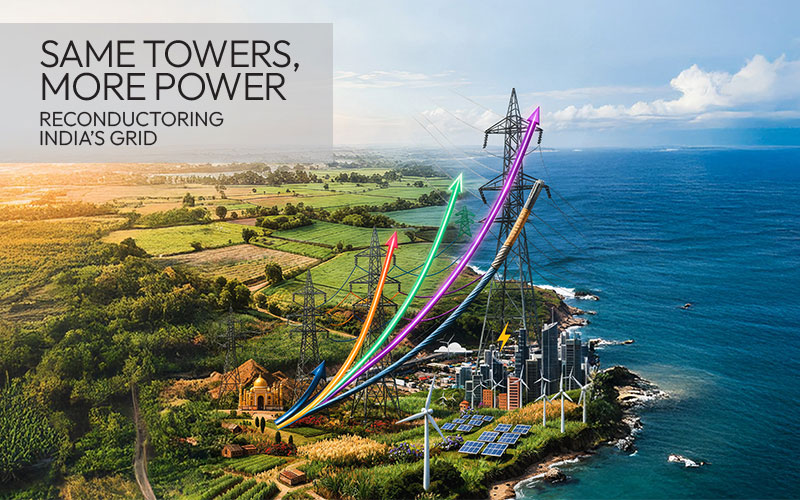
The pressure on India’s transmission infrastructure has rarely been this visible. Rising electricity demand and the accelerating integration of renewable energy are only part of the reason. The emergence of large renewable generation clusters is adding a new layer of complexity to an already stretched system. Expanding the grid, however, is becoming progressively complex as acquiring new transmission corridors faces growing Right-of-Way (RoW) constraints, from land acquisition challenges and environmental clearances to urban congestion and competing land use. In this context, utilities are increasingly exploring reconductoring of existing transmission lines as a practical strategy to augment capacity within established corridors, upgrading ageing conductors with higher-performance alternatives to increase power transfer without building entirely new lines.
Watch: Top Cable Companies in India
Grid Expansion Has Its Limits
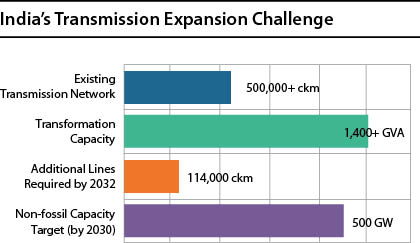
The scale of the challenge is significant. India already operates one of the world’s largest interconnected transmission networks, spanning hundreds of thousands of circuit kilometres across multiple voltage levels. According to the Ministry of Power and Central Electricity Authority data, India’s national grid now spans over 500,000 circuit kilometres of transmission lines (220 kV and above), with transformation capacity exceeding 1,400 GVA, making it one of the world’s largest synchronous power systems. At the same time, the country’s energy transition targets, including 500 GW of non-fossil capacity by 2030, are expected to significantly increase the need for transmission infrastructure capable of evacuating power from renewable generation clusters to load centres.
Meeting this demand will require substantial additions to the transmission system over the coming years. The National Electricity Plan (Transmission) 2022–32 estimates that over 114,000 circuit kilometres of new transmission lines will be required by 2032 to support demand growth, particularly to connect emerging renewable energy hubs in regions such as Rajasthan, Gujarat, and southern India.
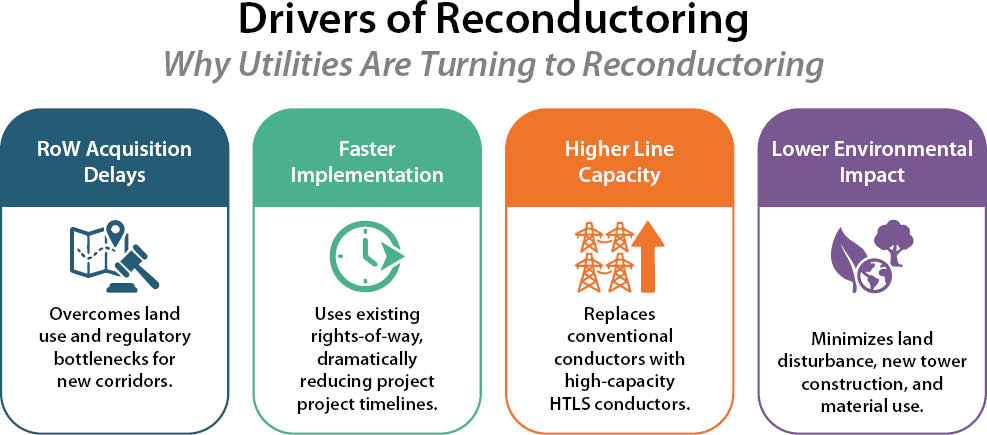
Right-of-Way constraints are emerging as one of the most persistent obstacles in meeting these targets. Securing land corridors for high-voltage lines often involves lengthy negotiations, environmental approvals, and increasing resistance in densely populated or urbanised areas. Manish Agrawal, MD, APAR T&D Projects Pvt. Ltd., puts it plainly: “With a population nearing 140 crore, acquiring new Right-of-Way (RoW) for greenfield lines has become time-consuming, costly, and uncertain.”
The consequence is a widening gap between what is planned and what actually gets built. “This is reflected in recent execution gaps—only 81 per cent of planned transmission line additions were achieved during the 13th Five-Year Plan, with similar shortfalls continuing thereafter due to RoW and land acquisition delays,” he adds.
As these challenges intensify, utilities are beginning to re-evaluate existing transmission corridors as assets that can be upgraded rather than replaced. Industry participants increasingly see reconductoring as a practical response to these constraints. Reconductoring, in this context, is emerging as a credible grid-strengthening strategy, one that works with the realities of land, regulatory, and environmental constraints rather than against them.
The Case for Reconductoring
Reconductoring refers to the process of replacing existing conductors on transmission lines with higher-performance alternatives capable of carrying significantly greater current while operating within the same structural and spatial constraints. Because the existing towers, insulators, and transmission corridor remain unchanged, the approach allows utilities to increase line capacity without undertaking the complex process of building entirely new transmission infrastructure. In an environment where acquiring additional Right-of-Way is becoming increasingly difficult, this strategy offers a relatively faster and often more cost-effective pathway for augmenting grid capacity.
The concept is gaining traction precisely because many existing networks were originally designed for much lower levels of power transfer. Built decades ago, these lines reflected the demand patterns, generation sources, and load centres of a very different era. As renewable generation clusters expand and electricity consumption continues to rise, upgrading these legacy assets is becoming an important consideration in transmission planning.
Unlocking additional capacity from existing corridors is, increasingly, what utilities are turning to reconductoring for. As Manish Agrawal, CEO, Conductor & Telecom Businesses, APAR Industries, explains: “Reconductoring offers a faster, scalable alternative by leveraging existing corridors to increase power transfer capacity—often up to two times—while reducing losses and extending asset life by 25–30 years, without the complexities of new land acquisition.”
Transmission planning frameworks in India are also beginning to recognise the role of such upgrades. Planning documents of the Central Electricity Authority (CEA) identify reconductoring and uprating of existing lines as viable options for increasing transmission capacity within existing corridors, particularly in areas where acquiring new Right-of-Way has become difficult.
Regulatory developments are now reinforcing this shift. As Manish Agrawal notes, “The Central Electricity Authority has revised RoW norms for HTLS conductors, clearly defining reduced corridor requirements across voltage levels and terrains, making reconductoring administratively smoother and quicker to implement.”
Several transmission utilities have already begun experimenting with such upgrades. Projects implemented by Power Grid Corporation of India Limited (PGCIL) as well as various state transmission utilities have deployed high-temperature low-sag (HTLS) conductors on existing 220 kV and 400 kV transmission lines, enabling significant increases in current-carrying capacity without requiring new towers or transmission corridors.
This approach is particularly relevant where developing entirely new transmission corridors is impractical. In densely populated regions, environmentally sensitive areas, and congested urban and renewable evacuation corridors, upgrading existing lines is often the faster and more practical alternative.
Technology developers and conductor manufacturers also see reconductoring as an important opportunity for modernising ageing grid infrastructure. According to Devesh Goel, Director and CEO, Laser Power & Infra Limited: “The world is looking at India for turnkey solutions, specifically reconductoring projects where utilities need to increase capacity on existing towers without massive civil work.”
Such solutions highlight how reconductoring is evolving into a mainstream strategy for optimising transmission networks. As grid operators balance the need for rapid capacity expansion with the practical constraints of land acquisition and environmental approvals, upgrading existing lines is increasingly being considered alongside the construction of new transmission corridors.
The Conductor Evolves
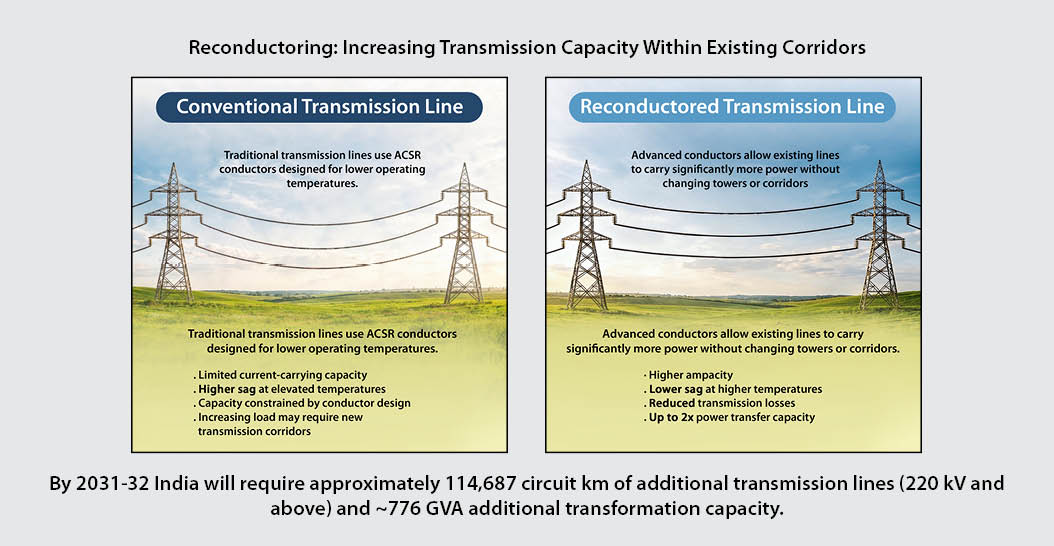
The growing interest in reconductoring is closely tied to advances in transmission conductor technology. Conventional aluminium conductor steel reinforced (ACSR) conductors, long used in overhead transmission lines, were designed to operate within specific thermal and mechanical limits. As power flows increase, these conductors can experience higher thermal expansion and sag, constraining the amount of current that existing lines can safely carry. Newer conductor technologies are addressing these limitations, enabling significant increases in capacity without requiring changes to tower structures or transmission corridors.
High-temperature low-sag (HTLS) conductors represent one of the most widely discussed solutions in this context. Designed to operate at higher temperatures while maintaining mechanical stability, HTLS conductors allow transmission lines to carry greater current without excessive sag. Various design approaches, including advanced aluminium alloys, composite or carbon fibre cores, and specialised strand geometries, are being developed to enhance ampacity, reduce resistance losses, and improve overall performance under demanding operating conditions.
For conductor manufacturers, these technologies are opening new possibilities for upgrading existing infrastructure. Devesh Goel, Director and CEO, Laser Power & Infra Limited, notes that the shift toward higher-performance conductors is transforming how transmission capacity upgrades are approached: “Our high-temperature low-sag (HTLS)/Aluminum Encapsulated Carbon Core (AECC) conductor products can be a suitable solution for this bottleneck.”
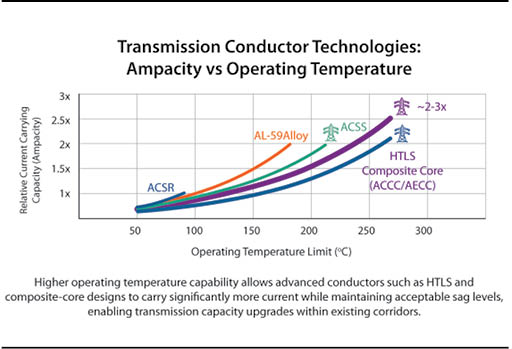
Composite-core designs such as AECC combine lightweight carbon fibre cores with aluminium strands, allowing conductors to operate at higher temperatures while maintaining lower sag characteristics. This enables utilities to increase power transfer capability without requiring major structural modifications to transmission lines.
Other conductor innovations are also contributing to improved transmission performance. Technologies such as trapezoidal wire designs, advanced aluminium alloys, and specialised surface coatings can enhance current-carrying capacity while reducing electrical losses. As Manish Agrawal of APAR Industries points out, newer conductor designs are increasingly focused on delivering higher ampacity and lower losses to improve grid efficiency: “Technologies such as HTLS-ACCC® support this transition by enabling capacity expansion within existing infrastructure while facilitating renewable integration and long-term reliability.”
Together, these technological developments are expanding the range of options available to utilities seeking to upgrade transmission infrastructure. As the operational limits of traditional conductors become more apparent under rising power flows, advanced conductor technologies are enabling reconductoring to move from a specialised engineering solution toward a broader strategy for strengthening transmission networks.
India Steps Up
The move toward advanced conductors is also drawing attention to India’s growing capability to manufacture and supply next-generation transmission solutions. As utilities increasingly look to HTLS and composite-core conductors for reconductoring projects, the question of domestic manufacturing capacity is directly relevant to the pace and scale of deployment.
Indian manufacturers have moved well beyond conventional conductor production. APAR Industries describes itself as the largest one-stop solution provider for the design, manufacturing, upgrading, and testing of conductors globally, and has executed over 165 turnkey reconductoring projects across India. The company holds around 50 per cent market share in domestic reconductoring projects, a figure that reflects both the scale of its manufacturing operations and the depth of its project execution capability. In FY2023-24, APAR expanded its manufacturing capacity for alloys, high-efficiency, and HTLS conductors from approximately 3,120 kilometres per month to 5,722 kilometres per month, a scale-up that reflects deliberate preparation for growing demand.
Sterlite Power Transmission is another manufacturer that has built significant capacity in this space. The company has an existing manufacturing capacity of 1,00,000 MT for conductors and has announced plans to expand this to 1,50,000 tonnes to meet rising demand, with its conductor manufacturing capacity booked for the next 12 to 14 months. In the reconductoring segment, the company has received orders from utilities including DVC, GETCO, WBSETCL, and OPTCL.
Specialised manufacturers are also contributing to this ecosystem. Devesh Goel, Director and CEO, Laser Power & Infra Limited, points to a concrete example of technology localisation: “By being the first in India to manufacture AECC conductors under a technology partnership with the US, we prove that India is a viable hub for high-end technology absorption and local value addition, capable of serving the world’s most demanding power grids.” He adds, “Through this partnership, we are able to locally manufacture advanced, high-capacity conductors in India, significantly reducing import dependency and production lead times.”
As domestic manufacturing capability matures alongside growing project demand, India is increasingly positioned not only as a market for reconductoring solutions but as a credible source of the advanced conductor technology that makes them possible.
The Bigger Picture
As India’s electricity demand continues to grow and renewable generation expands across geographically concentrated clusters, strengthening the transmission network will remain central to ensuring reliable power delivery. While the construction of new transmission corridors will continue to play an important role in grid expansion, practical constraints related to land acquisition, environmental clearances, and urbanisation are increasingly prompting utilities to explore complementary approaches for enhancing network capacity.
In this context, reconductoring is gaining recognition as a strategic option for upgrading existing transmission infrastructure. As conductor technologies continue to mature, they are expanding the range of options available to transmission planners seeking to balance rapid capacity expansion with practical infrastructure constraints, and the domestic manufacturing ecosystem is scaling in step with that demand.
The direction of travel is becoming clearer. As Manish Agrawal puts it, “Going forward, reconductoring should be evaluated as the first option for capacity enhancement, with its feasibility assessed before undertaking any Greenfield transmission expansion.” He adds, “Additionally, policy support to encourage the adoption of HTLS conductors for new transmission lines—particularly in urban and forested areas—would enable higher capacity deployment with lower Right-of-Way impact.” Together, these are not peripheral recommendations; they represent a fundamental rethinking of how India plans and builds its transmission infrastructure going forward.