

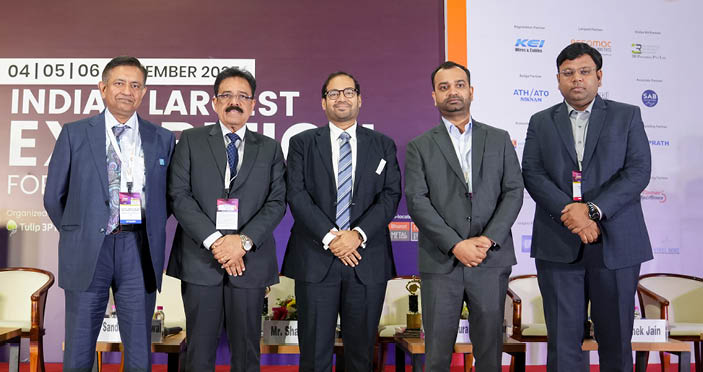
The session ‘Riding the Multisector Growth Wave: Cable Demand Across India’s Expanding Economy’ held on November 04, at CWF 2025 examined the rise in cable demand driven by concurrent growth in infrastructure, renewable energy, EV ecosystem, telecom/data, and real estate. Panelists Mr. Sandeep Aggarwal, Managing Director and Promoter, Paramount Communications Limited; Mr. Shashi Amin, Chief Executive Officer, Apar Cable Solutions, Apar Industries Limited; Mr. Saurabh Khedkar, President and CEO, Specialty Aluminas and Speciality Chemicals, Hindalco Industries Limited; and Mr. Abhishek Jain, Director Operations, Chandresh Cables Limited (AVOCAB) gave deep insights about the cable sector diversification, increasing opportunities for specialization and giving an understanding of sector-specific technical standards and procurement cycles that is key for cable manufacturers and suppliers.
Watch: Top Cable Companies in India
India today stands at the cusp of infrastructural and renewable transformation with the wire and cable industry being the core of this change. The multi sectoral growth wave across India’s expanding economy is creating a huge demand and opportunity for the wire and cable manufacturers, suppliers and industry as a whole.
Mr. Sandeep Aggarwal, Managing Director and Promoter, Paramount Communications Limited
According to Mr. Sandeep Aggrawal, India currently stands at the threshold where the country’s manufacturing capability meets international standards. “So, today an Indian manufacturer is not afraid of competing with China, US, Germany or any other country.”
“India is now a USD 4 trillion economy with USD 900 billion coming out of export. Out of which USD 400 billion is the value added in the manufacturing sector. This is almost about 10%. But if you look closely, the total is close to 16%. Now the manufacturing sector needs to grow from 16% in 2025 to 25% in 2035 as per the government of India ambition and various schemes are coming to promote the ‘Make-in-India’ initiative in every sector, and in every possible way. So the manufacturing in the next 10 years has to go up by 15% minimum. That is the kind of growth rate which the manufacturing sector is eyeing. Each sector of India, from EV to solar to steel to power, will require huge amounts of technologically superior and new design cables. Each product which we will manufacture is going to add to the growth of Indian GDP and showcase the story of India, ’’ says, Mr. Sandeep.
Mr. Shashi Amin, Chief Executive Officer, Apar Cable Solutions, Apar Industries Limited
As per Mr. Shashi Amin, most of the cable companies are expanding their capacity. “The size of the cable industry is around INR 75,000 crore in FY24. The numbers of FY25 are yet to be finalized.”
He reports, ‘‘If you see the market product composition, 48% of the total composition is the low voltage cables, light duty cables constitute around 34%, medium and EHV cable around 13%, and the elastomeric cable is around 5%. And if one sees the CAGR growth for each and every segment, LV cable has grown at around 14%, MV cables is at 11%, EHV has witnessed a slight dip in FY20, but in the last three years, this trend is also moving in the upward trajectory. All put together, the CAGR growth of cables is around 12%.’’
Considering the growth of the wire and cable industry which currently stands at USD 9 billion, can easily become a USD 14 to USD 15 billion industry as there are various projects coming up within India. ‘‘As a manufacturer, and as a compound supplier, I think we need to enhance our capacity. Today, with the ‘China+1 strategy’, a lot of countries internationally are looking at India.’’
He further says, ‘‘If you look at the US consumption, it is around USD 50 billion as opposed to USD 9 billion in India. The EU along with the UK is around USD 42 billion dollars. We can expand our focus to international markets as there is a significant opportunity for us to capture. However, to make the most of it, we must consistently deliver high-quality products and ensure timely supply. Many customers in Europe and the US are increasingly looking towards India as a reliable sourcing destination.’’
As far as India is concerned, the government has set ambitious targets. The country aims to achieve 800 gigawatts of power generation capacity by 2030, reflecting a projected growth rate of around 6% CAGR. Additionally, the urban population is expected to rise from 31% to 40% by then. To support this growth, the government has already announced major initiatives — such as the National Transmission Plan including the grid strengthening program, and an INR 3 lakh crore RDSS project. Phase one of the RDSS project is nearing completion, and phase two is about to commence. These projects will generate substantial demand for cables, presenting significant opportunities for suppliers in this segment.
These figures represent the planned investment that will be directed towards strengthening the country’s infrastructure and power sector. For instance, while airports such as Jewar and Navi Mumbai are being commissioned, many other airports across the country are undergoing a major revamp. Additionally, several new metro lines are being developed nationwide. Overall, India’s infrastructure landscape is rapidly improving, and the government is actively investing in this segment to drive growth and modernization. The government is also planning to approve around 500 gigawatts of solar power projects. Notably, a 30-gigawatt solar plant is being developed in Gujarat by Adani, NTPC, and others. The government has also launched the Pradhan Mantri KUSUM scheme, which is driving demand for rooftop solar installations. As a result, the requirement for cables and wires—particularly panel and string wires, as well as evacuation cables for large-scale projects—is set to rise significantly. These are some of the major developments shaping India’s solar energy landscape.
Now coming to the wind sector, India currently has an installed capacity of around 40 to 50 gigawatts, and the government plans to increase this to 100 gigawatts by 2030. The sector is receiving strong policy support through measures such as wind RPO mandates, ISTS charge waivers, and generation-based incentives. The wind projects are significantly driving the demand for cables. Each wind tower typically requires cables worth INR 40–50 lakh, including tower cables, nacelle cables, and auxiliary cables, for this segment. Moreover, the government is focusing on both onshore and offshore wind projects, which will further accelerate growth opportunities in the sector.
In the Indian Railways sector, the government has set an ambitious target of achieving 100% railway electrification by 2030, which will substantially increase the demand for catenary wires. An investment of around INR 2.5 lakh crore has been earmarked for this purpose.
Alongside this, the Mumbai–Ahmedabad High-Speed Rail Corridor and bullet train project is progressing, and the government is also exploring the development of high-speed rail networks in different states.
The government plans to introduce 800 Vande Bharat trains — a significant jump from the 46 trains in operation. Furthermore, the development of Gati Shakti terminals for freight movement is also underway. In addition to it, India has about 1,200 kilometers of operational metro lines, and this network is expected to double within the next five years. These initiatives collectively highlight the government’s strong push toward modernizing and expanding the nation’s transportation infrastructure.
Another major area of focus is electric vehicles (EVs). The government has set a target for 30% of private cars, 70% of commercial vehicles, and 100% of buses to be electric by 2030. Achieving these ambitious goals will require a robust charging infrastructure across the country, which in turn requires a lot of cables. The government is actively seeking reliable suppliers to power the charging networks, making this another key growth segment.
Another segment that cable manufacturers should seriously consider is the defence sector. Under the Atmanirbhar Bharat initiative, the government is encouraging Indian companies to step forward and indigenize various imported products. Currently, a significant volume of cables is imported from countries such as Russia, Austria, and France. However, the government is now focused on promoting domestic manufacturing for these products. By 2028, it aims to ban the import of around 4,000 items across the Army, Navy, and Air Force, creating substantial opportunities for local suppliers in the Military, Navy or Air Force. The major expansions in the defence sector also includes new air freight carriers and the addition of 24 submarines — up from the current 12. This means the submarine fleet alone is set to triple in size, reflecting a significant increase in overall defence capacity.
The real estate sector is also booming. Property prices are rising, and consumer spending has also increased. The people are increasingly investing in luxury lifestyles. The government is also allocating about INR 1.5 lakh crore annually towards urban housing and Smart City projects, underscoring the sector’s growth potential.
In addition to this, a significant wave of data centers is coming up across the country. Global tech giants like Amazon, Google, and Microsoft, along with leading Indian players such as Yotta, CapitaLand, and CtrlS, are driving this expansion. Around 150 to 200 megawatts of new data center capacity is expected to be installed over the next 12 to 24 months. ‘‘Considering all these developments, I firmly believe that the cable industry is on the right track as far as growth momentum is concerned.’’
‘‘Even if we don’t achieve a 12% CAGR and instead grow at around 10%, the cable industry would still reach a size of USD 14–15 billion. However, one thing we must remain absolutely clear is the focus on quality products. Whatever we produce must meet the highest safety and performance standards. Safety is a critical aspect, and as an industry, we will need the continued support and collaboration of all suppliers and machinery manufacturers to work closely with cable manufacturers in enhancing both the quality and safety of cable products,’’ he concludes.

Mr. Saurabh Khedkar, President and CEO, Specialty Aluminas and Speciality Chemicals, Hindalco Industries Limited
Moving forward, Mr. Saurabh Khedkar said that the wire and cable is at a very interesting play point at this time. Anything and everything in the world, and humanity in general, is driving the growth of wire and cable. Particularly in India, the infrastructure, renewable energy and sustainability, telecom, processing power, AI, machine learning, electricity, housing, is working through the wires and cables. The growth in any of these sectors means the need for ample high quality, high performance,and technologically advanced wire and cables.
Talking about fire safety, he said that one out of 5 fire incidents happen in India. There are multiple incidents that have happened recently. The economic impact of these incidents, beyond the impact on life, is colossal. From there comes the need for fire safety and the need for flame retardants.
Flame retardant materials are essentially of two types. One is a halogenated flame retardant material, which is a high smoke flame retardant material, essentially made from chlorinated organic compounds as well as brominated organic compounds. But the more popular one globally is the non-halogenated flame retardant, which is the low smoke variant, made from aluminum trioxide, magnesium hydroxide and organophosphorus compounds. We, at Hindalco, are in the first part of this step, making the aluminum trihydrate.
Mr. Saurabh cited that the global flame retardants market is valued at USD 2.8 billion in 2024, and it is expected to reach USD 3.8 billion by 2033. Within this, the ATH segment accounts for around 40%, while brominated and chlorinated compounds make up about 20%. The remaining share comprises halogen-free flame retardant materials. Globally, the market is projected to grow at around 8%, but in India, the growth rate is significantly higher—estimated at 12–14%, and potentially reaching up to 15% if the current expansion plans materialize.
In India, however, the situation is quite challenging, as there was major dependence on imports for this material. Supplies primarily come from Europe and China, leading to variability and frequent disruptions. In recent years, factors such as the COVID-19 pandemic, global supply chain disturbances, container shortages, freight rate fluctuations, and geopolitical tensions have severely impacted the market. As a result, many domestic users have been forced to maintain high inventory levels to ensure business continuity and sustain operations.
Talking about the development in Hindalco, he says, ‘‘Hindalco has built India’s first and only precipitated superfine hydrate plant at Belagavi. We started working in the flame retardancy space about 10 years ago and back then, it was a protected technology held only by few people in Europe. And therefore, we decided to build this from scratch in the lab. So this is a flask to factory technology that we’ve built with our inventors at the Aditya Birla Science and Technology Company and at our Hindalco Innovation Center who have put it together. From the state of 100% import dependence for this important product, we have transitioned, and are hopeful that the market also transitions and grows to the domestic supply of Hindalco’s PPT-ATH production.’’
He further says, the cable industry is witnessing multi-sectoral demands leading to a double-digit growth. But growth alone is not enough. ‘‘As an industry, we will have to come together to make and deliver safer wires and cables to the world. We’ll have to work together on building the right standards such as IEC and the BIS certifications, which will stand the test of scrutiny across the world. The growth for the safe material will depend on the switch and the adoption of HFFR as a material of choice by the wire and cable manufacturers.’’
Value chain integration is another important aspect in the wire and cable industry. ‘‘We lose a lot of value in the movement of the material across the country. So co-locating facilities, making sure that we are always available to the clients is very important. It is imperative that we as an industry work together to develop and deliver the promise of global export excellence, focusing on the Make in India and Made in India labels.’’
‘‘I think the wire and cable industry is seeing a lot of growth, and the raw material suppliers are also catching up. Players like ourselves have invested heavily in making safer aluminum, copper, and aluminum trihydrate for usage by the wire and cable industry. So, let’s come together and deliver the promise of Swadeshi products under the leadership of our Prime Minister Modi and his vision for India,’’ he concludes.

Mr. Abhishek Jain, Director Operations, Chandresh Cables Limited (AVOCAB)
Mr. Abhishek Jain further walks us through India’s rapid expansion across multiple industries including energy mobility, data, real estate, that is driving a multi-sector demand wave for cables and how AVOCAB or any other manufacturer is taking benefit or should take a benefit out of it.
The market size of the cable industry in India is currently valued at USD 21 billion and is projected to grow to USD 33 billion by 2030, at a CAGR of around 9%. The country is not just growing, it’s transforming. Over the past decade, we’ve shifted from a consumption-led economy to an investment-led and infrastructure-driven economy. The GDP of the country has grown from USD 2 trillion in 2014 to USD 3.6 trillion today, and we are driving towards a USD 5 trillion economy in 2027, aiming for a USD 30 trillion economy under the Viksit Bharat Vision of 2047. Infrastructure capex is projected to rise from INR 3 lakh crore to INR 10 lakh crore by 2025. The National Infrastructure Pipeline projects worth INR 111 lakh crore are planned across key sectors such as energy, transport, housing, and logistics. India’s growth is not a headline, It’s a hardware story where every rupee of CAPEX translates into kilometers of wiring cable.
He says, ‘‘When we talk about wiring India’s growth story, cables form the nervous system of infrastructure — carrying energy and data and powering India’s growth engine. The country’s journey from a USD 4 trillion to a USD 30 trillion economy by 2047 will be built on connectivity, with cables at its very core. As India develops new highways, power grids, and digital infrastructure, our industry plays a vital role in ensuring safety, reliability, and efficiency every step of the way.’’
In 2025, India generated 1,821 billion units of electricity — a 5% increase over the previous year. ‘‘Our per capita power consumption has risen to 1,395 kilowatt-hours, marking a 46% jump over the past decade, though it still stands at just one-third of the global average. The country’s grid network has expanded to over 4.6 lakh circuit kilometers and is expected to reach 6 lakh by 2030, with transmission investments projected to exceed INR 10 lakh crore by 2032. This growth aligns with India’s ambitious commitment to achieving 500 gigawatts of non-fossil fuel capacity by 2030.’’
He further emphasized that cables are quite literally the arteries of this expansion. Every metro line, data center, and solar array translates into kilometers and kilometers of aluminum and copper conductors and cables — underscoring the immense scale and vital role of the cable industry in powering India’s growth. The global wire and cable market stands at around 28 million tonnes per year. India accounts for only about 6% of this, despite representing 18% of the world’s population. ‘‘Our per capita cable consumption is just 5–6 kg, compared to 15 kg in South Korea and 20 kg in Saudi Arabia — clearly showing how much potential lies ahead for India to reach developed-economy levels. In many ways, India is still underwired — and this gap between India and global consumption represents one of our greatest opportunities.’’
Earlier, cable demand was largely driven by utilities and power projects. Today, however, the scope has diversified into a robust, multi-sector ecosystem powered by five key growth engines — infrastructure, renewable energy, the EV ecosystem, telecom and data, and real estate.This broad-based demand ensures resilience and sustained growth for the cable industry in India, making it one of the most dynamic sectors driving the nation’s progress.
The demand for specialized cables — such as HFFR, fire-survival, and low-smoke halogen-free (LSHF) cables for metros and airports — has surged. Over the past six to seven years, technical specifications have become increasingly stringent, pushing manufacturers to upgrade their skill sets, technology, and innovation capabilities to stay relevant.
Also Read: Wire & Cable India Emagazine Nov-Dec Issue 2025
Looking at the renewable sector, the solar DC cables, which were non-existent 10 years ago in India, have started contributing significantly in the energy sector. Similarly, flexible and tinned copper cables for EVs and instrumentation cables for process industries are witnessing strong demand.
The design conversation is winning in today’s market with early engagement with consultants, EPCs, and OEMs to ensure specification approval and compliance even before the tender stage. It’s not just important to educate customers, but equally important to bring awareness among the consultants and stakeholders about the latest technologies and innovations available in the market — and how these can benefit them in the long run. ‘‘Often, the Indian mindset focuses on short-term cost savings rather than long-term value. As manufacturers, it is our responsibility to bridge that gap by demonstrating that while an advanced or innovative product may cost slightly more upfront, it delivers substantial savings and reliability over time. This proactive, collaborative approach builds trust and clearly differentiates us from commodity players. We don’t just supply products — we co-engineer solutions with our partners to deliver lasting value.’’
He further says, ‘‘When we talk about delivering a truly Make in India and Made in India product, it’s not just about serving the domestic market — it’s equally about catering to global demand.’’ Indian quality today commands global trust, and that’s reflected in the growing export footprint of Indian manufacturers. ‘‘AVOCAB, for instance, exports to over 20 countries across Africa, the Middle East, and Southeast Asia, where our products are being widely adopted. It is not just about traditionally following IEC or BS standards, but manufacturers around the world have begun accepting Indian standards as well. This not only validates the quality of Indian products but also gives us a natural edge in terms of both performance and cost competitiveness. So cables are not just a product, they are India’s industrial ambassadors to the world.’’
Viksit Bharat 2047 envisions a developed and energy-secure India, a mission led by our Hon’ble Prime Minister The initiative aims to achieve: 24/7 reliable power for all, net zero emissions by 2070 and 50% non-fossil energy capacity by 2030. Meeting these ambitious goals will require next-generation cables and cutting-edge technologies.
Building export-ready specs as per IEC and BS standards, the future of cable is not just about conductivity, it’s about intelligence, sustainability and performance. Every megawatt of energy transferred, every byte of data transmitted is travelled through a cable that is safe, smart and sustainable. Whenever energy flows, data travels, and infrastructure grows, there are always cables that enable it. India’s transformation is no longer about potential. It’s about the execution of powering a smarter world. So, let’s together wire India’s future.