

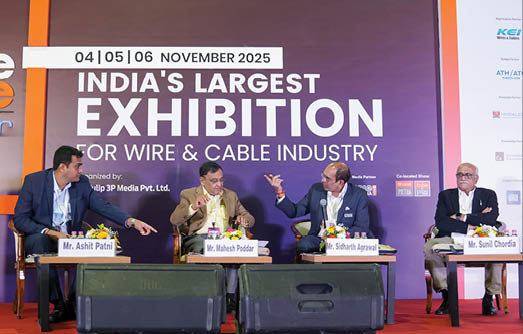
In the steel wire panel discussion at CWF2025, Mr. Sidharth Agrawal, Managing Director, Systematic Industries Ltd., beautifully stitched together the journey of India’s steel wire industry through three different phases- past, present and future, with panelists Mr. Mahesh Poddar, Chairman, Miki Wire Works Pvt. Ltd., Mr. Sunil Chordia, Founder & Promoter, Rajratan Global Wire Ltd. and Mr. Ashit Patni, Chief Marketing Officer, ESL Steel Limited. The session highlighted the journey of the Indian steel wire industry dating back from the resilient 1950s, to the present day world of automation and digitisation, offering a rare, comprehensive view of India’s steel wire evolution.
THE PAST: FOUNDATION OF INDIA’S STEEL WIRE INDUSTRY
Sidharth Agrawal: Sir, you have witnessed the wire industry from its early days. How did it all begin in India? What defining moments shaped the evolution of the Indian wire industry?
Watch: Top Cable Companies in India
Mahesh Poddar “The real journey of the steel wire industry in India started somewhere in the 1950s. During British rule, most steel came from England, and wire mostly from Germany and Italy.” He explained that India’s first organised wire factory emerged in Jamshedpur under Indian Steel and Wire Products, not Tata Steel. The post-independence decades were marked by scarcity of resources, restricted imports, bureaucratic controls, and limited technology. “In the 1960s, even wire nails were being imported. The wire that was made locally was rolled in Calcutta in small 100-kg coils..,” he added.
He highlighted several major turning points in the evolution of the Indian steel wire rod and wire products industry, beginning with the formation of Hindustan Steel, which later became SAIL, marking the earliest phase of organised steelmaking in the country. This was followed by the emergence of the Bhilai plant, which introduced 600-kg wire rod coils, an important shift in scale and capability.
The industry then witnessed the rise of dedicated wire rope manufacturers through the 1960s and 1970s, laying the foundation for a more diversified downstream sector. Over time, high-carbon wire rod began entering the market, albeit slowly, signalling a transition toward more specialised and higher-performance applications. The landscape changed more decisively in the 1980s with the arrival of controlled-cooling wire rod mills, established by companies such as Mukand Limited, Usha Martin, and Modi Steel, which significantly elevated product quality and positioned India for more advanced industrial demand.
Recalling the struggle of new entrants, he said, “When I started high-carbon wire in the late ’80s, it took intense persuasion to get an allocation of just 50 tonnes per month.” The 1990s marked a shift when Rashtriya Ispat Nigam Limited (RINL) started rolling high-carbon wire rods, democratizing access and breaking monopolies.
“Availability of raw material was the biggest defining moment for India’s wire industry.” He also emphasized the impact of infrastructure expansion, metro railways, and the explosion of the automotive components sector, which created demand for alloy, spring, and high-tensile wire.
He reflected on the financial and structural challenges, “Funding was a big constraint. Only Birlas and Tatas could go for public issues.” He noted the rise of induction-route steel producers in the last 20 years, “Today nearly 50% of mild steel wire rod comes from small manufacturers who never existed 25 years back.” He emphasized that India’s entrepreneurial wave post-liberalization propelled the industry forward.
THE PRESENT: CHALLENGES, INNOVATION & TECHNOLOGY
Sidharth Agrawal: What are the biggest challenges and opportunities in the steel wire industry today? How do you balance innovation with cost pressure?
Sunil Chordia Mr. Chordia began by reflecting on his 35-year journey in the industry, noting how “from a small INR 30-lakh investment in 1991, we have become a INR 2,500-crore company,” a transformation that mirrors the evolution of India’s wire and wire rod ecosystem itself.
He underscored the structural challenges that continue to shape the sector- raw material volatility that accounts for nearly 50-70% of product cost, rising energy expenses, tightening environmental norms, and the growing pressure to produce greener bead wire amid increasing global disruptions, logistics imbalances, and shifting tariff regimes in markets like the US. At the same time, he emphasised that India’s massive and rapidly expanding market has created unprecedented opportunities, with wire demand rising almost tenfold over the past three decades, supported by a China+1 sourcing shift and accelerating consumption of high-value, specialty, and performance-critical wires. He noted that this shift toward sustainability is not just regulatory but commercially rewarding, adding that “customers are willing to pay 15-25% premium if you make a sustainable product.”
Drawing from his earlier observations on the industry’s technological evolution- from the era of basic mills to today’s controlled-cooling plants and specialised high-carbon manufacturing, he explained how Rajratan has embraced TPM, TQM, automation, data-driven shop-floor operations, and inter-plant learning as core drivers of competitiveness. “There are no registers on the shop floor now. Everything flows through ERP and digital systems,” he said, emphasising that digitalisation, waste-heat recovery, and continuous innovation have enabled profitability despite rising input costs. He reinforced that the future will belong to companies that invest in quality, sustainability, automation, and global compliance, as the Indian wire industry moves from capacity-driven growth to capability-driven leadership.
THE FUTURE: GUIDANCE, GROWTH & INDUSTRY EVOLUTION
Sidharth Agrawal: Ashit ji, since you have been closely involved with the wire industry for the past five to six years despite being a wire rod manufacturer. What is your assessment of where the industry is heading? How has the journey been, what has changed, and what future do you foresee for the wire ecosystem?
Ashit Patni “The industry which was earlier a very unfragmented, unorganised one has turned into a largely organised one focusing on automation, quality and sustainability.”
He highlighted that automation has sharply improved productivity saying, “Automation has helped in improving process time and reduction in losses.” He pointed out that upskilling and structured quality systems have played an equal role: “Upscaling has helped in improving the quality again.”
Ashit added that the shift toward TPM, TQM, and circular economy practices is now visible across the sector. “These are all pivotal for sustainability in the future, which is also a requirement of global wire manufacturing.” He also acknowledged the government’s role, saying, “There has been good support in terms of PLI schemes, Make in India, and pushing the industry for new specialty products.”
He emphasised that India has now begun manufacturing several specialty wires– automotive, high tensile, and high-impact grades, resulting in a sharp reduction in imports. Confident about the long-term outlook, he said, “I am very confident that the Indian wire industry is capable of sustaining its global presence with good quality and sustainable operations, and I foresee at least a CAGR growth of 8% for the next five years.”
Vision for steel and wire rod sector in India over the coming decade
“India is on a journey of growth, we are in a nation-building phase with the aspiration to become a developed economy.” He explained that this ambition is anchored in macro strength, “Our steel demand to GDP has a multiplier of 1.6, and the key drivers remain building and construction, infra, automobile and renewable sectors.”
He stressed that none of this is possible without wires. “This could not have been possible without wire because to achieve all our infra projects, wire is the connecting dot.” Over the last five years, he noted, the wire rod industry has grown at nearly double digits.
Discussing structural triggers, he pointed to the government’s roadmap. “The National Steel Policy (NSP) lays out a vision of 230 million tonnes of steel production by 2030, and all plants have gone for capacity additions.” He added that with current progress, “There is a possibility that India may surpass it with the kind of capacities and demand coming in.”
He detailed the infrastructure surge. “There are projects worth USD 2.6 trillion in the pipeline.” He also cited the government’s massive capex thrust. “The capex this year itself was INR 11.21 lakh crores for infra– roads, connectivity, metros and ports, where speciality steel will be required.”
On automotive and renewables, he said, “India is likely to be the second largest producer of automobiles by 2032.” “Renewables will reach almost 550 gigawatts by 2032,” he added.
He emphasised that these sectors demand high-quality wires, and the industry is at a pivot point. “Today the wire industry is at a point of inflexion- rapid urbanisation and renewable energy demand are pushing the need for high-quality wires.” He assured readiness on the supply side, “We as manufacturers are aligned, and we assure we will work together to provide high-quality wire rod for strong wire manufacturers.”
Also Read: Wire & Cable India Emagazine Nov-Dec Issue 2025
Bottlenecks in the Indian wire industry today
He outlined the key hurdles in the industry, noting that “raw material volatility has remained a question we have always been discussing,” while “upscaling is something where wire manufacturers can improve the quality further.” He added that “automation has been largely implemented and new machines have improved productivity and quality,” yet challenges persist because “this is a very fragmented market where quality consciousness is low, and big players get impacted.”
Emphasising the importance of differentiation, he stressed that “more branding in wire will help manufacturers going forward,” and highlighted sustainability as a critical priority, stating that “circular economy is something all can implement and effective waste utilisation can be improved.” He closed with optimism and confidence in the industry’s trajectory, saying, “All these will enable us to come out with solutions and have a strong global presence.”
Mr. Sidharth Agrawal wrapped the panel discussion with shared objectives- the future belongs to technology, sustainability, high-value products, and globally integrated supply chains. With India’s demand surge and shifting global sourcing patterns, the coming years presents the biggest opportunity in the industry’s history, provided the ecosystem evolves together.