

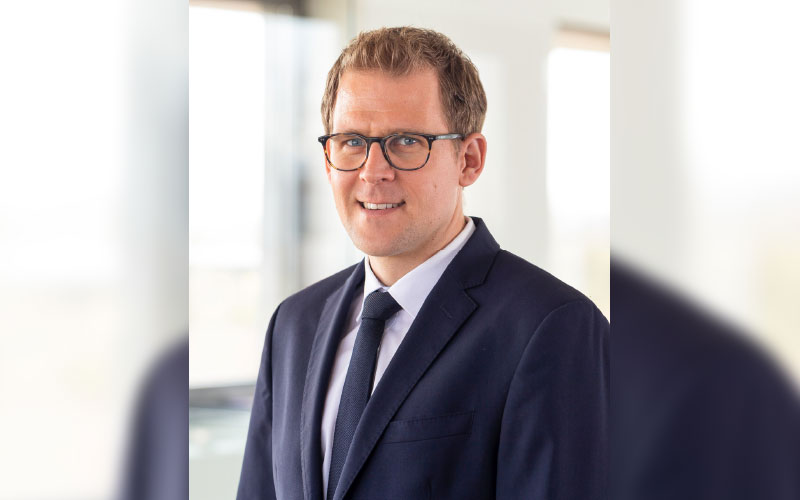
Citing India as an emerging market having a strong focus on technology, robust machine design and local technical support Mr. Benjamin Joachim, Authorised Officer and Sales Manager at FUHR GmbH & Co. KG, tells Wire & Cable India that the company, through its local representative Kemtree, is understanding the Indian market’s technical requirements and customer expectations, strengthening its customer engagement, project support, and reliable after-sales service elements, thereby building long-term partnerships in India.
Wire & Cable India: Please briefly outline your company’s cable and wire industry product focus, including key technologies, product types, and principal end-use sectors.
Benjamin Joachim: FUHR GmbH & Co. KG develops and supplies rolling mills and complete rolling lines for the production of flat, shaped and profile wire. Our core competence lies in precision rolling of copper, aluminium and all other ferrous and non-ferrous metals. The focus is on mechanically stable mill designs, precise roll tooling and reliable drive and control systems. Our principal end-use sectors are power transmission and distribution, automotive and e-mobility, renewable energy, electronics, and industrial applications requiring tight dimensional tolerances and reproducible surface quality.
Watch: Top Cable Companies in India
WCI: Within your core product segments, how would you characterise current demand conditions and order visibility?
BJ: The demand in our core segments is generally stable, with growth primarily driven by energy-related applications. At the same time, the global environment has become noticeably more fragile, which is reflected in more cautious investment behaviour. Order visibility remains reasonable, but customers are taking longer to finalise decisions and are planning investments more carefully. Projects are increasingly structured in phases, with a clear preference for modular solutions that reduce risk and allow capacity expansion once market conditions become clearer.
WCI: Within your manufacturing offerings, how do you currently assess investment sentiment among wire and cable producers, particularly in emerging markets such as India?
BJ: Investment sentiment is cautious but fundamentally positive. Wire and cable producers are investing when there is a clear link between the equipment and improved productivity, quality or capacity. In emerging markets such as India, there is a strong focus on proven technology, robust machine design and local technical support rather than highly customised or experimental solutions.

India is a key growth market for FUHR. Infrastructure expansion, electrification and a strong domestic manufacturing base are creating sustained demand for wire and cable production equipment.
WCI: Which customer or application requirements are currently exerting the greatest pressure to improve productivity and quality within your product range?
BJ: The main pressure comes from tighter dimensional tolerances, improved surface quality and higher output rates. Customers also expect stable processes across different materials and product geometries. Shorter setup times and reliable reproducibility over long production runs are becoming increasingly important.
WCI: Which manufacturing disciplines, automation measures, or quality-assurance practices have delivered the most tangible improvements in your yield or rework reduction?
BJ: The biggest improvements come from precise roll pass design, consistent tooling quality and well-tuned process control. In-line measurement and closed-loop control help to stabilise production and reduce scrap. Standardised commissioning and clear process documentation also play an important role in minimising rework.
WCI: How are sustainability and decarbonisation goals translating into practical changes at your company?
BJ: For FUHR, sustainability is closely linked to efficiency and durability. We design equipment to minimise material losses and energy consumption while ensuring long service life. Reducing the number of process steps and enabling stable production with less scrap has a direct impact on energy use and emissions, both for us and for our customers.
Investment sentiment is cautious but fundamentally positive. Wire and cable producers are investing when there is a clear link between the equipment and improved productivity, quality or capacity.
WCI: How are cost pressures across raw materials, energy, or logistics being managed without compromising product reliability or compliance?
BJ: We address cost pressure mainly through standardisation and modular design. Critical components are not downgraded; instead, systems are engineered to be as simple, robust and efficient as possible. An important aspect for our customers is that scalability in plant productivity can also translate into scalability in investment budgets. Modular machine concepts allow producers to start with a defined capacity and expand step by step as demand develops. Over the lifecycle of the equipment, reliable operation, high availability and low maintenance requirements remain the key factors in offsetting external cost pressures.
WCI: How has the wire and cable industry benefited, in practical terms, from automation or real-time digital control?
BJ: Automation and real-time digital control have mainly improved process stability and repeatability. Operators can detect deviations earlier and react more consistently, which leads to more predictable quality and reduced dependency on individual operator experience.
In addition, requirements for data analysis and quality documentation have increased significantly. To address this, FUHR has developed its data acquisition and analysis system F-MAS. F-MAS enables precise recording, evaluation and documentation of process and quality data. It is available as an option for FUHR’s tactile measuring systems but can also be retrofitted to existing digital or analogue measuring systems. During development, particular emphasis was placed on compatibility with third-party systems, especially with regard to upgrading existing production lines.
WCI: Looking ahead three to five years, which wire & cable segments or applications are most likely to drive the next investment cycle?
BJ: Investment will largely be driven by power transmission, renewable energy, e-mobility and compact, high-efficiency conductor designs. Flat and shaped wire applications are expected to gain further importance as material efficiency and space-saving designs become more critical.
Also Read: Madem Reels Group: India is Rapidly Moving Toward Automated, World-Class Manufacturing
WCI: How do you see India as a market?
BJ: India is a key growth market for FUHR. Infrastructure expansion, electrification and a strong domestic manufacturing base are creating sustained demand for wire and cable production equipment. Indian customers are technically well informed, cost-aware and increasingly focused on long-term reliability and stable production processes. This aligns well with FUHR’s engineering-driven approach. An important factor for our activities in India is our local representation through Kemtree. With Kemtree, we have an experienced and reliable partner who understands both the technical requirements of the market and the expectations of Indian customers. The local presence enables close customer contact, efficient project support and reliable after-sales service, which are essential for long-term partnerships in this market.