


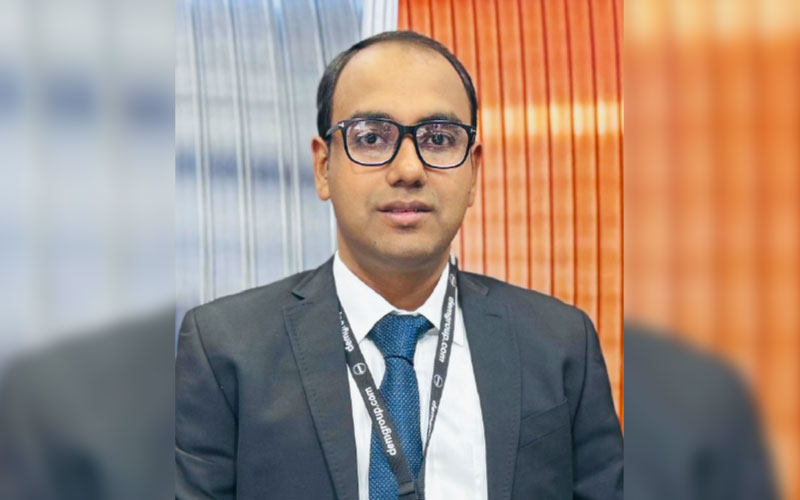
In an exclusive interaction with Wire & Cable India, Mr. Rahul Jha, Technical Consultant, DEM S.p.A., shares that India is witnessing a clear shift from volume-led expansion toward value-added wire and conductor production. Companies are increasingly backing advanced European technologies to unlock measurable gains in productivity, yield, dimensional accuracy, and to reduce operating cost. DEM is sharpening its capabilities in profile rolling, flat wire processing, and cold rolling equipment to support this shift toward higher-value, precision-driven production.
Wire & Cable India: Please briefly outline your company’s cable and wire industry product focus, including key technologies, product types, and principal end-use sectors.
Rahul Jha: DEM S.p.A., Italy, headquartered in Pavia di Udine, is an engineering and equipment manufacturer specializing in wire and rod processing technology for the metalworking and cable/wire sectors. The company designs and supplies machinery and complete production lines not for making cable products themselves, but for producing and transforming wires and profiles that are integral components in cable, reinforcement and other wire-based end products.
DEM core technologies revolve around advanced wire rolling and processing systems. DEM supplies major machinery and system categories for wire manufacturing such as flat & profile wire rolling lines, specialized mills for shaping wire cross-sections; cold rolling equipment & cassettes for precision forming tools for a range of materials; micro-rolling cassettes for fine or specialty wire profiles; auxiliary plant equipment for handling, coiling, and process support machines, and full turnkey lines for complete production facilities integrating automation and peripheral equipment.
The wires and profiles produced using DEM’s equipment serve a variety of downstream applications and industries such as automotive & EV industry that uses flat and shaped wires for motors, generators, and connectors; electrical & electronics utilises copper/aluminium wires for transformers, windings, conductors; construction & infrastructure sector uses reinforcing wires and structural profiles; welding & industrial fabrication segment uses flux cored wire and specialty wire producers; mechanical & consumer goods utilises springs, furniture components, and household appliances; and textiles, precision, medical & specialty components uses shaped wires for niche applications.
Watch: Top Cable Companies in India
WCI: Within your core product segments, how would you characterise current demand conditions and order visibility?
RJ: In the Indian market, the demand for DEM’s product portfolio remains strong and continues to expand, supported by sustained growth in the domestic wire and cable sector, ongoing capacity additions by leading manufacturers, and increasing export-oriented production.
Order visibility is particularly solid for core machinery, especially wire rolling and profile rolling systems, where project pipelines typically extend over the next 6–12 months and beyond. Demand for advanced automation and auxiliary equipment remains stable, though it is more dependent on modernization cycles and customer investment timing.
WCI: Within your manufacturing offerings, how do you currently assess investment sentiment among wire and cable producers, particularly in emerging markets such as India?
RJ: Within DEM S.p.A. manufacturing offerings, particularly wire rolling, profile rolling, cold rolling and integrated auxiliary systems, investment sentiment among wire and cable producers in emerging markets such as India is strong and increasingly strategic. Indian manufacturers are actively investing in capacity expansion and technology upgrades, driven by sustained growth in power infrastructure, construction, renewables, rail/metro projects, and industrial electrification. At the same time, there is a clear shift from purely volume-based expansion toward value-added wire and conductor production, where DEM’s strengths in precision profile rolling, flat wire processing, and high-efficiency cold rolling are especially relevant.
Overall, the sentiment can be described as confident but disciplined. Customers are willing to invest in advanced European technology when it delivers measurable gains in productivity, yield, dimensional accuracy, and operating cost reduction. Demand for automation, line integration, and modernization packages is also rising, although these investments remain more dependent on individual plant upgrade cycles and project timing.
WCI: Which customer or application requirements are currently exerting the greatest pressure to improve productivity and quality within your product range?
RJ: Within DEM’s product range, the strongest pressure to improve productivity and quality is currently coming from the following customer and application requirements:
Tighter dimensional tolerances and repeatability: Customers increasingly require consistent cross-section geometry, especially for profile and flat wire, where even small deviations impact downstream processes and final product performance.
Higher line speed with stable quality: Producers want to increase throughput without sacrificing surface finish or dimensional control—driving demand for high-speed rolling solutions, robust mill design, and stable process control.
Superior surface quality and defect reduction: Applications in automotive, electrical, and precision industrial sectors demand improved surface finish, reduced marks, and fewer defects, pushing upgrades in rolling technology and roll management.
Faster changeovers and flexible production: Manufacturers are under pressure to handle more product variants with shorter delivery times, increasing the value of cassette-based rolling systems, quick setup, and modular line design.
Lower conversion cost and energy efficiency: With raw material and energy costs remaining sensitive, customers seek solutions that improve yield, reduce scrap, minimize downtime, and lower operating costs through efficient rolling and automation.
Automation, monitoring, and process traceability: Demand is rising for integrated automation, digital monitoring, and consistent process documentation—particularly for export-oriented producers and quality-certified industries.

Investment sentiment among wire and cable producers in emerging markets such as India is strong and increasingly strategic. Indian manufacturers are actively investing in capacity expansion and technology upgrades, driven by sustained growth in power infrastructure, construction, renewables, rail/metro projects, and industrial electrification.
WCI: Which manufacturing disciplines, automation measures, or quality-assurance practices have delivered the most tangible improvements in your yield or rework reduction?
RJ: For DEM rolling stands (flat/profile rolling and cassette-based systems), the most measurable improvements in yield increase and rework reduction typically come from a combination of mechanical discipline, automation, and process-focused QA, as mentioned below:
Precise stand alignment and repeatable cassette positioning: The strongest yield gains come from maintaining consistent stand geometry such as accurate cassette mounting, roll centering, and stable pass alignment. This directly reduces out-of-tolerance material during start-up, and prevents dimensional drift during long runs.
Roll management discipline (wear control + grinding accuracy): Structured roll inspection, controlled regrinding, and documented roll life history reduce surface defects, marking, and profile variation, especially important for profile and flat wire rolling.
Standardized setup recipes and controlled pass design: Using defined rolling recipes such as gap settings, reduction schedule, lubrication parameters, speed/tension values, minimizes operator dependency and improves first-pass yield.
Inline monitoring and fast correction loops: Monitoring rolling load, speed, tension, and vibration, combined with operator alarms and corrective guidelines, helps detect instability early and prevents large batches of rework.
Automation of speed synchronization and material handling: The synchronised pay-off/take-up control, loop control (where applicable), and stable coiling reduce breaks, coil defects, and handling-related scrap.
Preventive maintenance focused on critical stand elements: Routine checks on bearings, lubrication, guides, roll chocks, and tightening systems improve stand stability and reduce unplanned downtime, which is a major cause of scrap in rolling operations.
QA practices built around traceability and root-cause prevention: Dimensional inspection at defined intervals, profile measurement templates, batch traceability, and structured corrective actions reduce repeat defects and stabilize quality over time.
WCI: How are sustainability and decarbonisation goals translating into practical changes at your company?
RJ: At DEM S.p.A (Italy), sustainability and decarbonisation goals are translating into practical, engineering-led improvements across both our manufacturing operations and the solutions we deliver to customers. On the product side, DEM’s rolling and profile wire technologies support lower energy consumption per ton, improved material yield, and reduced scrap through high-efficiency cold rolling, stable process control, and repeatable cassette-based rolling systems. This directly helps wire and cable producers reduce their conversion cost and carbon footprint while improving quality.
Internally, DEM continues to strengthen its focus on efficient production practices, optimized resource usage, and responsible supply-chain selection, while also expanding automation, digital monitoring, and predictive maintenance approaches that reduce waste, downtime, and rework. Overall, sustainability is increasingly embedded into both our equipment design philosophy and our operational priorities, aligned with customer expectations and evolving global standards.
WCI: How are cost pressures across raw materials, energy, or logistics being managed without compromising product reliability or compliance?
RJ: Cost pressures across raw materials, energy, and logistics are being managed through a combination of engineering optimisation, disciplined sourcing, and stronger process control, while maintaining full reliability and compliance standards.
From a manufacturing and delivery standpoint, DEM focuses on standardisation of critical components, strategic supplier partnerships, and careful material selection to ensure consistent quality and availability. At the same time, we work to reduce total cost through design efficiency, modular machine architecture, and optimised production planning, which limits rework, lead-time risk, and unnecessary logistics exposure.
On the customer side, our solutions help offset cost volatility by improving energy efficiency, material yield, and uptime—reducing scrap, lowering conversion costs, and ensuring stable production performance. Overall, the approach is to protect reliability and compliance through strong QA discipline, while improving cost competitiveness through smarter engineering and operational efficiency rather than compromise on standards.
WCI: How has the wire and cable industry benefited, in practical terms, from automation or real-time digital control?
RJ: In practical terms, automation and real-time digital control have delivered clear, measurable benefits to the wire and cable industry, especially in productivity, quality stability, and operating cost reduction.
First, automation has improved line efficiency and uptime by reducing operator dependency, minimizing setup errors, and stabilizing running conditions at higher speeds. Functions such as synchronized pay-off/take-up control, tension regulation, and automated changeover support help producers reduce wire breaks, coil defects, and unplanned downtime.
Second, real-time digital monitoring has strengthened quality consistency and process repeatability. By tracking key parameters such as rolling load, speed, tension, temperature, and dimensional stability, manufacturers can detect deviations early, correct them faster, and reduce scrap and rework. This is particularly valuable for flat and profile wire, where tolerances and surface quality are critical.
Finally, digital control supports traceability, compliance, and continuous improvement. Production data logging enables better root-cause analysis, preventive maintenance planning, and consistent documentation—supporting both export requirements and customer audits.
Overall, automation and digital control have shifted wire production toward higher throughput with tighter tolerances, lower conversion cost, and more predictable quality.
Also Read: Eurotek S.r.l. India Emerges As A Strategic Partner Amid Rapid Pace of Industrial Growth
WCI: Looking ahead three to five years, which wire & cable segments or applications are most likely to drive the next investment cycle?
RJ: Over the next three to five years, the next investment cycle in wire and cable is expected to be driven by high-value, precision conductor applications, particularly those requiring profile shaping, tight tolerances, and consistent surface quality, which strongly aligns with DEM’s profile wire and flat wire rolling technologies.
The demand is expected to rise in water treatment, oil & gas, mining, and industrial filtration, where V-wire and filter wire are critical components. These applications require high dimensional accuracy, repeatable profile geometry, and stable production, driving investment in advanced profile wire rolling machines.
The strongest investment momentum is expected in the power transformer and electrical equipment sector, supported by grid expansion, renewable integration, and higher transformer demand. CTC production requires high-quality flat copper wire with strict tolerance control, surface finish, and edge quality—supporting investments in DEM flat wire rolling solutions.
Transmission and distribution upgrades, renewable projects, and industrial electrification will continue to increase demand for premium conductors, pushing manufacturers toward higher efficiency and better yield in wire processing.
As producers expand exports, there will be greater focus on quality certification, traceability, and repeatability, encouraging investment in advanced rolling stands, automation, and process monitoring.
WCI: How do you see India as a market?
RJ: India is a highly strategic and high-potential market for DEM, supported by strong structural growth in power, infrastructure, industrial manufacturing, and export-oriented production.
The demand is being driven by continuous expansion in the wire and cable sector, with manufacturers investing not only in capacity, but increasingly in value-added and precision products—such as profile wire (V-wire / filter wire) and flat copper wire for transformer and CTC applications. These segments require tight tolerances, repeatability, and stable high-speed production, which aligns strongly with DEM’s rolling and cassette-based technologies.
At the same time, Indian producers are becoming more quality and efficiency focused, seeking solutions that deliver higher yield, lower conversion cost, and consistent compliance for both domestic and international markets. Overall, India represents a long-term growth market where DEM’s technology positioning fits well with the industry’s shift toward advanced, high-performance wire products.