
The cable industry is built around a simple expectation: materials developed today must continue performing decades after installation. As networks expand, operating conditions evolve and service-life expectations increase, understanding the factors that influence long-term reliability remains one of the industry’s most relevant technical challenges.
For more than thirty years, Mixer has been dedicated exclusively to the cable industry, developing in-house compounds for low and medium-voltage insulation as well as cable sheathing. Its EKOPREN® products are used by cable manufacturers worldwide, while continuous technical support activities maintain a direct connection with customers, production processes and application requirements. Among emerging applications, wind energy presents some of the most demanding requirements in terms of durability, reliability and operational life.
Watch: Top Cable Companies in India
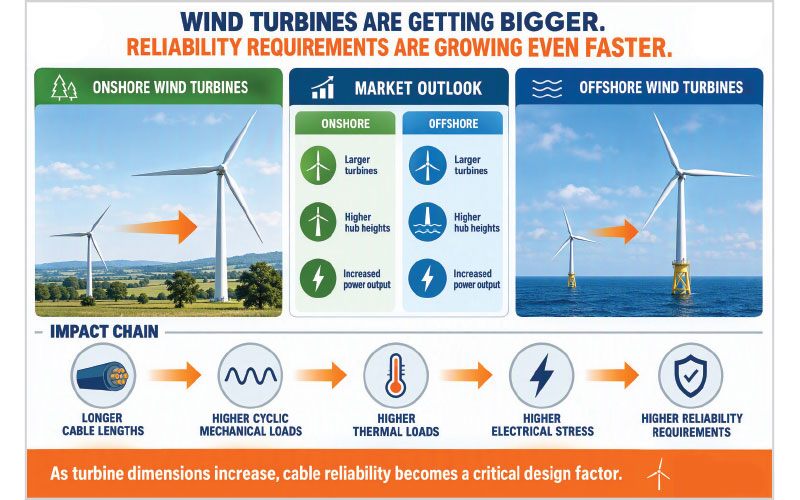
Nowhere is this challenge more evident than in wind turbines, where an expected service life of 25 to 30 years raises an important question regarding medium-voltage cable systems: is compliance with standards sufficient to demonstrate reliable performance throughout the entire operating life? Although norms such as IEC 60502-2 and UL 1072 provide essential requirements for material and cable qualification, long-term reliability also depends on the ability of the insulation system to withstand the combination of stresses to which the cable is subjected during operating conditions.
In fact, cables installed in wind turbines are exposed to a complex combination of electrical, thermal, mechanical and environmental stresses. Electrical fields and current loads act simultaneously with temperature variations, moisture, oxygen, ozone and other environmental agents. Moreover, focusing on dynamic applications, mechanical hysteresis represents an additional factor: cyclic deformation dissipates energy within the polymer, potentially generating local heating and creating a coupling between mechanical and thermal ageing mechanisms. The selection and design of the insulation compound therefore play a fundamental role.
For these reasons, Mixer’s next research programme will focus on the synergistic relationship between mechanical deformation, energy dissipation, temperature and electrical degradation. By cooperating with the University of Bologna, a three-year research project will start in November 2026, and it will address such interactions for rubber-based compounds intended for dynamic AC and DC cable applications.
Also Read: Mixer S.p.A. Elevates Its Specialty Compounds With High-Performance Stabilizer & Elastomers
Extending the lifetime of energy infrastructures is no longer only a matter of compliance with standards. It increasingly requires a deeper understanding of how materials behave when different ageing mechanisms interact over years of operation.
As the cable industry continues to face new challenges, proximity to customers worldwide remains essential for anticipating future needs and supporting innovation. This commitment will once again be reflected at Wire India, where Mixer and its local partners will welcome visitors at HALL 6/ M-50.