India’s optical fibre industry is expanding capacity while engineering cables for denser networks, tighter installation constraints and more demanding qualification requirements. The competitive equation now rests on manufacturing depth, integration, quality, utilisation and application-specific engineering.

India’s optical fibre market is being shaped by several network requirements at once. FTTH continues to drive large volumes, while 5G backhaul, BharatNet, enterprise connectivity and data centres impose different technical demands. The result is not simply a requirement for more fibre. It is a requirement for fibre and cable designs that can deliver greater density, faster installation and predictable performance within increasingly constrained infrastructure.
Data centres are an important example. Higher transmission speeds, cloud infrastructure and AI-led workloads are pushing fibre density and connectivity requirements upward. Conventional telecom networks, meanwhile, continue to demand compact, bend-optimised and installation-friendly cables for access and backhaul applications. Rural networks introduce another set of requirements around mechanical protection, environmental resistance and deployment economics.
This differentiation is changing the engineering equation for manufacturers. Cable construction is increasingly being determined by where the product will be installed, how much fibre the infrastructure must carry and how quickly the network needs to be deployed.
The consequence is visible in the products now moving through development and manufacturing. Higher fibre counts are being accommodated within smaller or optimised cable diameters. Ribbon and intermittently bonded ribbon constructions are gaining importance in high-density applications. Bend-insensitive fibre has moved beyond a specialised feature in several access applications. Micro-duct-compatible and low-friction constructions are being developed to increase fibre density without requiring proportionate expansion of physical infrastructure.
The optical fibre industry is therefore dealing with a more demanding manufacturing problem. More capacity remains important, but competitiveness increasingly depends on how effectively that capacity is utilised and supported by engineering, quality and supply-chain capabilities.
Watch: Top Cable Companies in India
More Fibre Within Existing Infrastructure
The most consequential product development is taking place around a straightforward physical constraint, i.e., networks need to carry more fibre without continually expanding the infrastructure that houses it.
Existing ducts, pathways, building risers and other network spaces have finite capacity. Increasing fibre count therefore creates pressure to reduce cable dimensions, improve fibre packing and control the mechanical and optical behaviour of the cable more precisely.
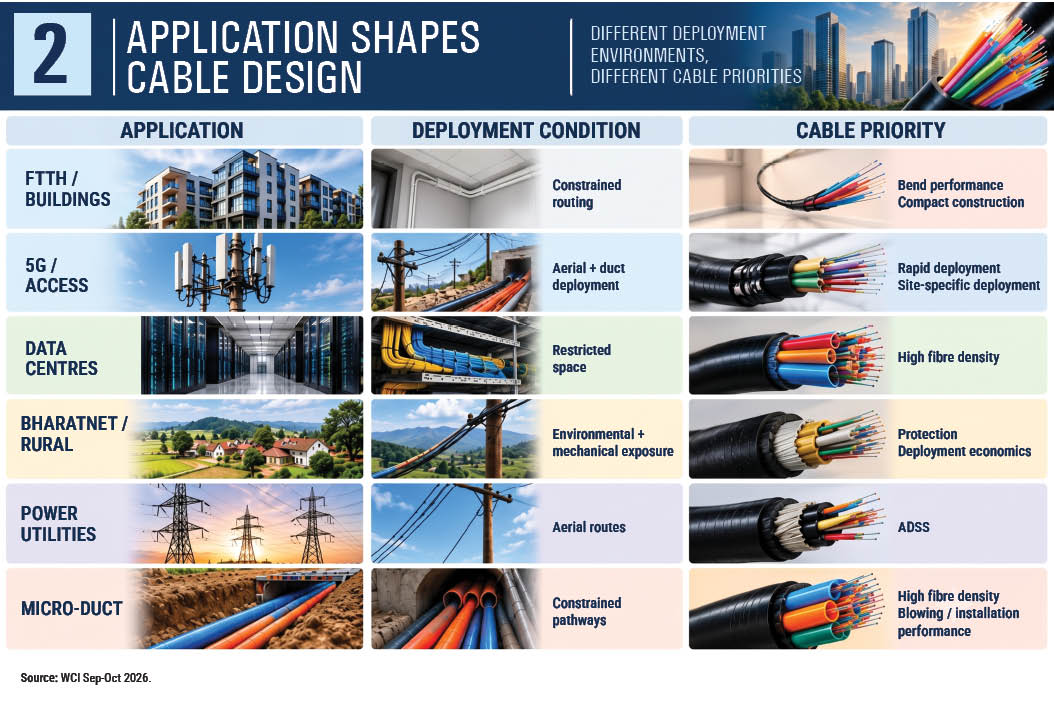
Higher fibre counts in compact constructions are now commercially relevant across several applications. In FTTH and building environments, bend performance can determine how easily a cable is routed through congested spaces. In 5G and access networks, aerial and duct configurations need to accommodate rapid deployment under different site conditions. In data centres, high fibre density has to coexist with restricted space and faster connection requirements.
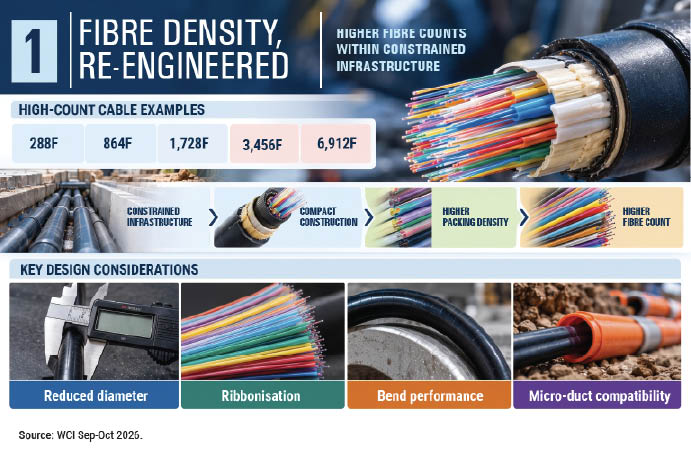
The same principle is appearing at progressively higher fibre counts. Pramod Kumar Srivastava, CEO, West Coast Optilinks, points to growing interest in 288F, 864F and 1,728F solutions where duct space and deployment efficiency are important. Harsh Pagay, Executive President-OFC, HFCL Limited, cites the development of 3,456-fibre and 6,912-fibre micro-duct IBR cables, alongside higher-density designs on the roadmap.
The significance is not the fibre count alone. A higher-count cable becomes commercially useful when it can fit within existing infrastructure, maintain optical and mechanical performance and remain practical to install and maintain.
That is why cable geometry is becoming as important as fibre count. Reduced-diameter constructions, thinner coatings, tighter packing, improved bend performance and ribbonisation are being developed together rather than as isolated product features.
Kapil Mehta, CEO, Birla Furukawa Fibre Optics, describes the objective in terms of accommodating higher fibre counts within an optimised cable diameter. He links this directly to better utilisation of existing ducts and infrastructure. The same logic appears in Sunil Upmanyu, President – Operations, Finolex Cables Ltd.’s, assessment that higher fibre count in compact form factors is becoming a central commercial requirement.
Deployment is consequently becoming part of cable design. Low-friction jackets, lightweight constructions and air-assisted blowing can influence how far a cable can be installed through a duct. Ribbon construction can reduce the time required for mass-fusion splicing. Bend-optimised fibre can reduce losses when cables are routed through constrained spaces. These characteristics affect labour, installation time, restoration and the use of existing infrastructure.
Ashish D. Jain, CEO – Telecom Business, Polycab India Ltd., points to high-core-count underground armoured OFC for BharatNet Phase III, ADSS cables for power-utility routes and bend-insensitive fibre for FTTH as examples of how cable construction is being shaped by deployment requirements. Polycab is also developing micro-sheath and smaller-diameter designs for applications where duct space is constrained.
This also explains why there is no single product configuration that can serve every segment efficiently. A cable designed for a hyperscale data-centre environment does not have the same priorities as one intended for a rural BharatNet route. A high-density urban FTTH application has different installation constraints from an aerial 5G backhaul deployment.
The move toward application-specific construction is consequently not simply a product-development trend. It is a response to different physical and economic conditions in the network.
Manufacturing Precision Becomes a Part of the Product
As cable designs become denser and less tolerant of variation, manufacturing capability becomes increasingly important.
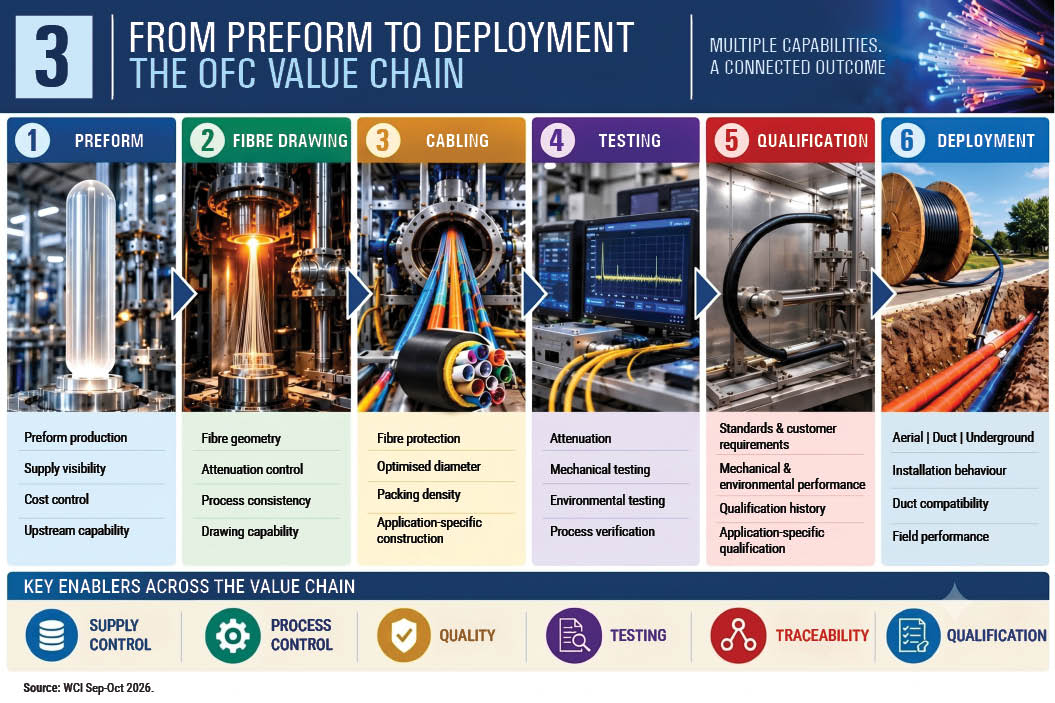
Automated cabling, online quality checks, optical inspection, process monitoring, traceability and advanced testing are increasingly being treated by manufacturers as baseline capabilities for serious OFC production.
Pramod Kumar Srivastava characterises basic automation, quality systems, testing and manufacturing scale as an “entry ticket” for a serious manufacturer. Sunil Upmanyu similarly describes automated cabling lines, inline quality checks and ISO-aligned quality systems as increasingly standard expectations among major customers. “…combination of scale, vertical integration and consistency in manufacturing, quality and delivery is where the competitive advantage lies today,” he says.
The distinction between baseline capability and competitive advantage is important.
Automation itself is no longer necessarily the differentiator. What matters is whether the manufacturing system can consistently produce increasingly complex constructions at the required speed, yield and quality.
Ashish D. Jain identifies AI-driven automated optical inspection, online monitoring and advanced manufacturing systems as important elements of this control environment. He also points to dry-core technology and automated processes as part of the effort to improve consistency while supporting higher-performance cable constructions.
That places greater emphasis on process control. High-density cables require tighter control over fibre handling, coating, tension, ribbon geometry, buffering and cabling. Variations that might have been manageable in a conventional construction can become commercially significant when the design is optimised for high fibre density and constrained installation.
The growing importance of in-house testing reinforces this point. Manufacturers are investing in optical, mechanical and environmental testing so that product performance can be evaluated throughout development and production rather than only after the cable is complete.
Sunil Upmanyu highlights tighter control over attenuation, tensile and crush performance, water blocking, fibre geometry and bend loss across temperature extremes. These requirements are being accompanied by more detailed testing and documentation.
The qualification process itself is becoming part of manufacturing capability. Sandeep Aggarwal, Managing Director, Paramount Communications Ltd., links automation, online process monitoring, testing and traceability to the need for greater consistency in field performance.
Large network operators, infrastructure companies and other customers increasingly expect documented process control, traceability and evidence of consistent performance. Standards and customer-specific requirements consequently influence production systems well before a finished cable reaches the customer.
The practical consequence is that the boundary between manufacturing, quality assurance and product development is becoming less distinct.
A manufacturer developing a new high-density cable cannot simply design the product and then ask whether an existing production line can make it. The manufacturing process, testing capability and qualification pathway increasingly have to be considered together.
This is also why engineering depth is repeatedly cited alongside manufacturing scale. Manufacturers need to move from a customer requirement to a manufacturable, testable and qualifying cable design without excessive development time.
The Economics Moves Upstream
The economics of optical fibre manufacturing is becoming more closely tied to control of the value chain.
Fibre drawing and preform production involve significant capital investment. That makes capacity utilisation important, while raw-material and glass costs can have a substantial effect on unit economics. At the same time, supply disruptions and changes in global pricing can expose manufacturers that depend heavily on external sources.
This explains the industry’s growing interest in backward integration. Sunil Upmanyu describes upstream integration as strategically important, but notes that the economics do not justify the same degree of integration for every OFC producer. In his view, greater control of the value chain becomes more compelling when the scale of operations is sufficient to support the investment.
Vertical integration is not automatically an economic advantage simply because more processes are brought in-house. The investment has to be supported by sufficient utilisation, demand visibility and manufacturing scale.
Yet the underlying rationale is becoming clearer. In-house control can improve visibility over supply, lead times, quality and production planning. It can also reduce exposure to external price movements.
Harsh Pagay places particular emphasis on preform and fibre control, linking upstream supply to cost and lead-time management. HFCL has announced a INR 580 crore investment in a greenfield preform facility, while also expanding its optical fibre capacity. Finolex has likewise commissioned its own preform facility as part of its backward-integration programme.
The industry is moving toward greater control of the fibre-to-cable chain, but the economics differ by manufacturer. For some, integration is primarily a supply-security decision. For others, it is about margin protection, quality control or faster product development. For still others, the priority is balancing the fixed cost of upstream assets against utilisation and the expected demand cycle.
That makes utilisation just as important as installed capacity. A large fibre-drawing or preform facility does not automatically create a cost advantage if it operates below an economically sustainable level. Conversely, a manufacturer with a well-balanced domestic and export order book can use the same capital base more effectively. Sunil Upmanyu identifies capacity utilisation and backward integration as key economic levers, alongside raw-material costs and the timing of capacity expansion relative to demand cycles.
The product mix adds another layer. Sandeep Aggarwal links competitiveness to manufacturing automation, process consistency, product quality, supply reliability and the ability to meet increasingly specific customer requirements. These factors become particularly important as manufacturers compete across both domestic infrastructure programmes and export markets.
The market increasingly distinguishes between high-volume conventional telecom products and more engineered products such as high-count cables, data-centre connectivity and application-specific constructions. These products require greater engineering capability but can also reduce direct exposure to pure price competition.
Installed capacity becomes commercially meaningful when manufacturers can sustain high utilisation, maintain yields and quality, and convert production into products that command viable margins and can be delivered reliably.
Quality Extends Beyond Production
The definition of cable quality is also becoming broader. Traditional acceptance criteria remain essential. Attenuation, mechanical strength, water penetration, environmental resistance and dimensional performance continue to determine whether a cable meets its specification.
Customers increasingly want evidence of how the cable will behave after installation. Pramod Kumar Srivastava notes that customers are concerned with how cables perform over long service lives and under varying environmental and mechanical conditions. Sunil Upmanyu points to more rigorous testing of attenuation, tensile and crush loads, water blocking and bend-loss performance across temperature conditions.
This has pushed testing further into the product-development process. For manufacturers, the objective is not simply to demonstrate that a finished cable passes a type test. It is to understand how the product behaves under the conditions in which it will actually be deployed.
That includes blowing behaviour, duct compatibility, friction, installation forces, splicing and restoration.
Harsh Pagay describes HFCL’s in-house jetting and blowing capability as a way of evaluating blowing distance, friction and duct compatibility during development. Such capabilities are significant because a cable can meet optical specifications and still create difficulties during installation if its mechanical characteristics are poorly matched to the deployment environment.
The manufacturing decision therefore has consequences beyond production. Qualification, installation behaviour and long-term field performance increasingly feed back into cable design and product development.
The commercial implications are substantial. If a cable can be installed faster, occupies less duct space, requires less labour, simplifies splicing or reduces restoration time, those characteristics can influence the economics of the network even if the cable itself carries a higher purchase price.
Procurement is consequently becoming more technically detailed. Supplier evaluation increasingly extends beyond price. Customers are looking at quality systems, qualification history, testing documentation and traceability, alongside delivery record, financial strength, supply continuity and technical support.
The evidence does not justify saying that price has ceased to matter. In volume telecom applications, cost remains important. But the supplier evaluation is becoming broader, particularly for large infrastructure commitments where inconsistent quality or delayed supply can affect an entire deployment schedule.
Kapil Mehta describes the assessment as increasingly comprehensive, including qualification track record, product consistency, traceability, demonstrated performance and supply assurance. Sunil Upmanyu similarly points to delivery consistency and testing documentation alongside price.
The emerging procurement model therefore places greater value on the manufacturer’s ability to sustain performance at scale. A manufacturer may have sufficient capacity to quote for a project, but capacity alone does not establish that it can maintain specification, supply and technical support throughout the project.
Pramod Kumar Srivastava captures this distinction succinctly: “Manufacturing capacity may get you to the conversation table, but it doesn’t necessarily win you the business.”
How Complete Is India’s Manufacturing Chain?
India has built substantial capability in fibre drawing, cable design, automation, testing and high-fibre-count optical fibre cables.
The more complicated question concerns the layers above and around cable manufacturing. Ashish D. Jain identifies advanced glass preforms, specialised raw materials and some heavy machinery as areas where dependence on external sources remains. At the same time, he points to growing domestic capability in fibre and cable manufacturing, including higher-density and application-specific products.
Preforms remain an important area of investment. Several companies are expanding or establishing domestic capability, indicating that the upstream gap is narrowing. But specialised fibres, advanced optical components, specialised materials, precision equipment and some high-end technologies remain areas of dependence.
This makes “self-reliance” difficult to define as a single industry-wide condition. At the cable-manufacturing level, Indian producers increasingly claim the ability to meet global quality requirements. Fibre-drawing capacity has also expanded. Yet that does not mean every element required to develop and manufacture the most advanced optical products is available domestically at comparable scale.
Pramod Kumar Srivastava describes India as having made substantial progress across the value chain while identifying gaps in advanced optical components, specialised fibres, active connectivity and certain high-end technologies.
The more useful measure, therefore, is not whether India is “self-reliant” or “import-dependent”. It is where domestic capability exists at each layer of the value chain, where scale is commercially viable, and where international sourcing continues to make economic or technological sense.
That distinction is increasingly relevant because the industry’s requirements are expanding beyond conventional telecom cable.
Specialty fibre technologies such as hollow-core and multi-core fibre are being discussed as part of the next technology cycle. Co-packaged optics and increasingly dense data-centre architectures are also influencing cable design. These developments are important, but they should be distinguished from technologies already being deployed commercially at scale.
The immediate manufacturing agenda is more concrete. It includes higher fibre counts, compact constructions, bend performance, ribbonisation, micro-duct compatibility, automated inspection, process traceability, testing and faster qualification.
These are not speculative developments. They respond directly to current network constraints.
The more advanced fibre technologies sit further upstream in the development cycle. Their eventual significance will depend not only on technical performance, but also on whether the surrounding ecosystem of fibre, components, connectivity, equipment and manufacturing capability develops at sufficient scale.
Also Read: Wire & Cable India Emagazine Sep-Oct Issue 2026
Competitiveness Beyond Capacity
Capacity remains the foundation. Without scale, it is difficult to serve large infrastructure programmes or absorb the fixed costs associated with fibre and cable manufacturing. But scale increasingly has to be accompanied by other capabilities.
Vertical integration can improve control over supply and cost. Automation can improve consistency and yield. Testing capability can shorten qualification cycles. Application engineering can allow manufacturers to develop products around specific network requirements. Product flexibility can help manufacturers respond when demand shifts between conventional telecom and higher-density applications.
The importance of flexibility is particularly relevant as demand becomes more segmented. A manufacturer serving only one product configuration may face greater exposure when the market moves. A manufacturer capable of shifting between conventional telecom products, high-density access cables, data-centre constructions and specialised applications can potentially use its manufacturing base more effectively.
This does not eliminate the importance of price. It changes the factors that determine whether a manufacturer can compete on price sustainably. Lower unit cost can result from scale, but it can also depend on yield, utilisation, raw-material control, energy efficiency, supply-chain reliability and product design.
The competitive advantage lies in combining scale, integration, engineering, quality and execution without allowing one element to undermine the others. As Harsh Pagay, Executive President-OFC, HFCL Limited, puts it: “The strategic question, therefore, is not how much capacity a company can add, but what combination of capacity, product mix, integration and market positioning will remain competitive across the cycle.”
India’s optical fibre industry is not short of manufacturing expansion. The more consequential question is whether that expansion is accompanied by sufficient upstream control, engineering capability, quality infrastructure and market diversification to support it economically.
At the product level, the direction is already visible. More fibre is being engineered into constrained spaces. Cable designs are becoming more application-specific. Manufacturing processes are becoming more closely controlled. Qualification is becoming more demanding. Procurement is looking beyond nominal product specifications toward delivery and lifecycle performance.
The result is an industry in which manufacturing capability increasingly extends from the fibre and cable itself to the ability to engineer, qualify, produce, deploy and support the product at scale. That is where the competitive equation is being decided.