

As wire and cable manufacturers push for tighter tolerances, superior surface quality, and higher production speeds, the role of advanced die technology has become increasingly critical. In an exclusive interaction with Wire & Cable India, Mr. Kamal Babu, Chairman & Managing Director, Mikrotek, highlights how optimized die design, material selection, and precision manufacturing are shaping modern wire drawing processes. He underscores the importance of application-specific die solutions, from tungsten carbide to PCD and diamond, while detailing how evolving technologies in coatings, polishing, and inspection are enabling consistent performance, longer die life, and enhanced productivity in high-speed, automated manufacturing environments.

Wire & Cable India: Wire drawing dies are central to achieving dimensional accuracy and surface quality. In your view, how does die design influence the overall performance of the wire drawing process?
Kamal Babu: Die design plays a decisive role in the overall efficiency and stability of the wire drawing process. We utilize premium-grade, inclusion-free diamond raw materials, precisely selected across ND, SSCD, and PCD based on wire material, surface finish requirements, and production conditions.
This ensures exceptional wear resistance, superior dimensional accuracy, and consistently reliable performance. The geometry of the die, including entry angle, reduction angle, bearing length, and back relief, directly affects metal flow, friction, heat generation, die size and final wire quality. A well-designed die ensures uniform deformation of the material, resulting in consistent dimensional accuracy, improved surface finish, and reduced risk of wire breakage.
At Mikrotek, die design is optimised according to material type, reduction ratio, and drawing speed, ensuring smooth wire flow and longer die life. Precision finishing and polishing of the bearing area further contribute to maintaining tight tolerances required in modern wire and cable manufacturing.
Watch: Top Cable Companies in India
WCI: Wire manufacturers today use different types of dies, such as tungsten carbide, PCD, and diamond. How do manufacturers decide which die type is best suited for a particular wire application?
KB: The selection of die type depends on several key factors, including the wire material, wire size, drawing speed, type of drawing(wet or dry), required surface finish, and production volume. In practical applications, different die materials are chosen based on the specific wire being produced.
Tungsten carbide dies are typically used for wet drawing low carbon and high carbon steel wires, welding wires, and used for steel wires and general-purpose industrial wires. where cost-effectiveness and reasonable wear resistance are important.
Polycrystalline diamond (PCD) dies are widely used for stainless steel , low carbon steel, copper, aluminium, and alloy wires, tungsten steel wire, molybdenum, titanium and nickel especially in medium and fine wire drawing applications such as electrical conductors and cable strands. They offer excellent wear resistance and consistent performance over long production runs.
For very fine wires, such as stainless, tungsten, platinum wire for fine copper wires, magnet wires, and precision electronic wires, natural diamond or synthetic single crystal diamond dies are preferred due to their superior hardness, high dimensional accuracy, and excellent surface finish.
In addition, advanced solutions like diamond coated dies are increasingly used for ferrous wires and high-speed drawing applications and also manufacturing of low and high voltage cables, where longer die life and stable performance are critical.
We also produce dies for nickel-plated wire drawing, selecting suitable die types based on application requirements to achieve good surface finish and accurate dimensional control.
Our dies are designed to minimize coating damage and ensure consistent performance during continuous production. Ultimately, manufacturers select the die type by balancing technical requirements with operational efficiency and cost, ensuring optimal performance for the specific wire application.
WCI: As industries demand tighter tolerances and better surface quality, how have die design and manufacturing technologies evolved to meet these requirements?
KB: With increasing demand for high-precision wires in sectors such as automotive, electronics, and power cables, die manufacturing technology has advanced significantly. Modern dies are produced using high-accuracy machining, controlled polishing processes, and advanced inspection systems to ensure consistent geometry and mirror-finish bearing surfaces.
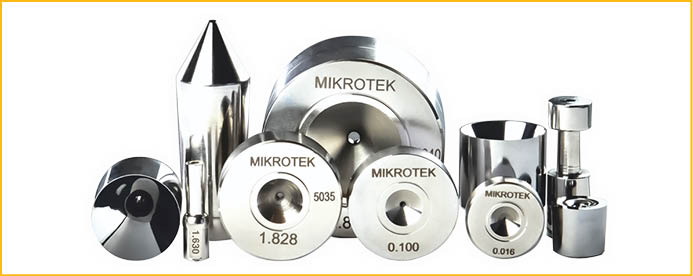
At Mikrotek, we use precision finishing equipment, its accurate laser measuring instruments, high end die profile measuring instruments and quality diamond polishing compounds, and strict quality control procedures to achieve micron-level accuracy. In addition, improved materials such as high-grade PCD, single crystal diamond, and dies to maintain dimensional stability even under high-speed and high-load conditions. These developments help manufacturers achieve better productivity while maintaining superior wire quality. At Mikrotek, level of precision is particularly vital for medical wire applications, where ultra-fine tolerances, flawless surface quality, and uncompromising consistency are required; we design and manufacture dies accordingly to meet these critical end-use performance requirements.
WCI: Die wear is a critical operational concern in high-speed drawing. What factors most strongly affect die life, and how can manufacturers optimize die performance?
KB: Die life is influenced by several factors, including wire material hardness, lubrication quality, drawing speed, reduction per pass, and cooling and filtration systems. Improper lubrication or excessive reduction can lead to higher friction and temperature, resulting in faster wear of the die bearing surface.
To optimise die performance, it is important to select the correct die material, maintain proper lubrication, and follow recommended reduction schedules. Regular inspection and timely re-polishing of dies also help extend service life.
Mikrotek provides high-precision dies along with reconditioning and polishing solutions, enabling customers to maintain consistent performance and reduce overall tooling cost.
WCI: Modern drawing lines operate at higher speeds and with greater automation. How has this influenced die design, materials, or maintenance practices?
KB: Higher drawing speeds and automated production lines require dies with superior wear resistance, better heat dissipation, and consistent dimensional stability. As a result, there has been a shift toward advanced materials such as PCD, single crystal diamond, and diamond coated dies, which can withstand high loads and long production runs.
We use our proprietary ‘Solid Rock Technology’ to mount the diamond into its casing. Our technology is proven to withstand higher thermal conductivity and thermal stability. This means long die life, blemish-free wire surface, maximum recuts, and good luster in every meter of wire drawn.
Die geometry is also optimized to reduce friction and heat generation, ensuring stable operation at high speeds. In addition, automated lines demand consistent die quality, making precision manufacturing and strict quality control more important than ever.
Maintenance practices have also evolved, with greater emphasis on preventive inspection, proper storage, and professional reconditioning to ensure reliable performance in continuous production environments.
Also Read: Ajex & Turner Drives High-Speed Efficiency Through Advanced Die Solutions
WCI: Looking ahead, what technological developments in materials, coatings, or manufacturing techniques are likely to shape the next generation of wire drawing dies?
KB: The future of wire drawing dies will be driven by advanced materials, improved coating technologies, and higher precision manufacturing methods. Diamond coated dies and nano-poly crystalline diamond coatings are expected to play a major role, as they offer exceptional hardness, reduced friction, and longer service life compared to conventional dies. In addition, developments in ultra-fine polishing, laser measurement systems, and automated finishing equipment will allow manufacturers to achieve even tighter tolerances.
At Mikrotek, we are continuously working on new coating technologies, high-precision polishing methods, and improved die materials to meet the growing demand for high-speed, high-accuracy, and cost-efficient wire production. Our focus is to provide tooling solutions that support the next generation of wire and cable manufacturing.