
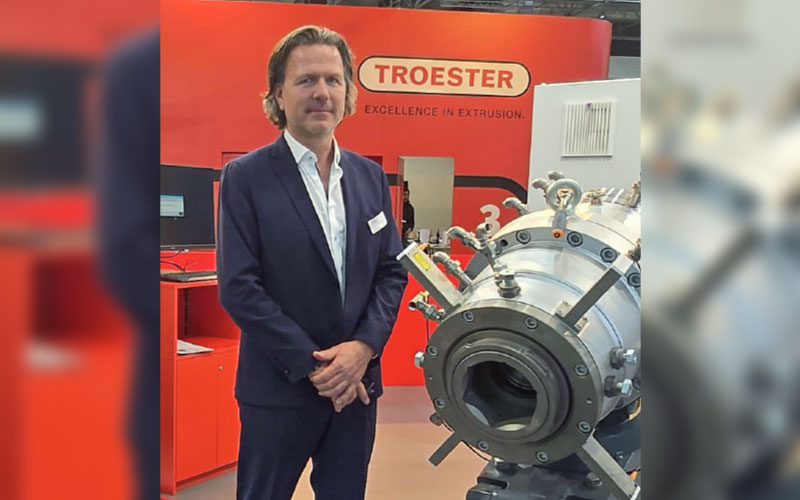
TROESTER shared a confident outlook after achieving a record 2025, driven by sustained demand for medium and extra high voltage CV lines. Backed by global investments in power infrastructure, renewables, and data centres, the company is witnessing steady growth across markets. In an exclusive interaction with Wire & Cable India, Mr. Dirk Schmidt, Director Sales Cable, TROESTER GmbH & Co. KG, highlighted the strong resurgence of the Indian market, describing it as well-connected, transparent, and increasingly active post-COVID, with engagement across most major players. He also outlined ongoing technological advancements focused on enhancing productivity, enabling longer CV line lengths, and improving energy efficiency through process optimisation and monitoring systems. Emphasizing TROESTER’s long-standing, relationship-driven approach, he reiterated the company’s commitment to remaining a reliable partner for the Indian cable industry in the years ahead.
Wire & Cable India: To begin with, how has the past year been for TROESTER and what are the key highlights?
Dirk Schmidt: The past year, 2025, was actually a record year for us, both for the cable division and the company overall. We achieved the highest turnover in our history, which is something that makes us quite happy. We have two divisions– the rubber division for the tyre market and the cable division– and our growth has been strongly driven by our core business in medium and extra high voltage CV technology. Demand has been consistently high over the last three years, and even this year has started at a similar level, so overall, we feel very positive about where we stand.
Watch: Top Cable Companies in India
WCI: What are the main factors driving this sustained demand in your business?
DS: It’s really a combination of several global trends coming together. You have infrastructure development in emerging economies, renewal of power grids in more mature markets, and the shift towards renewable energy, all of which require new and upgraded networks. The move toward renewables, in particular, is creating a strong need for new grids and transmission systems.
At the same time, increasing power consumption is pushing further expansion of existing networks. Another important driver right now is the data centre segment. We are supplying our lines to customers serving data centres, where our lines processing EPR or rubber cables are being used in such applications.
So, it’s not just one factor– it’s multiple demand drivers acting simultaneously, and that is what is keeping demand at a consistently high level.
WCI: Have there been any notable advancements or improvements in your technology and processes?
DS: Yes, we are continuously working on improving our processes. A big focus is on increasing efficiency and productivity for our customers. For example, we are enabling longer line lengths, which directly improves output. We are also using technologies like post-heating and in-tube heating to optimise the cross-linking and cooling processes. The idea is to get more performance out of the same space at the customer’s site, which is becoming increasingly important.
We achieved the highest turnover in our history, which is something that makes us quite happy. We have two divisions– the rubber division for the tyre market and the cable division– and our growth has been strongly driven by our core business in medium and extra high voltage CV technology.
WCI: What steps are you taking towards improving energy efficiency?
DS: Energy efficiency is definitely an important area for us. Cross-linking cables requires a significant amount of energy, making this a key area of focus.What we are doing now is delivering all our lines with energy measurement units, which allow customers to clearly identify where energy is being consumed and then fine-tune the process accordingly.
This helps optimise parameters within the CV tube, particularly around heating. Our CV tube technology, especially resistance tube heating, is already proven to be quite energy efficient. By combining this with better monitoring and process optimisation, we are able to further reduce energy consumption while maintaining performance.
WCI: How do you view the current momentum in the Indian market, and could you share some recent customer engagements?
DS: The Indian market is clearly showing a strong upward trend. We had a good phase there about 20 years ago, then things slowed down for a period, but over the last 3–4 years—especially post-COVID—the market is back. We are in continuous discussions with almost all major players, which we really appreciate.
What stands out is how well-connected and open the Indian cable industry is. Even though companies are competitors, there is a strong network and a level of transparency—you often see people from different companies sitting at the same table. That creates a very positive environment to work in.
In terms of engagements, we have supplied lines to all major companies like Polycab, KEI, Finolex, RR Kabel, Sterlite, Havells, Torrent, APAR Cables and Universal Cables, among others.
There are also several additional projects currently in the pipeline, so overall activity levels remain strong.
WCI: Are there any plans to establish manufacturing or assembly operations in India?
DS: At the moment, production of cable machinery in India is not on our agenda. Our main manufacturing is in Hannover, Germany, and some components are produced at our Shanghai facility. However, given the growth we are seeing in India, we are closely watching the market. I would not rule it out in the future, but it is not something we are planning in the short term.
What stands out is how well-connected and open the Indian cable industry is. Even though companies are competitors, there is a strong network and a level of transparency—you often see people from different companies sitting at the same table. That creates a very positive environment to work in.
WCI: How are you strengthening your service and support capabilities in India?
DS: This is an area where we are definitely increasing our focus. We have established our presence in India, and our local team is being trained alongside our experienced colleagues from Germany. They are already involved in installation and commissioning, and over time, they will take on more responsibility. Given the number of lines being delivered to India, we see a very bright future for our service operations there.
WCI: Any closing thoughts you would like to share?
DS: TROESTER has been in the market for more than 130 years, and I have been with the company for 25 years. We have seen continuous growth, particularly in the cable division. As a family-owned company, we place strong emphasis on long-term relationships, which aligns well with many of our customers, especially in India. India is an important market for us, and we are committed to supporting its further development with our technology and expertise.
Also Read: Rosendahl Nextrom Leverages Innovation, Productivity in Buoyant Market Phase
WCI: Could you share more details about your India subsidiary and its current structure?
DS: In 2022, we established a strong and growing presence in India, with our office in Chennai and a local team of around 40 employees, more than half of whom are in technical roles.
Our team supports customers with installation, commissioning, and engineering services, and we continue to expand these capabilities. In addition, we operate a local workshop that enables us to provide faster service, spare parts handling, and certain refurbishment activities.
Over the years, we have built up significant service experience both within India and internationally, and we are also supporting selected auxiliary equipment projects.
Overall, India is becoming an increasingly important part of our global service and support network, with further growth expected in line with the expanding installed base.