

India’s steel wire industry is undergoing a transformation, with manufacturers moving beyond commodity products toward specialized, high-performance solutions. In an exclusive interaction with Wire & Cable India, Mr. Sidharth Agrawal, Managing Director, Systematic Group, shares insights on how evolving demands from sectors such as power, infrastructure, automotive, and agriculture are shaping product development. He discusses the increasing need for precision, advanced coatings, and consistent quality to meet critical application requirements. He highlights the company’s focus on application-oriented offerings, including specialized galvanized wires and Zn-Al alloy coated products like GALVASYS, designed for superior corrosion resistance and durability. He also underscores the critical role of wire rod quality and pricing in determining manufacturing efficiency and final product performance, making raw material reliability a key factor in sustaining competitiveness and industry growth.
Wire & Cable India: Steel wire manufacturers today cater to a wide range of end-use industries through both conventional commodity and specialized products. Could you briefly describe your company’s specialty or application-specific steel wire portfolio and the key industries they serve?
Sidharth Agrawal: At Systematic, our focus has always been on developing application-oriented steel wire solutions rather than only producing commodity wires. Along with conventional galvanized steel wires, we have developed specialized products such as Zn + Al alloy coated wires under the brand GALVASYS, which offer significantly higher corrosion resistance and longer service life.
Our products such as specialized galvanized wires, and Zn-Al coated wires are designed to meet these demanding applications and are used across industries like power and transmission, telecom, infrastructure, agriculture, fencing, and cable armouring. Each of these sectors has very specific performance requirements, so our approach has been to design wires that can perform reliably in demanding environments, whether it is supporting critical infrastructure or operating in outdoor conditions for long periods.
Watch: Top Cable Companies in India
WCI: A large portion of steel wire production has traditionally consisted of general purpose, commodity products such as binding wire, fencing wire, and low carbon drawn wire. In your view, how does application-specific (specialty) steel wire differ from these commodity products in terms of metallurgy, performance requirements, and manufacturing precision?
SA: Commodity wires such as binding or general fencing wires are typically produced with standard metallurgical specifications and broader tolerances, as their applications are relatively simple.
In contrast, application-specific steel wires require tighter metallurgical control, precise dimensional tolerances, and specialized surface coatings. Their performance is often critical to the final product, whether it is reinforcing cables, supporting transmission infrastructure, wire ropes used in lifting and mining applications, or providing long-term corrosion resistance in outdoor environments.
For such applications, factors like uniform tensile strength, consistent wire diameter, controlled mechanical properties, and superior surface quality become extremely important, as even minor variations can affect the performance and durability of the finished product. In applications like wire ropes, for instance, maintaining strict size tolerances and uniform tensile properties is essential to ensure reliability, safety, and long service life.
Similarly, advanced coatings also play a key role. For example, Zn-Al alloy coated wires such as GALVASYS provide significantly higher corrosion resistance compared to conventional galvanized coatings, making them particularly suitable for coastal or high-humidity environments where durability is critical.

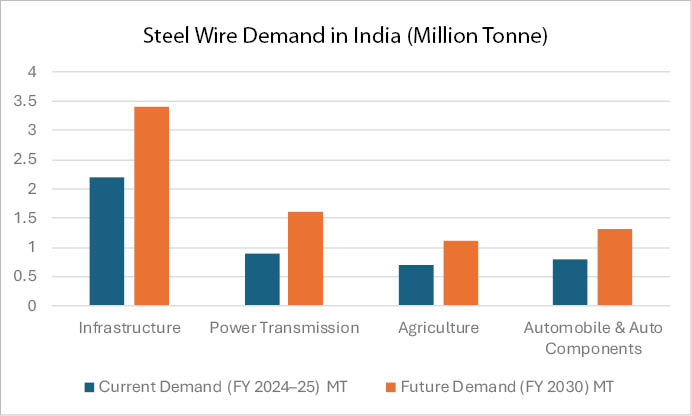
With the expansion of power grids, renewable energy projects, and large infrastructure developments, there is a growing demand for wires that offer higher strength, reliability, and longer service life.
WCI: As end-use industries evolve, their performance requirements increasingly influence wire design. Which sectors today are exerting the strongest influence on steel wire development and demand for specialized products
SA: Today, sectors such as power and transmission, infrastructure development, and the automobile industry are strongly influencing the evolution of steel wire products. With the expansion of power grids, renewable energy projects, and large infrastructure developments, there is a growing demand for wires that offer higher strength, reliability, and longer service life.
At the same time, the automobile sector is also driving demand for specialized steel wires used in applications such as springs, tyre bead wires, control cables, fasteners, and wire ropes used in lifting and mechanical systems. These applications require wires with precise mechanical properties, consistent tensile strength, and excellent fatigue performance to ensure reliability and safety in automotive components.
Applications such as agriculture and fencing are also evolving, with customers increasingly looking for materials that can withstand harsh outdoor conditions with minimal maintenance. These evolving requirements are pushing manufacturers to develop more advanced coatings and higher-performance wire products.
WCI: Different applications require specific mechanical and physical properties. What key technical parameters (such as tensile strength, fatigue resistance, surface quality, or dimensional tolerance) are becoming most critical for these specialized steel wire applications?
SA: For specialized wire applications, several technical parameters are becoming increasingly important. Mechanical strength and consistency remain fundamental, but factors such as higher tensile strength, fatigue resistance, corrosion protection, surface quality, and dimensional precision are equally critical.
In many infrastructure and industrial applications, wires are expected to perform continuously under stress and environmental exposure for long periods. This means manufacturers must ensure not only high strength but also uniform mechanical properties and consistent tensile performance across production batches.
Achieving these requirements demands tight process control throughout manufacturing, as even small variations in diameter, tensile strength, or surface condition can directly impact the reliability and service life of the final application.
WCI: Does producing high-performance specialized wires often require advanced processing capabilities? If yes, what types of manufacturing technologies or specialized equipment are essential for producing such high-performance steel wires?
SA: Yes, producing high-performance steel wires definitely requires advanced manufacturing capabilities and precise process control. Modern wire production today caters to highly demanding applications such as oil tempered steel wires, spring steel wires, and wires used in wire rope manufacturing, where consistency and reliability are critical.
To meet these requirements, manufacturers rely on high-speed precision production equipment and sophisticated testing systems to maintain consistent product quality. Properties such as tensile strength, fatigue resistance, and dimensional accuracy must be carefully controlled to ensure the wire performs reliably in its final application.
Continuous monitoring of process parameters and rigorous quality checks have therefore become essential, particularly when producing wires for critical industrial and engineering applications where performance and durability cannot be compromised.
WCI: Steel wire production depends heavily on the quality and availability of wire rods. How do variations in raw material quality or fluctuations in input prices influence downstream wire manufacturing?
SA: Wire rods are the primary raw material for steel wire manufacturing, so their quality and availability have a direct impact on the entire downstream process. The chemical composition, cleanliness, and consistency of the rod determine how efficiently it can be drawn and how reliable the final wire will be. One of the ongoing concerns in the industry has been the availability of high-quality wire rods, which are essential for producing specialized and high-performance wires.
Variations in quality can affect productivity as well as the performance of the final product. At the same time, pricing competitiveness and fluctuations in raw material costs also influence manufacturing economics. There is also a strong need to make wire rod available at international pricing levels, as this remains a major challenge for the growth of the wire industry. We as a country are globally competitive in value-added wire products, provided we are able to access wire rod at international pricing levels.
There is increasing discussion within the industry on the need to align domestic wire rod production with global quality benchmarks, reduce certain import dependencies, and strengthen collaboration between industry, government bodies, and PSUs to ensure a more stable and competitive supply chain.
Wire rods are the primary raw material for steel wire manufacturing, so their quality and availability have a direct impact on the entire downstream process. The chemical composition, cleanliness, and consistency of the rod determine how efficiently it can be drawn and how reliable the final wire will be.
WCI: Across the industry, manufacturers are investing in process improvements and automation. Which recent technological or operational upgrades have had the greatest impact on product quality and manufacturing efficiency?
SA: Over the past few years, automation and digital monitoring systems have had a significant impact on manufacturing efficiency and product quality in the steel wire industry. Modern production lines increasingly incorporate automated controls, inline inspection systems, and real-time monitoring of key process parameters.
Technologies such as SCADA-based process monitoring and AI-enabled inspection cameras are also being adopted to track production conditions and detect quality deviations at an early stage. These technologies help manufacturers maintain better consistency, reduce operational losses, and improve overall productivity. At the same time, improvements in coating technologies have also contributed to enhancing product performance and durability. As the industry continues to evolve, companies that are able to effectively integrate digital technologies and AI into their manufacturing processes will be better positioned to drive efficiency, improve quality, and shape the future of the industry.
WCI: India’s steel wire industry has historically been fragmented, but larger organized manufacturers are steadily expanding their presence. How do you see the competitive structure of the industry evolving in the coming years?
SA: The steel wire industry in India has traditionally been quite fragmented, with many small and medium manufacturers producing general-purpose wires. However, we are gradually seeing a shift toward more organized and technologically driven manufacturers.
Customers today are placing greater emphasis on quality, reliability, and technical capability, especially for specialized applications. As a result, companies that invest in technology, process control, and product development are likely to strengthen their position in the market over time.
Also Read: Patil Group Aligns with Evolving Demands in Steel Wire Applications
WCI: Looking ahead, what will be the key strategic priorities for steel wire manufacturers— whether in terms of product specialization, capacity expansion, technology investments, or exploring new application segments?
SA: Going forward, steel wire manufacturers will increasingly focus on moving up the value chain by developing more specialized and high-performance wire products such as wire ropes, oil tempered wire in LRPC Investments in advanced manufacturing technologies and coating solutions will continue to be important. At the same time, opportunities are emerging from sectors such as infrastructure development, renewable energy, telecom networks, and agriculture, which will drive demand for durable and reliable wire products. Expanding into new applications and strengthening export markets will also remain key priorities for many manufacturers.
Going forward, steel wire manufacturers will increasingly focus on moving up the value chain by developing more specialized and high-performance wire products such as wire ropes, oil tempered wire in LRPC Investments in advanced manufacturing technologies and coating solutions will continue to be important.