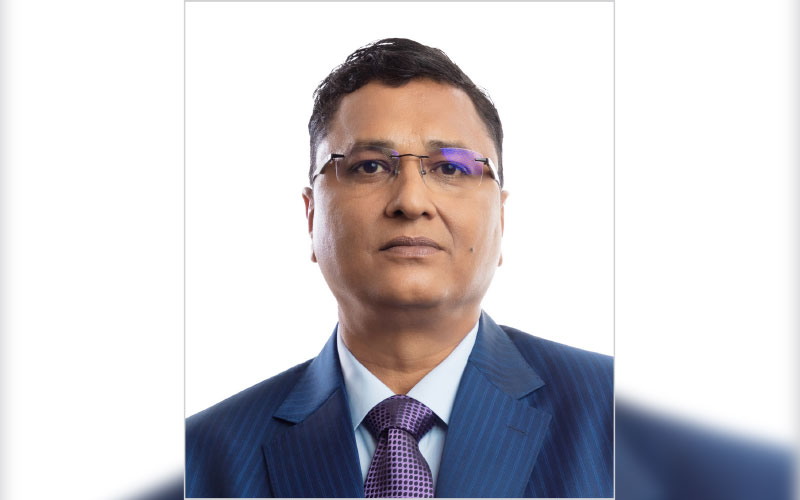
India’s optical fibre cable industry is moving beyond conventional volume-driven manufacturing as FTTH, 5G, BharatNet and data-centre applications create increasingly differentiated requirements for fibre count, cable construction, deployment and performance. BharatNet Phase III, in particular, is driving demand for high-core-count underground armoured OFC, ADSS aerial cables and bend-insensitive FTTH solutions suited to middle and last mile deployment. This shift is placing greater emphasis on manufacturers’ ability to combine high-density product development with automation, backward integration and the flexibility to serve diverse network architectures. In an exclusive interview with Wire & Cable India, Mr. Ashish D. Jain, CEO – Telecom Business, Polycab India Ltd., discusses these evolving requirements and how Polycab is strengthening its OFC manufacturing capabilities in response. From high-core-count cables for BharatNet and 5G backhaul to micro-sheath, bend-insensitive and ribbon-based designs, the company is expanding its capabilities across applications while leveraging its backward-integrated Halol facility, in-house strength-element manufacturing and advanced automation.
Wire & Cable India: India’s fibre deployment is expanding across FTTH, 5G backhaul, data centres, BharatNet, enterprise networks and other segments. Which application segments are currently shaping product development and manufacturing priorities the most and how do their technical requirements differ?
Ashish D. Jain: While FTTH, 5G backhaul and BharatNet are currently driving optical fibre product development in India, technical specifications vary widely depending on the deployment environment.
As a project implementing agency executing the middle-mile network under the amended BharatNet Phase III programme, Polycab is prioritizing high core-count underground armoured OFC, ADSS aerial OFC and bend-insensitive single-mode grade FTTH OFCs for the last-mile projects.
Our high core-count underground cables utilize corrugated steel tape armour to survive harsh inter-village routes, rodent threats and unorganized roadside excavations, providing reliable backbone capacity for IP-MPLS routers and 5G backhauling between block headquarters and gram panchayats. Concurrently, our ADSS aerial cables feature fully non-metallic, anti-tracking and weather-resistant designs, engineered for safe and high-tensile installation along high-voltage power utility routes.
Watch: Top Cable Companies in India
WCI: Over the past 3-5 years, what manufacturing capabilities or process improvements have become commercially essential as an OFC-producer that were previously considered optional?
ADJ: Driven by BharatNet Phase-III deployments, 5G roll-outs and data centre inter-connectivity demands, OFC-manufacturing in India has shifted from standard high-volume extrusion to high-density and bend-optimized designs with AI-driven Automated Optical Inspection (AOI). These capabilities were considered optional 3-5 years ago, but are now critical requirements for the manufacturers to remain relevant.
WCI: Which market, technological or customer requirements have made these capabilities increasingly critical?
ADJ: The shift from standard cable-extrusion to high-density, automated manufacturing and dry-core technologies is being influenced by nationwide digital infrastructure programmes such as BharatNet Phase-III and 5G network roll-outs. Furthermore, data centres, cloud infrastructure and 5G backhaul require significantly higher fiber-counts in the existing underground ducts, making micro-sheath, smaller-diameter and bend-resistant fiber-designs increasingly important.
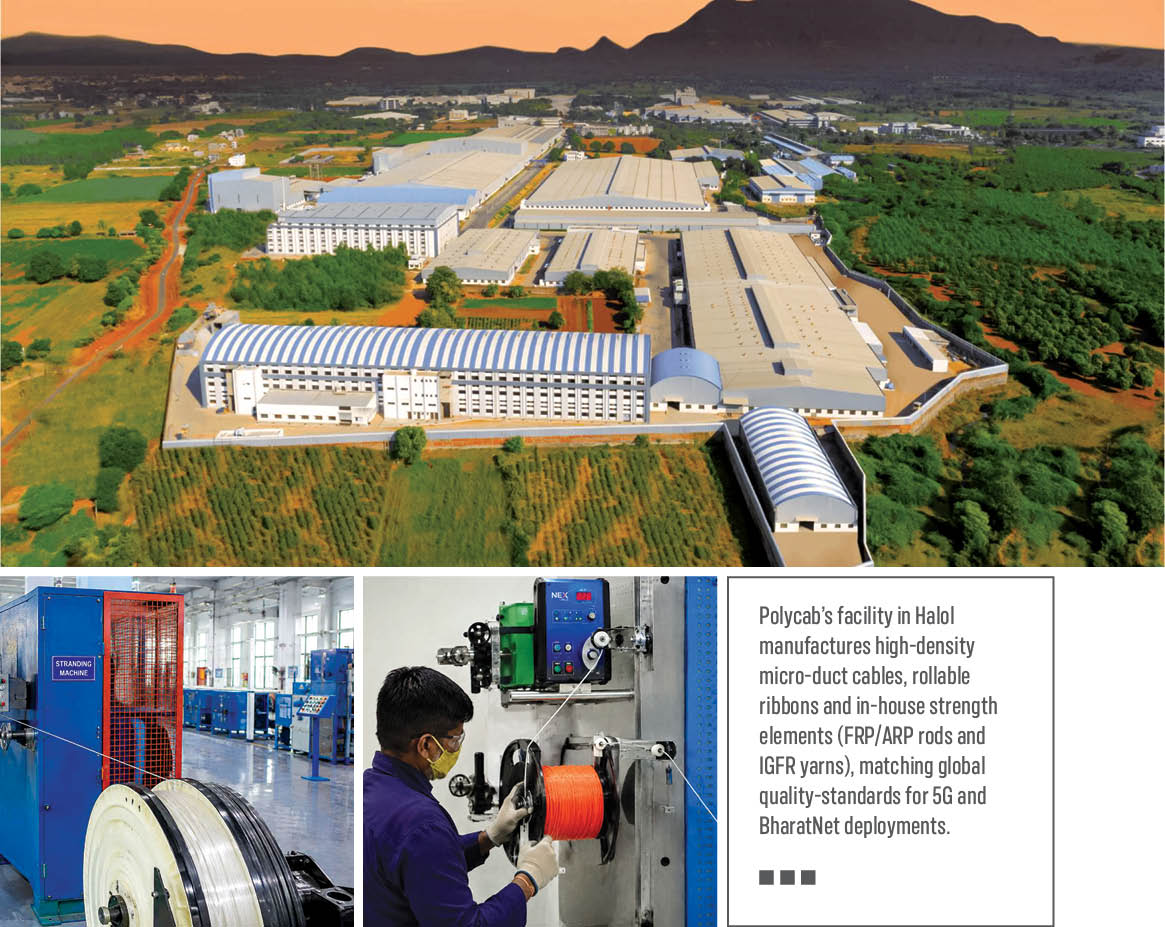
At Polycab, our backward-integrated manufacturing hub in Halol, Gujarat, is directly aligned with these requirements, enabling us to deliver high-capacity and future-proof fiber-optic solutions for India’s digital backbone.
WCI: Network operators today expect higher reliability, faster deployment and longer service-life. Which product-attributes, quality-parameters or qualification-requirements have become significantly more demanding? How has Polycab responded?
ADJ: To meet network operators’ demands for high reliability, faster installation and longer lifespan, the benchmark for cable-quality and qualification has shifted significantly.
Industry-standards now require ultra-compact micro-sheath designs and high-density bendable ribbons which drastically reduce cable-diameter and weight, enabling faster installation through ducts and maximizing fiber-density without signal-loss.
Compliance testing now requires mandatory Telecommunication Engineering Centre (TEC) certification under the MTCTE framework in India, alongside extreme environmental cycling (-40°C to +70°C aging tests), accelerated UV-resistance and strict dry-core water-penetration testing (IEC 60794 standards) to guarantee field longevity.
Polycab’s fully automated manufacturing and testing facilities exceed these parameters, supporting EPC companies, partners and network operators with seamless installation and long-term infrastructure reliability.
WCI: From preforms and optical fibre to cable manufacturing and testing, where has the Indian industry made the most significant progress towards technological self-reliance? Which critical gaps still remain?
ADJ: India has gained greater self-reliance by making significant progress across optical fibre drawing, cable manufacturing, process automation, advanced testing capabilities and high-fibre-count products. However, dependency on foreign technology-providers for advanced glass preforms, specialty raw materials and some heavy machinery remains the most critical gap.
Polycab’s facility in Halol manufactures high-density micro-duct cables, rollable ribbons and in-house strength elements (FRP/ARP rods and IGFR yarns), matching global quality-standards for 5G and BharatNet deployments.
WCI: Recent investments across the industry suggest a growing emphasis on automation, quality-assurance and manufacturing scale. In your view, which investments have now become standard expectations or industry-necessities and which continue to provide a tangible competitive advantage for you?
ADJ: As OFC manufacturing ecosystem rapidly evolves to meet BharatNet, 5G, FTTH and data centre demands, investments across high-speed automated extrusion and buffering, real-time QA and inline monitoring and high-core count capabilities are critical to meet standard network roll-out demands. Polycab’s in-house backward integration at scale guarantees strict supply-chain control, superior quality consistency and unmatched cost-competitiveness. Investments in advanced high-speed ribbon machines allow us to produce high-density fiber bundles at scale.

As a project implementing agency executing the middle-mile network under the amended BharatNet Phase III programme, Polycab is prioritizing high core-count underground armoured OFC, ADSS aerial OFC and bend-insensitive single-mode grade FTTH OFCs for the last-mile projects.
WCI: The economics of OFC-manufacturing are evolving with increasing investments in capacity, technology and quality. In your view, which factors now have the greatest influence on the commercial viability and long-term competitiveness of OFC-manufacturing?
ADJ: The commercial viability and long-term competitiveness of OFC manufacturing is defined by backward integration, technological agility and stringent quality governance. As network architectures shift to support 5G roll-outs, data centre expansion and BharatNet, commercial viability for us relies on three core operational capabilities- vertical integration, supply chain resilience and specialization in producing high-density, micro-sheath and ultra-bend-insensitive fiber-designs.
WCI: Beyond manufacturing capacity, what factors now determine your ability to secure large telecom, infrastructure or data communication projects? How have your procurement expectations evolved?
ADJ: Securing large scale telecom infrastructure projects is no longer just about manufacturing volume, it requires total project lifecycle reliability, end-to-end turnkey deployment, advanced digital infrastructure standards, supply-chain transparency and strict environmental, social and governmental compliance. Adhering to robust quality-control, Polycab delivers resilient and future-ready infrastructure solutions for global networks of clients and partners.
WCI: As fibre networks become denser and applications more diverse, how are cable designs evolving? In your opinion, which developments, whether in fibre count, cable construction, miniaturisation, bend performance, installation practices or other aspects, are becoming commercially important today?
ADJ: Cable designs are rapidly evolving from basic point-to-point physical links to highly optimized, high-density and space-efficient solutions, designed for faster deployment.
At Polycab, our focus is on extreme miniaturisation and high density fibre solutions to maximize duct utilization without major civil works. We place strong emphasis on bend-insensitive fibre technology that minimizes attenuation losses from tight bends, enabling reliable performance and structural resilience during high-density and aggressive routing. Cable sheath mechanics are evolving for air-assisted blowing in micro-ducts, using low-friction jackets and lightweight construction to enable longer blowing distances and faster deployment.
Also Read: Wire & Cable India Emagazine Sep-Oct Issue 2026
WCI: Looking beyond demand-growth, what do you believe will distinguish the most competitive OFC-manufacturers over the next few years? Please draw upon broader industry-developments and the capabilities that will matter most, such as manufacturing excellence, technology, quality systems, engineering expertise and supply-chain resilience.
ADJ: Beyond volume-growth, the future of optical fibre cable manufacturing belongs to companies that combine deep backward integration with precision engineering.
At Polycab Telecom, we believe competitive strength rests on advanced manufacturing automation like specialized ribbon technology, in-house manufacturing capabilities for critical strength components like FRP/ARP rods, stringent quality-measures and strong R&D capabilities across high-density and specialized OFC-production.
As network architectures evolve for BharatNet, 5G rollouts and data centres, our focus remains firmly centred on delivering scalable, end-to-end reliability and total supply-chain resilience.
As network architectures shift to support 5G roll-outs, data centre expansion and BharatNet, commercial viability for us relies on three core operational capabilities- vertical integration, supply chain resilience and specialization in producing high-density, micro-sheath and ultra-bend-insensitive fiber-designs.