

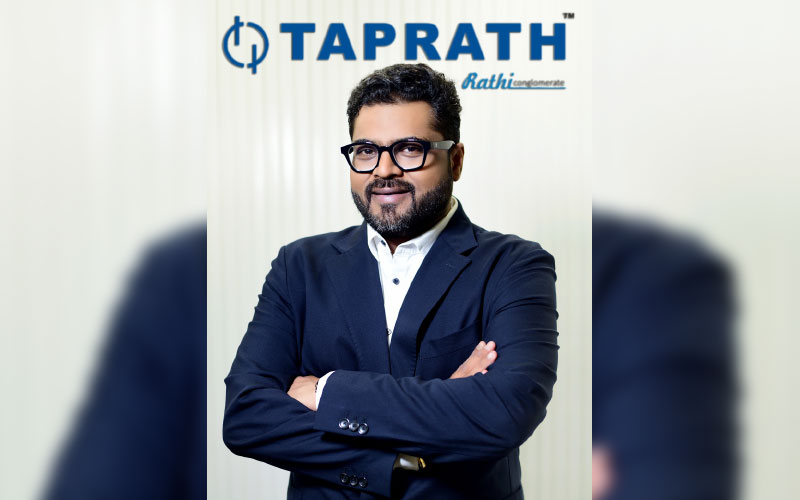
In an exclusive interaction with Wire & Cable India, Mr. Abhishek Rathi, Founder & Director, Taprath Elastomers LLP, shares that India today represents a dependable global engineering partner backed by strong manufacturing execution. Taprath contributes to this positioning by manufacturing high-performance formulations designed for demanding cable applications, demonstrating innovation, manufacturing systems, and material performance.
Wire & Cable India: What will you showcase at WIRE Düsseldorf to highlight India’s technological capabilities and manufacturing excellence to a global audience?
Abhishek Rathi: At WIRE Düsseldorf 2026, Taprath will showcase India’s capability to deliver engineering-led, application-specific polymer solutions for the wire & cable industry at global benchmarks. We will highlight our advanced material platforms such as electron beam crosslinkable cable compounds, thermoplastic LSZH/HFFR insulation and sheathing compounds, NBR powders for PVC modification, and functional additive masterbatches engineered for long-term reliability, safety, and processing efficiency. Our focus is to demonstrate that India is not just a manufacturing base, but a technology-driven innovation partner for global cable manufacturers.
Watch: Top Cable Companies in India
WCI: How do platforms like WIRE Düsseldorf help Indian manufacturers connect with global markets and customers?
AR: WIRE Düsseldorf is one of the most important global platforms because it enables direct engagement with decision-makers across OEMs, compounders, cable manufacturers, and certification-driven markets.
For Indian manufacturers like Taprath, the exhibition accelerates global business by enabling faster customer qualification and approvals, in-person technical discussions for application development, and long-term partnerships built on performance, compliance, and supply reliability. It also helps position India as a serious contributor to global supply chains, not only for cost competitiveness, but for engineering capability and quality consistency.
WCI: What key global market insights are you hoping to gain and bring back to strengthen India’s wire and cable manufacturing ecosystem?
AR: Our key objective is to understand how global customers are evolving their requirements around fire safety and low-smoke performance (especially for infrastructure and transit), sustainability-driven material selection, high-speed processing compatibility and productivity targets, and reliability expectations for solar, EV, railway and speciality cables.
We aim to bring back insights that help strengthen India’s ecosystem through better standard alignment, performance benchmarking, and next-generation product development, so Indian cable manufacturing continues moving up the value chain.
WCI: How have you seen India’s representation evolve at international trade fairs, and how do you contribute to strengthening India’s image as a global engineering hub?
AR: India’s presence has evolved from being viewed primarily as a cost-driven supplier to being increasingly recognized for capability, scale, and technical competence. Today, Indian companies are demonstrating world-class performance in materials, manufacturing systems, and innovation.
Taprath contributes to this shift by focusing on high-performance formulations designed for demanding cable applications, consistent product quality backed by process control and technical support, and collaborative development with customers to solve real manufacturing challenges. Our aim is to represent India as a dependable global engineering partner with strong execution.
India is a serious contributor to global supply chains, not only for its cost competitiveness, but also for its engineering capability and quality consistency.
WCI: What core Indian manufacturing strengths differentiate you on the global stage? For what turnkey solutions is the world looking at India?
AR: India’s biggest strengths today are manufacturing scalability, engineering adaptability, and cost-effective innovation. The world increasingly looks at India for turnkey solutions where performance and value must come together.
At Taprath, our key differentiation is delivering ready-to-run compound solutions that simplify manufacturing for customers, covering insulation, sheathing, crosslinkable systems, and functional additives that improve reliability and productivity. Globally, customers want partners who can provide not just raw materials, but complete, application-ready solutions, and India is increasingly meeting that expectation.
WCI: How are Indo-global collaborations helping reinforce India’s engineering leadership?
AR: Indo-global collaborations are becoming essential for building speed, specialization, and scale. These partnerships help India accelerate leadership by combining global application requirements and compliance expectations, India’s manufacturing strength and engineering execution, and joint development cycles that shorten time-to-market.
For Taprath, international collaboration strengthens our ability to deliver solutions aligned with global performance needs, especially in high-safety cable applications, where material science and consistency are critical.
WCI: Which international regions do you see as strategic growth markets, and how is India positioned as your global manufacturing base to support these expansions?
AR: We see strategic growth opportunities across Europe, Middle East, Southeast Asia, and selective opportunities in Africa and other emerging markets. India is well positioned as a global manufacturing base because it offers strong advantages in capacity scalability, skilled technical resources, and competitive manufacturing economics. Taprath aims to support global customers with dependable supply and consistent quality from India.
WCI: How are cost pressures across raw materials, energy, or logistics being managed without compromising product reliability or compliance?
AR: Cost pressures are real globally, but at Taprath, we manage them through engineering and process discipline rather than compromising performance. Our approach includes formulation optimization while maintaining compliance and long-term properties; manufacturing efficiency improvements and waste reduction; supply chain planning to improve availability and logistics stability; and delivering compounds designed for stable processing, reducing customer rejections and downtime. Ultimately, reliability and compliance cannot be compromised in the wire & cable segment. So, we focus on controlling total cost through smart engineering, not shortcuts.
WCI: How are sustainability expectations translating into changes in product design, manufacturing practices, or material choices?
AR: Sustainability is no longer optional. It is directly shaping product design and material selection. Customers and regulators are increasingly asking for safer fire-performance materials such as LSZH/HFFR systems, lower emissions and improved environmental profiles, longer service life to reduce replacement cycles and waste, and materials that support responsible manufacturing practices.
At Taprath, we see sustainability as a performance-driven shift, where products must deliver safety, durability, and compliance while also aligning with environmental expectations. This is influencing both our R&D direction and the way we support customers with future-ready material solutions.
Indo-global collaborations are becoming essential for building speed, specialization, and scale. These partnerships help India accelerate leadership by combining global application requirements and compliance expectations, India’s manufacturing strength and engineering execution, and joint development cycles that shorten time-to-market.