

India’s specialty cable industry is evolving beyond conventional manufacturing as customers increasingly seek engineered solutions tailored to demanding operating environments. In an exclusive interview with Wire & Cable India, Mr. CS Shrotri, CEO, Cable Solutions, APAR Industries Limited, shares that growth is driven by renewable energy, railways, data centres, automation, defence and other critical infrastructure sectors, each with distinct technical requirements and stringent qualification standards. He notes that customer priorities have shifted from price and basic compliance to lifecycle performance, reliability, safety and customised engineering. As infrastructure projects become more complex and localisation gathers pace, manufacturers with strong design capabilities, advanced technologies and the ability to deliver application-specific solutions are well positioned to ride with the next phase of growth in India’s specialty cable market.
Wire & Cable India: How do you currently define the specialty cable segment within your organization, and which application areas are presently driving the strongest business momentum for you?
CS Shrotri: At APAR, we define specialty cables as highly engineered solutions designed for demanding environments where performance, reliability, safety, and compliance requirements exceed conventional cable standards. Our portfolio includes Solar PV, elastomeric, instrumentation & control, fire survival, railway & metro, defence, nuclear, marine, offshore & mining, data communication, and other high-performance cable solutions serving critical infrastructure and strategic sectors.
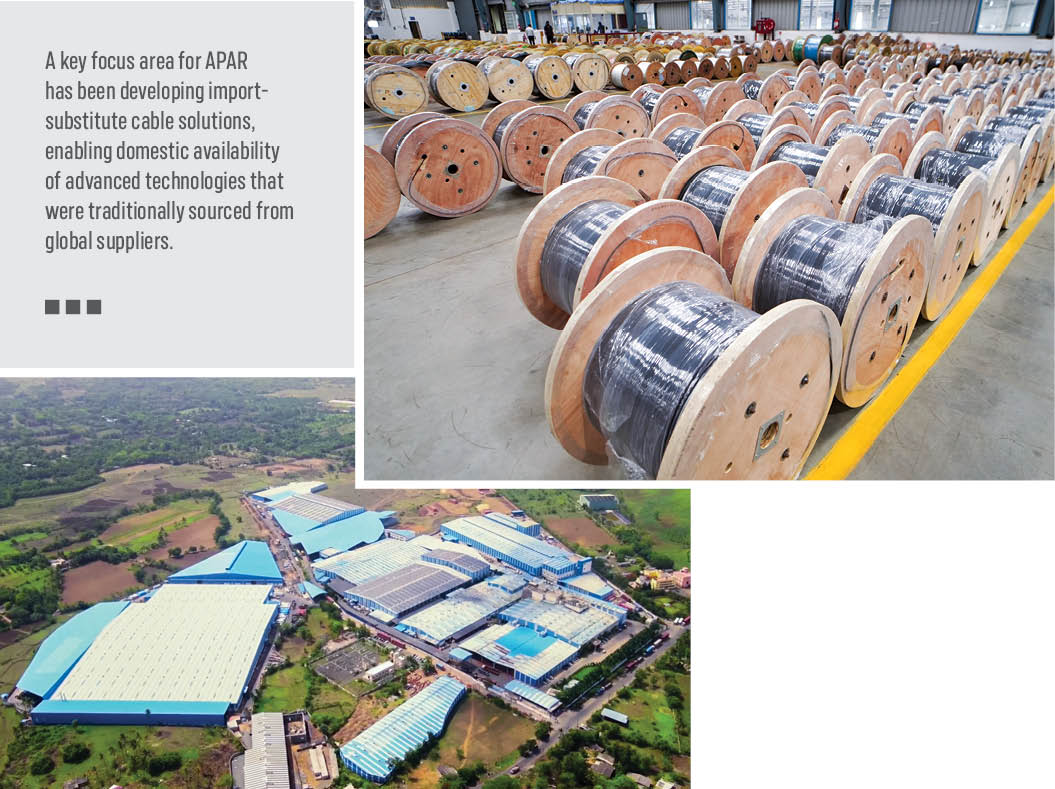
Growth momentum is currently being driven by renewable energy, rail and metro infrastructure, industrial automation, defence modernization, nuclear power, and data centres. A key focus area for APAR has been developing import-substitute cable solutions, enabling domestic availability of advanced technologies that were traditionally sourced from global suppliers.
As India accelerates investments in energy transition and infrastructure, demand for premium cable solutions continues to rise. We see specialty cables emerging as a key value driver, supported by increasing localization, higher technical specifications, and stronger focus on lifecycle performance.
Watch: Top Cable Companies in India
WCI: Among automation, railways, renewables, data centers, EVs, oil & gas, mining, marine, or defense, which end-use sectors are generating the most meaningful demand today, and how do their technical expectations differ?
CSS: Each segment has distinct technical requirements, although renewables and data centres currently lead demand growth.
Renewable energy projects require superior UV resistance, thermal stability, and long service life to withstand harsh outdoor conditions. Railways and metro systems prioritize fire safety, low-smoke halogen-free performance, vibration resistance, and compliance with stringent transportation standards.
Data centres and automation-driven industries focus on signal integrity, uptime, power efficiency, and communication infrastructure, while oil & gas, marine, and mining sectors require cables capable of operating under extreme temperatures, moisture, chemicals, mechanical stress, and hazardous environments.
Defence and nuclear applications demand the highest levels of reliability, environmental resilience, electromagnetic compatibility, and rigorous qualification standards.
As infrastructure becomes more complex, demand is shifting toward engineered cable solutions tailored to specific operating conditions, creating significant opportunities for manufacturers with strong design, engineering, and localization capabilities.
WCI: What major shifts are you observing in customer expectations regarding performance, reliability, lifecycle requirements, qualification standards, and application-specific engineering?
CSS: Customer expectations have shifted beyond price and basic compliance toward reliability, safety, lifecycle performance, and total cost of ownership. Demand for higher qualification standards, rigorous testing, enhanced fire and environmental performance, longer service life, and compliance with evolving global standards continues to increase.
At the same time, advances in sectors such as renewables, railways, automotive, data centres, and industrial automation are driving more complex requirements for cables, harnesses, and connectors. Factors such as power density, space constraints, connectivity, and harsh operating environments increasingly require customized engineering and integrated system solutions.
As a result, customers expect manufacturers to act as technology partners, delivering solutions tailored to specific performance, qualification, and operational requirements.
WCI: Which performance parameters are becoming critical in specialty cable design today, including flexibility, thermal endurance, fire performance, EMI shielding, chemical resistance, weatherability, or signal integrity?
CSS: Key performance priorities today include fire performance, thermal endurance, environmental resistance, mechanical reliability, and signal integrity. As operating environments become more demanding, customers expect consistent performance throughout the asset lifecycle.
For infrastructure, railways, metro, and data centre applications, fire survival capability, low-smoke halogen-free characteristics, and EMI shielding are essential. In renewable energy, marine, and outdoor environments, UV resistance, weatherability, moisture resistance, and thermal stability are critical. Industrial automation and communication-intensive applications prioritize signal integrity, low attenuation, and shielding effectiveness, while defence, nuclear, mining, and oil & gas sectors require exceptional mechanical robustness and chemical resistance.
Customers increasingly expect a single cable solution to meet multiple requirements for safety, durability, environmental resilience, and electrical performance. This is driving continuous innovation in conductor design, insulation systems, shielding technologies, and specialized compounds.

As India accelerates investments in energy transition and infrastructure, demand for premium cable solutions continues to rise. We see specialty cables emerging as a key value driver, supported by increasing localization, higher technical specifications, and stronger focus on lifecycle performance.
WCI: How are industrial automation, robotics, high-flex applications, and the growing convergence of power, control, and data systems influencing product development and cable architecture?
CSS: Industrial automation, robotics, and digital manufacturing are reshaping cable design. As production environments become increasingly interconnected, cables are evolving from simple power transmission components into critical enablers of machine communication, control, and operational continuity.
The convergence of power, control, and data systems is driving demand for integrated cable architectures that support higher data transmission rates, signal integrity, electromagnetic compatibility, and reliable performance in compact installations. Robotics and high-flex applications also require cables capable of withstanding continuous bending, torsion, vibration, and dynamic movement over extended operating cycles.
These requirements are accelerating innovation in conductor stranding, insulation materials, shielding technologies, and hybrid cable designs. We are also seeing growing demand for solutions that combine flexibility, electrical performance, environmental resistance, and communication capabilities within a single system. As Industry 4.0 adoption expands, demand for advanced cable technologies will continue to grow.
WCI: What manufacturing and process challenges are most significant in specialty cable production compared to conventional cable systems, particularly in areas such as precision extrusion, shielding, testing, qualification, and consistency control?
CSS: Unlike conventional cables, specialty products require significantly higher levels of engineering precision, process control, and quality assurance. The challenge lies in consistently delivering performance under demanding operating conditions.
Key manufacturing challenges include precision extrusion of specialized insulation and sheath compounds, maintaining tight dimensional tolerances, advanced shielding configurations, and ensuring consistency across complex multi-layer constructions. In sectors such as defence, nuclear, railways, data centres, and industrial automation, even minor process variations can impact long-term performance.
Testing and qualification requirements are equally demanding, often involving extensive electrical, mechanical, thermal, fire, environmental, and endurance testing. Customers frequently require project-specific validation in addition to standard certifications.
As a result, specialty cable manufacturing requires significant investment in advanced production technologies, laboratory infrastructure, process automation, traceability systems, and technical expertise. Consistent quality and repeatability at scale remain key differentiators.
WCI: How important have certification, traceability, and customer qualification requirements become in sectors such as railways, offshore, infrastructure, industrial automation, and critical installations?
CSS: Certification, traceability, and qualification are now fundamental requirements, often carrying as much weight as product performance itself.
Customers increasingly demand complete traceability across the manufacturing value chain—from raw materials and process parameters to testing records and final validation. This ensures accountability, consistency, and reliability throughout the asset lifecycle.
Qualification processes have also become more rigorous, often involving extensive testing, third-party certifications, factory audits, and long-term performance validation. As reliability expectations continue to rise, robust quality systems, traceability frameworks, and compliance capabilities have become essential prerequisites for participation in high-value projects.
A significant opportunity lies in the localization of advanced specialty cable technologies. As India builds indigenous capabilities in strategic sectors, manufacturers with strong R&D, engineering expertise, and qualification capabilities will play a critical role in developing globally competitive solutions.
WCI: To what extent does India still remain dependent on imports for advanced specialty cable categories, and where do you see the strongest opportunities for deeper localization?
CSS: India has made significant progress in domestic cable manufacturing; however, certain advanced specialty cable categories—particularly in defence, nuclear, offshore, rolling stock, and high-end industrial automation—have historically relied on imports due to stringent performance requirements, specialized materials, and complex qualification processes.
The opportunity for localization remains substantial as India strengthens its focus on self-reliance, strategic infrastructure, energy transition, and advanced manufacturing. We see strong potential for import substitution across defence-grade cables, nuclear cables, specialized elastomeric and fire-survival cables, and marine and offshore applications.
At APAR, we have invested significantly in technology, product development, testing infrastructure, and manufacturing capabilities to develop world-class specialty cable solutions within India. Growing domestic demand, policy support, and increasing confidence in Indian engineering capabilities are creating a strong foundation for accelerated localization. Over the coming years, we expect India to become a globally competitive manufacturing hub for advanced cable solutions.
WCI: How do you assess the present competitive landscape in specialty cables, particularly in relation to pricing pressure, qualification costs, customization demands, and margin sustainability?
CSS: The specialty cable market differs significantly from the conventional cable business, with competition driven by technology, engineering capabilities, quality systems, and customer qualification rather than pricing alone. While pricing pressure exists, customers in critical applications continue to prioritize reliability, lifecycle performance, and compliance, creating opportunities for value-based differentiation.
At the same time, barriers to entry are rising. Manufacturers must invest continuously in product development, testing infrastructure, certifications, qualification programs, and engineering capabilities. Increasing customization requirements further add complexity as customers seek solutions tailored to specific operating environments and project requirements.
Although qualification costs and technical expectations continue to increase, they also support margin sustainability for manufacturers capable of delivering differentiated solutions. We believe the market will favour companies that combine engineering expertise, proven execution, strong quality systems, and localization capabilities. Sustainable growth will be driven less by scale alone and more by innovation, technical credibility, and customer trust.
Also Read: Praneetha EcoCables’ Focus on 100% Primary Electrolytic Copper for Solar Cables
WCI: Looking ahead, which specialty cable applications or technology areas do you believe will define the next phase of growth and development for the industry in India?
CSS: The next phase of growth will be driven by India’s energy transition, infrastructure modernization, digitalization, and self-reliance initiatives. Renewable energy, energy storage systems, green hydrogen, data centres, rail and metro networks, defence, nuclear power, industrial automation, and advanced manufacturing are expected to be key growth engines.
From a technology perspective, demand will increasingly shift toward cables offering enhanced fire safety, higher thermal ratings, superior environmental resistance, advanced shielding, and longer service life. We also foresee growing adoption of intelligent cable solutions supporting the convergence of power, control, communication, and monitoring systems.
A significant opportunity lies in the localization of advanced specialty cable technologies. As India builds indigenous capabilities in strategic sectors, manufacturers with strong R&D, engineering expertise, and qualification capabilities will play a critical role in developing globally competitive solutions. The future of the industry will be shaped by innovation, technology leadership, and reliable solutions for critical applications.