Specialty cables are engineered around the specific demands of the applications they serve. Meeting those demands increasingly depends on material innovation, manufacturing precision, rigorous qualification and commercially viable domestic capability.
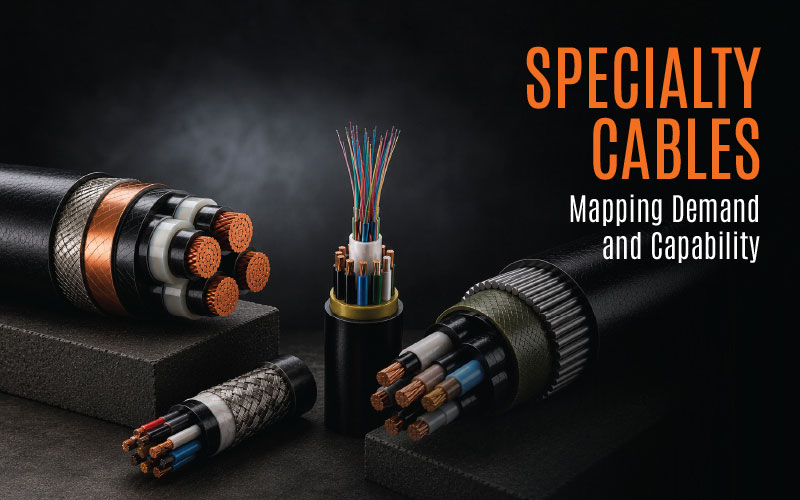
Specialty cables do not follow a single demand cycle in India. Current demand spans data centres, railways and metro systems, industrial automation, renewable energy, electric mobility, defence, shipbuilding, oil and gas, mining, marine applications and process industries. The common label, however, conceals substantial differences in operating conditions, procurement, qualification and cable construction.
Mapping the Specialty Cable Market
Manufacturers broadly agree that demand is expanding simultaneously across several infrastructure and industrial sectors, although each identifies a different mix of high-growth applications. Polycab reports strong demand from data centres, railways, EVs, shipbuilding and naval applications, and renewable energy. APAR places renewables and data centres at the front of current demand growth, while also seeing momentum in rail and metro infrastructure, automation, defence and nuclear power. KEI similarly identifies automation, renewables and railways among important applications, with data centres gaining relevance.
The market map widens across industrial applications. RR Kabel is seeing demand from automation, instrumentation, OEM applications, renewable energy, and data and communication infrastructure. Digitalisation in pharmaceuticals, oil and gas, food processing and packaging is adding requirements for signal and communication cables. Cords Cable identifies oil and gas, automation, renewables, metro rail and data centres among its strongest demand areas, including exports. Paramount Communications points to railways, automation, renewables, infrastructure, data centres and defence.
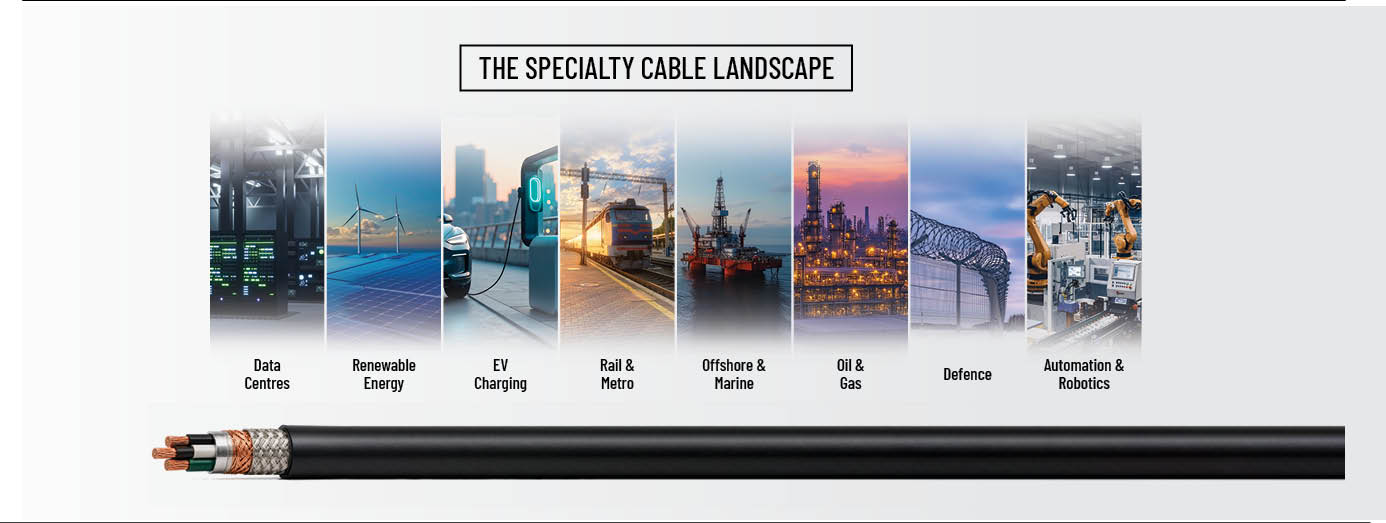
These are not interchangeable markets. As CS Shrotri, CEO, Cable Solutions, APAR Industries Limited, notes, “Each segment has distinct technical requirements.” A servo cable operating through repeated bending cycles, a fire-survival cable for a metro project, a submarine cable and an instrumentation cable in a process plant may all sit within the specialty segment. Their materials, constructions, testing and customer-approval requirements differ. Anurag Agarwal, CEO – Global Exports & New Businesses, Polycab India Limited, describes such applications as having “unique operating conditions” requiring complex constructions against stringent Indian and international standards.
Within this dispersed market, data centres recur unusually often across the manufacturers’ discussions. Polycab, APAR, KEI, RR Kabel, Cords and Paramount identify the segment as a current or increasingly important demand area. Havells provides a more specific view of the engineering requirement. According to Manjit Singh Sethi, President & SBU Head – Cables, Havells India Limited, data centres require products across the 1.1 kV to 33 kV range, including flexible, control and HT cables. More importantly, “the modules where data is housed are becoming smaller but far more complex.”
Greater cable density within compact modules raises the importance of flexibility. “As equipment shrinks, connectors and cables must become much more flexible,” Sethi says. Teknor Apex sees the corresponding material requirement in AI infrastructure and higher fibre density: smaller cable diameters must retain mechanical integrity, flame performance and installation reliability.
Other demand areas are developing around different constraints. Automation and robotics increase requirements for repeated flex-life, shielding and compact construction. EV charging combines high electrical loads with communication and control functions. Rail and metro projects remain closely tied to fire performance and qualification. Renewable energy continues to generate substantial cable demand, although Havells makes an important distinction: much of the present requirement remains conventional DC and AC cable rather than inherently specialised products.
The specialty cable market is therefore better read application by application.
Watch: Top Cable Companies in India
Application Conditions and Performance Requirements
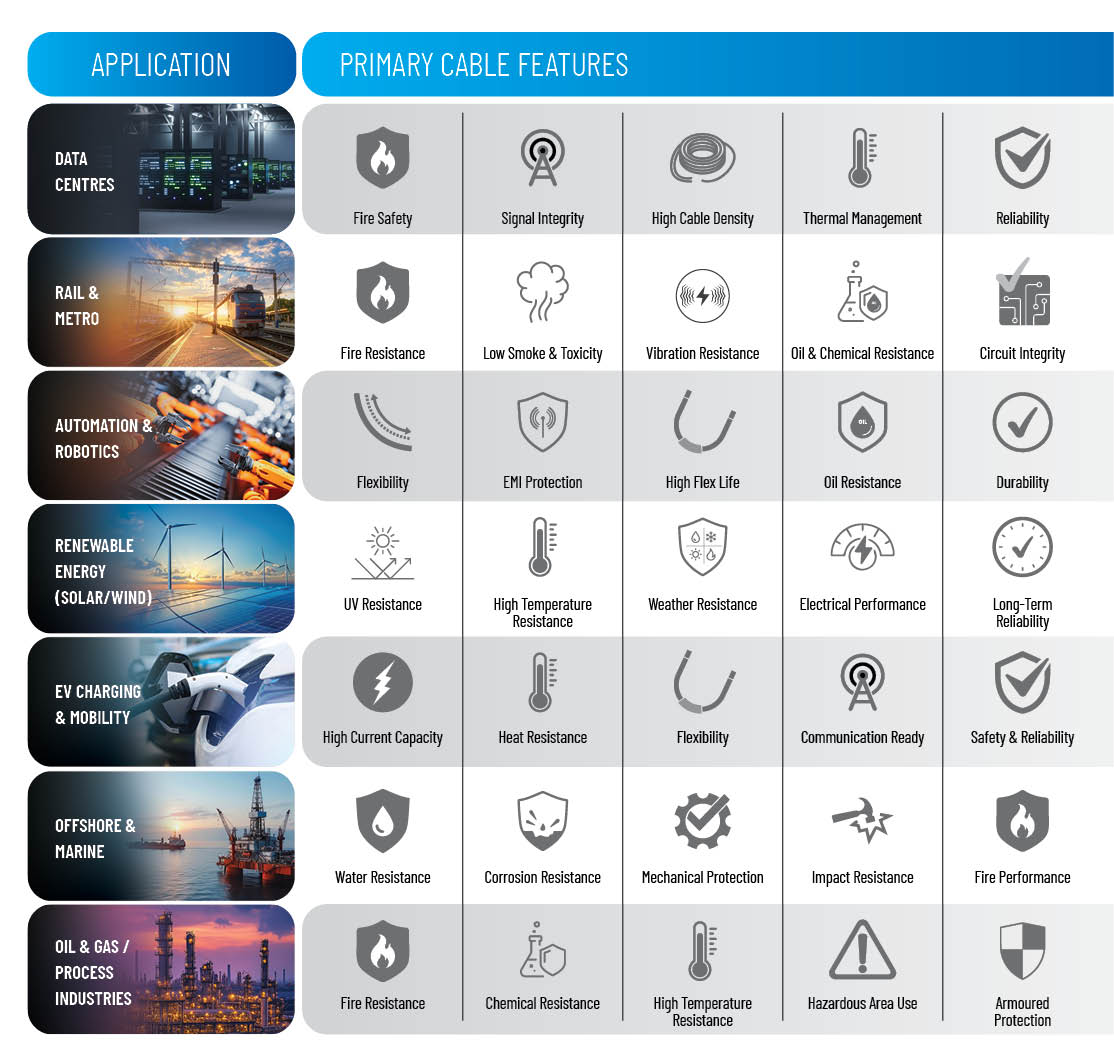
Operating conditions vary widely across specialty cable applications. Data centres emphasise fire performance, signal integrity and uninterrupted service; robotics and automation require continuous flex-life; solar installations test long-term resistance to UV radiation, moisture and thermal cycling; and submarine, naval, mining, and oil and gas applications introduce pressure, chemicals, corrosion and mechanical stress.
Some conditions are unusually specific. Polycab cites long-term thermal endurance as a key qualification requirement in naval shipbuilding. In submarine applications, Agarwal says cables may have to withstand “pressure testing up to 72 bars.” Automation, robotics, railway rolling stock, mining and material-handling systems present a different problem: continuous movement places flexibility and fatigue performance under scrutiny.
Industrial automation also adds electrical and communication requirements. Cords Cable links these applications to flexibility, signal integrity and EMI protection. RR Kabel identifies resistance to continuous mechanical movement as important in automation, while digital infrastructure places greater emphasis on “signal integrity, network reliability, and uninterrupted performance.” Moving cables must manage flexing and electrical continuity; instrumentation cables operating around industrial equipment may require EMI shielding; communication cables are additionally judged by transmission integrity.
Fire performance cuts across several applications, but the specifications and consequences vary. Rail and metro systems emphasise low-smoke performance, mechanical robustness and passenger safety. Data centres combine fire requirements with dense electrical and communication infrastructure and operational continuity. Oil and gas installations add hazardous operating conditions. APAR identifies “fire safety, low-smoke halogen-free performance, vibration resistance” and transportation-specific compliance among rail and metro requirements.
Outdoor energy infrastructure presents a different ageing problem. RR Kabel points to UV resistance, weatherability and long service life as central renewable-energy requirements. NAVANK reports continuous operating-temperature expectations of 90°C to 120°C in solar, EV and industrial automation applications, while procurement specifications in infrastructure, renewable energy and utilities increasingly reference design lives of 25–30 years.
Solar is relevant here primarily as an outdoor-lifecycle case. UV exposure, thermal ageing and moisture act on insulation and sheathing over decades of expected service. The critical issue is long-term retention of electrical and mechanical performance.
EV charging shows how several stresses can converge. In his authored input, Sunil Upmanyu, President – Operations, Finolex Cables Limited, distinguishes charging loads from conventional household consumption. Fast and ultra-fast charging creates concentrated electrical loads over prolonged periods, increasing demands on conductor sizing, insulation and heat management. Outdoor chargers add sunlight, rain, dust and temperature fluctuations.
Upmanyu describes high-power charging cables handling currents “up to 600 amps,” with internal liquid cooling used in some systems to control heat while retaining handling flexibility. Embedded temperature sensors can add another safety layer. Thermal management here becomes part of the cable system rather than simply a property of the insulation.
Chemical and mechanical exposure further differentiate applications. Oil and gas, mining and marine systems may expose cables to oils, moisture, chemicals and physical abuse. Automotive wiring combines heat, vibration and restricted installation space. Takkar Polychem sees rubberised PVC/NBR PVC used where flexibility, oil resistance and cold-bend performance are required, with automotive formulations differing between interior harnesses and under-bonnet wiring.
As Naveen Sawhney, Chairman & Managing Director, Cords Cable Industries Limited, observes, “The importance of these parameters depends on the application.” A submarine pressure requirement does not translate into robotic flex-life; UV stability cannot substitute for shielding effectiveness. Complexity increases when several conditions act simultaneously and the cable must also accommodate electrical, communication or monitoring functions.
Compact and Multifunctional Cable Architectures
Power transmission is increasingly being combined with control signals, data communication or fibre in selected specialty applications. Elsewhere, restricted installation space is placing greater emphasis on compactness and flexibility. The most visible examples come from automation, robotics, data centres and EV charging, although manufacturers also cite fixed power and subsea systems.
Polycab describes composite cables as a notable development in cable architecture. According to Agarwal, industrial automation and digitalisation are driving “composite cables that combine power, control, and data transmission functions, including fibre, within a single cable system.” Polycab reports such constructions in automation, robotics and automotive sensor systems, as well as EHV underground and subsea power-data transmission.
APAR similarly links interconnected production environments with machine communication, control and operational continuity. KEI reports architectures combining power transmission and control functions through “enhanced shielding, optimized conductor designs, improved flexibility, and compact construction.” Cords says integration of power, control and communication is encouraging constructions that “reduce installation complexity while maintaining performance and reliability.” Paramount also points to hybrid solutions intended to simplify installation.
Compactness introduces its own constraints. Havells’ data-centre observations are relevant because smaller, more complex modules increase cable density within restricted space. Flexibility, current-carrying requirements and installation practicality must coexist. RR Kabel reports demand for “higher ampacity, compact cable designs, improved flexibility, and optimized space utilization.”
Teknor Apex sees the material consequence of the same requirement. AI workloads, greater fibre density and space limitations are increasing demand for smaller-diameter cables that retain flame performance, mechanical integrity and installation reliability. Reducing cable dimensions cannot mean simply removing material; conductor design, insulation and sheathing must still satisfy the operating specification.
EV charging provides another form of functional integration. Finolex describes modern charging cables as “intelligent, multi-functional systems.” Alongside high-voltage power transmission, integrated data lines allow the vehicle and charger to communicate on charging status, user authorisation and power-flow regulation. At higher currents, liquid cooling and temperature sensing may also be integrated.
Across these architectures, multiple functions are being resolved within tighter electrical, mechanical or spatial limits.
Sterlite Electric introduces another dimension through cable monitoring. Its Cable Monitoring System, CAMOS, addresses the cable as an operating asset. Frédéric Tréfois, CEO, Sterlite Electric, says the platform seeks to “embed intelligence directly into the cable system” through fibre-optic current sensing. The system measures variables including load currents, sheath currents, capacitive currents and insulation-related parameters.
Continuous operating data can support predictive analytics, fault localisation and dynamic cable rating. In underground networks, where physical access is difficult, visibility into electrical behaviour can improve loading and maintenance decisions.
Whether through integrated functions, compact construction or embedded monitoring, these architectures place greater demands on conductor design, shielding, insulation and sheathing. The material system must make these functions workable.
Materials, Compounds and Performance Trade-offs
The growing number of performance and functional requirements places a larger burden on materials surrounding the conductor. Insulation and sheathing must preserve electrical performance while responding to heat, fire, movement, chemicals, weather and tighter dimensions.
Havells states the issue directly. “Fundamentally, the conductor doesn’t change very much. Most innovation is happening in compounds,” says Sethi. He points to fire-performance materials, flexibility and work around polypropylene-based compounds in HT cables. On thinner, more flexible cables, he adds: “That’s again largely a compounding challenge.”
Polycab’s material list extends across alloys, specialised shielding materials, fibres, advanced insulation and sheathing compounds, tapes and fillers. APAR similarly links multiple performance requirements with insulation systems, shielding technologies and specialised compounds. The material system is part of the cable architecture, not an interchangeable input.
The compounder views reveal the difficulty of combining several properties in one formulation. Tim Schnettler, Sales Manager, Melos GmbH, says “some key properties of our products are adversaries to each other.” High flame retardancy, he notes, “normally does not go well together with high mechanical and electrical performance.”
Teknor Apex notes that greater flame-retardant loading may affect flexibility, mechanical performance or processing. NAVANK identifies reduced flexibility and elongation as possible consequences of elevated mineral filler loading in halogen-free systems. Mixer S.p.A. says high filler loadings or specialised polymers can improve durability while reducing flexibility or complicating processing.
The trade-off becomes tangible on the extrusion line. Takkar Polychem says higher flame-retardant loading can affect “flexibility, elongation, surface finish and extrusion speed.” Amit Takkar, Managing Director, makes an important distinction between laboratory compliance and production suitability: “A compound is not successful only because it passes a lab test.” It must provide “stable processing, less plate-out, good surface finish, low rejection and consistent batch-to-batch performance.”
Processability is therefore part of material performance. Taprath Elastomers identifies “batch-to-batch consistency” and efficient processing across different extrusion lines as continuing formulation concerns. Teknor Apex describes the compounder’s role as optimising the complete performance package while keeping the material practical and cost-effective for cable manufacturers.
HFFR and LSZH compounds appear across railways, metros, data centres and public infrastructure. XLPO and other crosslinked systems address thermal and electrical requirements. Elastomeric and rubberised materials are relevant where flexibility, oil resistance or vibration are important. Silicone systems serve extreme-temperature and fire-survival applications, while semiconducting compounds form a specialised category in MV, HV and EHV constructions.
Additives and masterbatches address narrower field conditions. Takkar cites UV stabiliser, anti-rodent, anti-termite and E-Beam masterbatches, along with silicone additives intended to improve lubrication, processability, abrasion resistance and dispersion. These interventions show how specific application requirements translate into defined material functions.
Solar provides one example through XLPO and E-Beam-compatible halogen-free systems designed around UV exposure, thermal ageing and long outdoor service. Havells is investing in E-Beam capability at Alwar for specialised and solar cables, while KEI also identifies E-Beam among its manufacturing developments. Takkar says E-Beam can improve “thermal, mechanical and dimensional performance without depending on chemical curing agents.”
Thermoplastic insulation is another area of technical attention. Havells points to global work around polypropylene-based compounds in HT cables. Fainplast sees potential for PP to replace XLPE in certain applications because its thermoplastic nature makes recycling easier. This does not establish a wholesale replacement of XLPE, but indicates active development around insulation systems with different processing and end-of-life characteristics.
Melos cautions against searching for “the one next big thing.” PVC, HFFR/LSZH, XLPO, elastomers, silicone and emerging thermoplastic systems occupy different technical and commercial positions. The material question remains application-specific.
The challenge is to combine multiple performance requirements in formulations that process consistently and retain their properties throughout service life.
Manufacturing Precision and the Qualification Chain
Once the material system is defined, the finished cable must reproduce the approved performance across production batches. Specialty cable manufacturing therefore becomes a process-control problem. Tighter tolerances, complex shielding, specialised materials and multilayer constructions leave less room for variation.
Polycab traces the complexity from metallurgy and conductor design through alloys, shielding materials, fibres, compounds, tapes and fillers. Agarwal says, “Cable design and process engineering are critical stages because they define all performance parameters required for production, testing, and qualification.”
APAR identifies precision extrusion of specialised insulation and sheath compounds, tight dimensional tolerances, advanced shielding and consistency across multilayer constructions. Shrotri notes that in defence, nuclear, railways, data centres and automation, “even minor process variations can impact long-term performance.”
KEI identifies dimensional accuracy, shielding effectiveness, insulation consistency and material performance across batches as continuing challenges. RR Kabel places uniform insulation, shielding effectiveness and dimensional control among critical manufacturing considerations. Cords adds customer-specific construction as another source of variation. “Maintaining consistency from batch to batch is critical,” Sawhney says, particularly with complex shielding and tight tolerances.
Production and measurement systems are responding to this requirement. Havells has described automated diameter measurement and control at its Tumkur facility, where line parameters can be adjusted when variation is detected. KEI is developing VCV and CCV manufacturing for EHV cables and adding E-Beam technology. RR Kabel points to process automation and advanced testing infrastructure. The objective is to control variation before it becomes a finished-product failure.
Testing establishes whether the manufactured cable reflects the design intent. Electrical, thermal, mechanical, environmental, fire and endurance evaluations recur across the interviews. APAR notes that project-specific validation may be added to standard certification. Mixer makes the corresponding material-side point: testing must consider long-term behaviour under mechanical stress, high temperatures, chemicals and harsh environments.
Technical testing is only one stage of acceptance. Polycab describes “stringent qualification procedures, compliance requirements, and homologation processes before products are approved for use.” Qualification can include witnessed testing and audits by customers or approving authorities. APAR also cites third-party certification, factory audits and long-term validation.
Railways, offshore projects, defence, automation and critical infrastructure may involve vendor approvals or project-specific qualification. Cords says “documentation and traceability are almost as important as technical performance” in many critical installations. RR Kabel notes that customer audits increasingly extend into manufacturing practices, process controls and quality-assurance systems.
KEI says customers increasingly seek transparency on raw materials, manufacturing processes, testing records and compliance documentation. At the compound level, suppliers report similar expectations around certificates of analysis, test reports and batch traceability.
Installed extrusion capacity alone therefore says relatively little about capability in a particular specialty cable category. A manufacturer may possess the equipment but still require application engineering, specialised process controls, testing infrastructure and an established qualification record. As Polycab puts it, acceptance in critical sectors depends “as much on compliance and traceability as it does on technical performance.”
The difficult requirement is not to manufacture a cable that works once. It is to reproduce the approved construction, document its performance and retain customer acceptance over successive production cycles. That requirement directly affects localization and commercial viability.
Also Read: KEI Industries Expands Capabilities for India’s Evolving Specialty Cable Market
Localization, Capability Gaps and Commercial Reality
Localization in specialty cables cannot be measured simply by whether the final cable is manufactured in India. Critical polymers, additives, tapes, shielding materials or formulation technologies may remain imported. Conversely, a cable using a specialised imported input may still be engineered, manufactured, tested and qualified domestically.
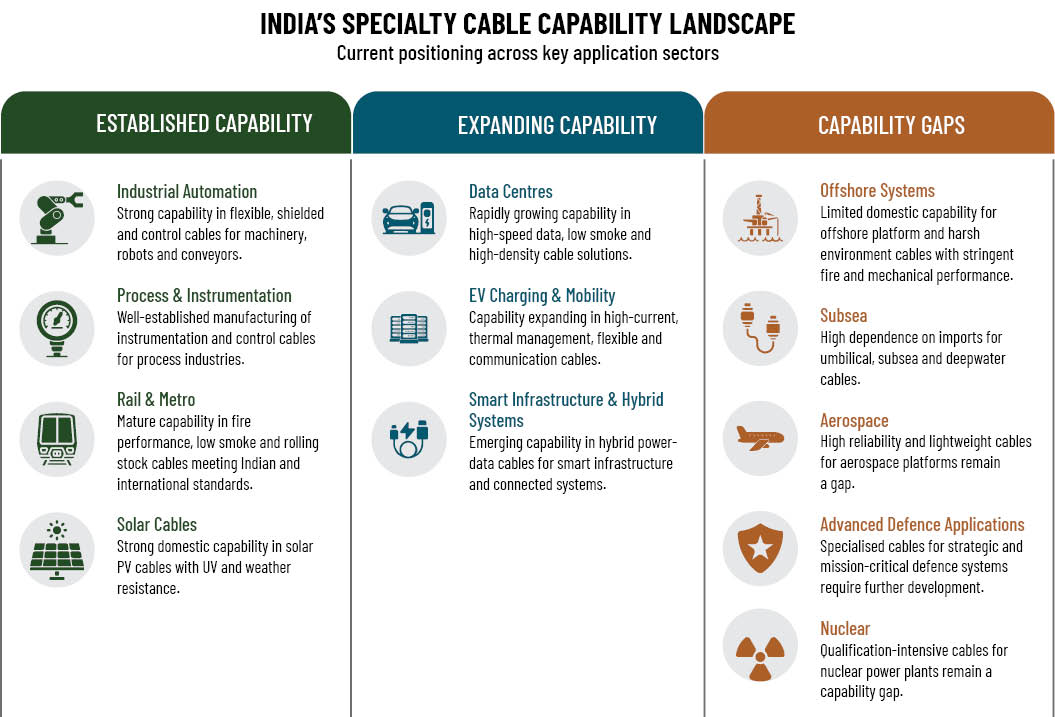
Manufacturers broadly agree that Indian capability has expanded, but their lists of remaining gaps are specific. Polycab identifies aerospace, automation, offshore oil and gas, offshore wind, subsea, railway rolling stock, automotive and EV, and electronics among advanced categories where import dependence remains. APAR points to defence, nuclear, offshore, rolling stock and high-end industrial automation, citing stringent performance requirements, specialised materials and complex qualification.
Cords says many products earlier imported can now be manufactured domestically, while gaps remain in subsea systems, certain defence applications and select advanced communication cables. KEI notes that “certain highly specialized cable categories, advanced compounds, and niche materials still rely on imports to varying degrees.”
Subsea and offshore systems combine specialised construction, materials and qualification. Rolling stock adds transportation standards, fire requirements and customer approvals. Defence and nuclear applications carry demanding environmental and validation requirements. The capability gap can sit across engineering know-how, material availability, testing and qualification rather than production capacity alone.
NAVANK argues that India’s capability is stronger in downstream compounding and application-specific customisation than in upstream specialty polymer production. It identifies specialty polyolefins, EVA and advanced LDPE systems used in XLPE, LSZH and semiconducting compounds as largely sourced from China, Korea and the Middle East. Flame retardants, antioxidants, peroxide crosslinking agents and UV stabilisers also remain connected to global supply chains. In NAVANK’s assessment, “the primary gap remains at the upstream specialty polymer manufacturing level.”
Other suppliers offer a less uniform picture. Taprath reports dependence on imported specialty polymers, performance additives and stabilisers. Teknor Apex says selected specialty polymers and formulation technologies continue to be sourced internationally for higher-performance applications. Fainplast, however, says the Indian market is “much less dependent on imported polymers,” with domestic players expanding their capabilities.
These assessments show that import dependence varies by material system and application rather than across polymers or compounds as broad categories.
Localization can also involve technology partnerships. Teknor Apex cites its PolyTek joint venture with Shriram PolyTech as a model “combining local manufacturing capabilities with global formulation and compounding technology expertise.” Such arrangements move production and technical support closer to Indian cable manufacturers without assuming that every formulation technology must originate domestically.
For manufacturers, developing a local cable is only part of the commercial equation. Engineering, prototypes, testing, certification, homologation and customer approvals can precede regular supply. Polycab describes specialty cables as requiring “long-term commitment, continuous investment in research and development, and deep technical expertise,” with significant effort required “before commercial success can be achieved.”
Customization adds cost and manufacturing complexity. KEI says qualification and customization costs can be significant in regulated sectors. RR Kabel links customised products with sustained investment in engineering, testing and quality systems. APAR notes that customers increasingly seek constructions tailored to particular operating environments.
These costs do not remove price pressure. Polycab reports increased competition and pricing pressure in railway rolling stock, automotive and EV, and shipbuilding and naval applications. KEI points to metal-price volatility.
Paramount sees simultaneous pressure around pricing, customization and quality. NAVANK says customers increasingly expect improved technical performance “without proportionate cost escalation.” Fainplast says suppliers unable to offer the lowest price must compete through “high quality or deeper customization of products.”
Qualification expenditure may therefore precede commercial orders, while customer-specific products require engineering and manufacturing flexibility. Smaller batches can complicate procurement and scheduling, and testing infrastructure must be maintained even where individual categories do not offer mass-market volumes.
Manufacturers also differ in their assessment of margins. APAR argues that higher qualification costs and technical expectations can support margin sustainability for companies capable of differentiated execution because product development, testing and certification raise entry barriers. Polycab is more cautious, acknowledging pricing pressure while emphasising quality, reliability and consistent delivery.
Specialty cables are not automatically a high-margin business. Technical barriers may protect qualified suppliers in some applications, while competition and price expectations remain strong in others. Commercial viability depends on qualification intensity, customization, competitive depth and the ability to spread engineering and testing costs across viable order volumes.
The same economics influence localization. Import substitution is more feasible where domestic demand can sustain material development, testing, qualification and repeat production. It is harder where applications are technically narrow, qualification cycles are long and local volumes limited.
The more useful measure of India’s specialty cable capability is therefore specific: which applications can be engineered, materially supported, manufactured, tested and qualified domestically at commercially sustainable volumes? Across data centres, automation, rolling stock, defence, offshore systems, EV charging and other critical applications, the answers already differ.