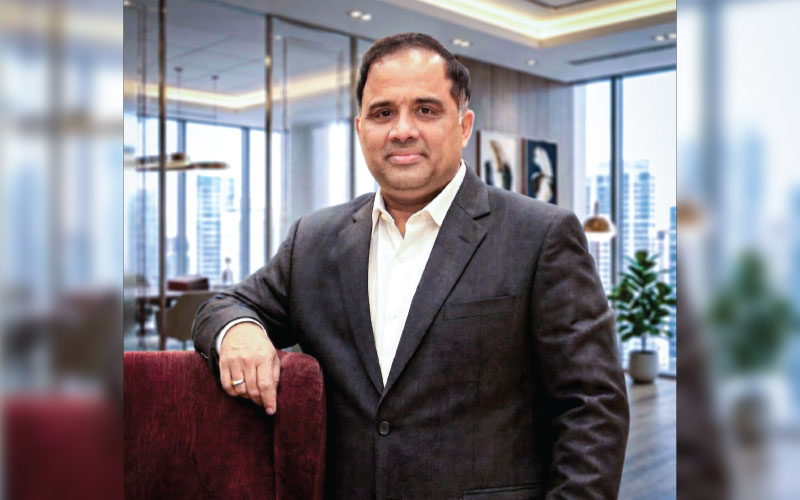
As India advances its infrastructure, renewable energy, electric mobility and digital connectivity ambitions, copper is emerging as a key enabler of the country’s industrial growth. Building resilient domestic manufacturing capabilities and integrated supply chains will be critical to meeting this rising demand. In an exclusive interaction with Wire & Cable India, Mr. Pramod C, Director, Gopalan Metals, discusses the evolving role of copper in India’s energy transition, the need to enhance domestic manufacturing and recycling capabilities, the advantages of an integrated manufacturing ecosystem, and the opportunities shaping the future of the country’s wire and cable industry. He also shares how Gopalan Metals is positioning itself to contribute to India’s vision of becoming a globally competitive and self-reliant manufacturing hub.
Wire & Cable India: To begin with, could you give us an overview of Gopalan Metals and Gopalan Wires & Cables, including your product portfolio, manufacturing capacities, key end-use industries, and market presence?
Pramod C: Gopalan Metals is a copper manufacturing company under the Gopalan Enterprises group. Established in 2023, we are headquartered in Bengaluru, with our manufacturing facility located in the KIADB industrial area in Hoskote. Our product portfolio spans the copper value chain, including copper rods, busbars, bare and tinned annealed copper wires, fine and superfine copper wires, bunched copper conductors, continuous cast copper rod(OFC), copper strip and premium OFC rod, and TPC-covered copper wires and strips conductor.
Under our Gopalan Wires & Cables vertical, we manufacture PVC insulated cables built on 99.97% pure copper conductors, offered in FR, HRFR, FRLS and ZHFR insulation grades and conforming to IS 694:2010, with conductors meeting IS 8130:2013. These cables are designed for fixed wiring in conduits and under plaster and for appliance wiring and distribution applications, with standard coil packing of 90m, 100m, 180m and 360m.
These products serve a wide industry base spanning power and electrical, automotive, telecommunications, construction and industrial manufacturing, transformers and switchgear, solar energy, railways, marine and defence, and precision electronics and robotics applications where high-purity conductivity is non-negotiable. Operationally, we run on an SAP-integrated backend across MM, PP, SD and FI/CO modules for real-time inventory tracking and precision scheduling, and we position ourselves as a high-responsiveness technical partner to OEMs and industrial clients rather than as a purely commodity supplier. We are actively expanding our footprint across domestic and international markets, with renewable energy and power distribution as key growth areas.
Watch: Top Cable Companies in India
WCI: Copper has become increasingly strategic for infrastructure, renewable energy, electric mobility, and digital connectivity. How do you see its role evolving in supporting India’s long-term growth?
PC: Copper is fast becoming one of the foundational metals of India’s next growth cycle, shifting from a conventional industrial input to a strategic enabler of the energy transition. The International Energy Agency has noted that renewable power infrastructure such as solar and wind requires between 2.5 and 7 times more copper than equivalent fossil-fuel-based generation, depending on the technology. Global refined copper demand itself is projected to reach around 33 million tonnes by 2035 and 37 million tonnes by 2050 under the IEA’s stated policy scenario, while the International Copper Association estimates demand could reach about 50 million tonnes by 2050.
In India specifically, the Centre for Social and Economic Progress projects copper demand in conventional sectors alone will reach 3.24 million tonnes by FY2030, with additional demand layered on from energy-transition uses such as EVs, grid infrastructure and renewables. On the mobility side, a battery electric vehicle uses significantly more copper than a conventional vehicle, largely for motors, batteries and wiring harnesses. With India targeting 500 GW of installed non-fossil power capacity by 2030, and having already crossed 262.74 GW as of November 2025, the grid, transmission and cabling build-out this demands places copper squarely at the centre of India’s infrastructure, mobility and digital connectivity story for decades to come.
WCI: Despite growing domestic demand, India continues to rely on imports for several copper products. What steps are needed to strengthen domestic copper manufacturing and achieve greater self-reliance?
PC: The self-reliance gap is real and widening. In FY2024-25, India produced approximately 497,000 metric tonnes of refined copper domestically, a 7.1% increase over the previous year, yet the country still imports over 90% of its copper concentrate requirement, a share projected to rise to as much as 97% by 2047. This gap traces back significantly to constrained domestic smelting and refining capacity, a shortfall that widened after a major smelter closure in 2018 that once met over a third of India’s refined copper demand.
Closing this gap needs sustained investment across the value chain, not only at the mining end, and that investment is underway. New smelting capacity is also coming online, alongside a stronger push toward domestic copper recycling and organised scrap collection as a supplementary raw-material source, since global mine supply alone will not keep pace with demand. For manufacturers like us further down the value chain, in wires, cables and conductors, this upstream investment is what will eventually translate into more stable domestic cathode and rod availability.

Under our Gopalan Wires & Cables vertical, we manufacture PVC insulated cables built on 99.97% pure copper conductors, offered in FR, HRFR, FRLS and ZHFR insulation grades and conforming to IS 694:2010, with conductors meeting IS 8130:2013.
WCI: Supply chain resilience has become a key priority for manufacturers. How can India’s copper and wire & cable industry reduce import dependence while building a more robust and competitive supply chain?
PC: Resilience here needs to be built on two fronts: reducing concentration in import sources and strengthening the secondary, recycled-copper stream. A stock-and-flow study developed by Fraunhofer ISI for the International Copper Association found that India currently sources less than half, around 46%, of the copper needed for semi-finished and finished goods from primary (mined and refined) routes, with the remaining 54% coming from secondary sources, largely the recycling of new and old scrap. That secondary route is a genuine strategic asset, though it needs more organised, formal recycling and e-waste recovery infrastructure to scale it responsibly and consistently.
At the same time, import dependence currently concentrated among a handful of source countries needs geographic diversification, faster ramp-up of announced domestic smelting and mining capacity, and continued policy support for native refining. The IEA’s own modelling under its Net Zero Emissions scenario points to a nearly 20% supply deficit, equivalent to about 6 million tonnes globally, by 2030 if energy-sector demand alone grows as projected, so this isn’t a challenge unique to India but one where early investment in resilient, integrated domestic capacity becomes a genuine competitive advantage.
WCI: How does an integrated manufacturing ecosystem—from copper processing to finished wires and cables—help improve product quality, operational efficiency, and supply consistency?
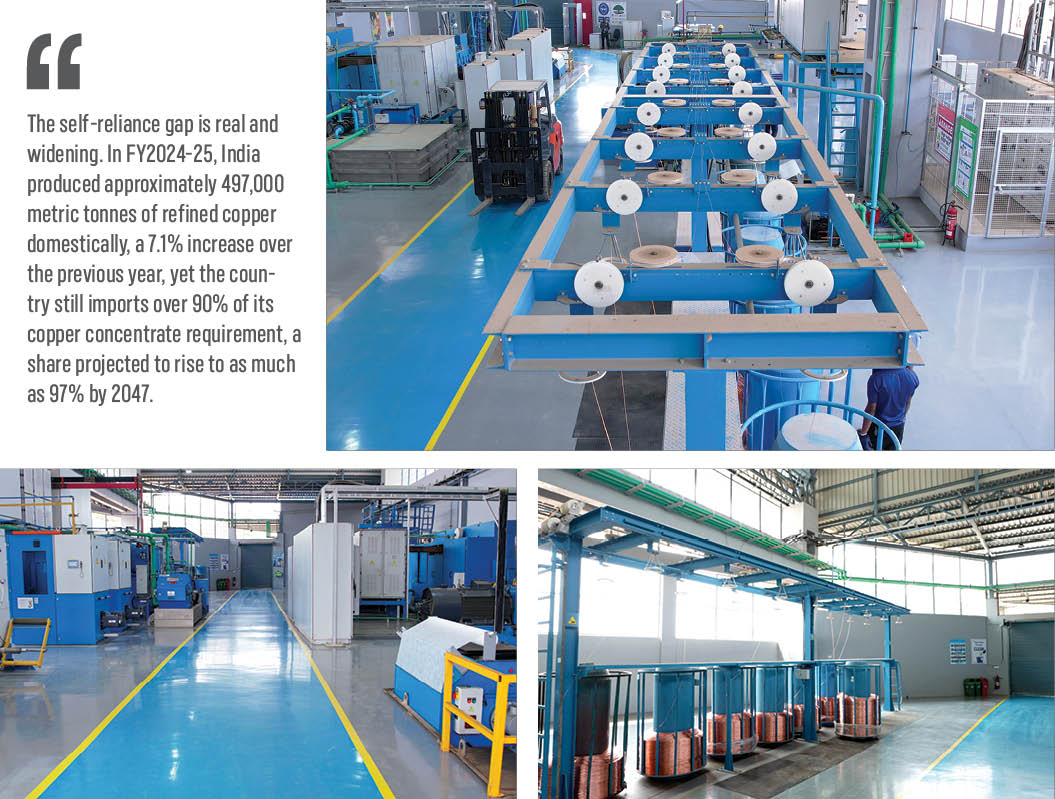
PC: An integrated ecosystem from the copper rod to the finished wires and cables gives the manufacturer far tighter control over the variables that determine quality: conductivity, consistency of draw, insulation adhesion and dimensional accuracy. Integrating wire drawing, annealing, tinning and cable extrusion within the same rod-casting framework eliminates handoff losses, minimises third-party variability and speeds up root-cause resolution.
Our own operations reflect this, as we track the entire production lifecycle through an SAP-integrated digital backbone spanning materials management, production planning, sales and distribution, and finance, which gives us real-time visibility into raw material and finished goods movement rather than periodic vendor updates and supports a just-in-time, zero-defect manufacturing approach. Cable manufacturers running large infrastructure or utility orders cannot afford input volatility, whether that’s price volatility on purchased rod or lead-time volatility from an external supplier, and an integrated, digitally tracked setup lets us plan production schedules against firm input availability rather than external market timing, supporting the large-volume, on-time delivery expectations that construction, power and infrastructure buyers increasingly demand.
WCI: As customer expectations continue to evolve, how important are technology, process control, and quality assurance in ensuring Indian manufacturers meet both domestic requirements and global benchmarks?
PC: Technology, process control and quality assurance are non-negotiable if Indian manufacturers are to be seen as equal to global benchmarks, rather than as lower-cost alternatives. Our copper rods are produced from high-purity electrolytic copper to guarantee excellent conductivity and corrosion resistance. All products are subjected to rigorous testing and process control in-house prior to dispatch.
On our cable lines we apply modern extrusion technology to maintain insulation thickness and heat resistance uniformity. Our cables are produced to meet IS 694:2010, conductors meeting IS 8130:2013 Class 2 and Class 5 specifications, tested against parameters such as oxygen index, temperature index and heat-shock resistance, rather than merely meeting basic pass-or-fail criteria.
As buyer sophistication increases, particularly among EPC contractors and utility procurement teams executing under the government’s renewable energy and transmission build-out, so does scrutiny at every stageraw material traceability, in-process testing, and third-party certification. A structural shift is also happening in India’s wire and cable market from unorganised regional manufacturing to BIS-certified, organised players. Mandatory BIS certification is nudging institutional buyers towards manufacturers that can demonstrate consistent process discipline. Investment in testing infrastructure and certification is no longer a differentiator; it is baseline table stakes to win and retain large accounts.
WCI: With India’s manufacturing ecosystem expanding rapidly, what opportunities do you see for domestic wire and cable manufacturers across sectors such as power, renewable energy, telecom, construction, and electric mobility?
PC: The opportunity in front of Indian wire and cable manufacturers right now is genuinely broad-based. Mordor Intelligence estimates the India wire and cable market at USD 23.13 billion in 2026, growing at a 9.01% CAGR to reach USD 35.58 billion by 2031, with utility projects tied to India’s 500 GW non-fossil capacity target creating multi-year procurement pipelines for extra-high-voltage products. The insulated wire and cable segment specifically is projected to grow from USD 8.1 billion in 2025 to USD 12.6 billion by 2034.
Sector by sector, the drivers are distinct but all point the same way. In power, transmission and distribution network expansion tied to the renewable build-out is generating sustained EHV and MV cable demand. In telecom, India’s BharatNet program is extending fibre connectivity to 250,000 village councils, underpinning long-run demand for both fibre- and copper-based network infrastructure. In construction, roughly 600,000 new urban homes completed in 2023 alone are driving demand for flame-retardant, low-smoke housing wire in premium residential and commercial projects. And in electric mobility, rising EV production, where a battery electric vehicle can use well over twice the copper of a conventional vehicle, is creating an entirely new demand category for high-performance conductors and charging infrastructure cabling. Beyond these, we’re also seeing steady demand build in railways, defence and marine, and precision segments like 5G telecom, robotics and microelectronics, where fine and super-fine copper wire accuracy is critical.
For Gopalan Metals specifically, renewable energy and power distribution are priority growth areas as we expand our domestic and international footprint, alongside a broader push to diversify our portfolio for evolving electronics and automotive standards.
Also Read: Wire & Cable India Emagazine Sep-Oct Issue 2026
WCI: Looking ahead, what will be the key drivers for India to emerge as a globally competitive player in the copper and wire & cable value chain, and how does Gopalan Metals intend to contribute to this vision?
PC: India’s way to become a player in the copper and wire and cable industries depends on a few important steps: increasing the speed of building smelting and refining capacity in the country to cut down on importing copper concentrate and cathode; creating a better-organised and bigger system for recycling copper; keeping investing in process technology and testing facilities to meet global quality standards; and having consistent policies that let manufacturers feel safe to invest in long-term projects.
At Gopalan Metals, our role is to create this model that focuses on quality from copper rods to finished wires and PVC cables. We use an SAP-based system and follow the strict standards and testing rules that big companies now expect as a basic requirement. Our goal matches with the government’s Make in India and Atmanirbhar Bharat plan. We make quality, accurate copper products locally to cut down on importing and to help the country’s manufacturing system grow stronger. As India’s power, renewable energy, telecom, construction and electric mobility industries grow together, our long-term aim is to be known around the world as one of the most trusted copper manufacturers. We want to be known for our technology and for helping the industry reduce its need for imported copper products, one product area, at a time.
Sources provided by the company:
https://csep.org/reports/the-copper-report-navigating-through-the-demand-and-supply-gap/
https://www.pib.gov.in/PressReleasePage.aspx?PRID=2209478®=3&lang=1
https://www.icicidirect.com/research/equity/finace/details-about-copper-industry-in-india
https://www.iisd.org/system/files/2024-07/securing-india-copper-supply.pdf
https://www.mordorintelligence.com/industry-reports/india-wire-and-cable-market