Cable manufacturers are asking extrusion lines to process more materials, products and applications at higher output and tighter tolerances. The focus is on process stability, material-specific engineering, measurement, control and lifecycle economics.
Cable extrusion is being asked to accommodate a wider production envelope. Manufacturers are processing more polymers, developing specialised cable constructions and serving applications with tighter dimensional and performance requirements. At the same time, pressure for higher output, material efficiency and lower operating costs remains high.
The result is a narrower and more demanding process window. HFFR and LSZH compounds can bring higher filler loading, different rheological behaviour and greater sensitivity to thermal conditions. XLPE and related materials introduce different requirements around dispersion, residence time, cooling and curing. Thermoplastic elastomers, PUR and engineering polymers add further processing requirements.
These requirements are influencing machinery design itself. Screw and barrel geometry, feeding, thermal management, tooling, cooling, curing and process control are increasingly being considered in relation to the material and application rather than as independent machine elements.
Dr. Mikko Lahti, R&D Director, Maillefer, describes the operating challenge in similar terms. “Today’s extrusion systems must cope with an unprecedented range of cable constructions, materials and application requirements.” He points to automotive electrification, renewable energy, HVDC transmission, data communication and fire-safe building cables as applications placing greater demands on materials, tolerances and production conditions.
As cable designs become more material-efficient, acceptable process variation also becomes smaller. Maintaining output linearity, temperature control and dimensional consistency therefore becomes more consequential.
Watch: Top Cable Companies in India
Material Behaviour Is Reshaping the Machine
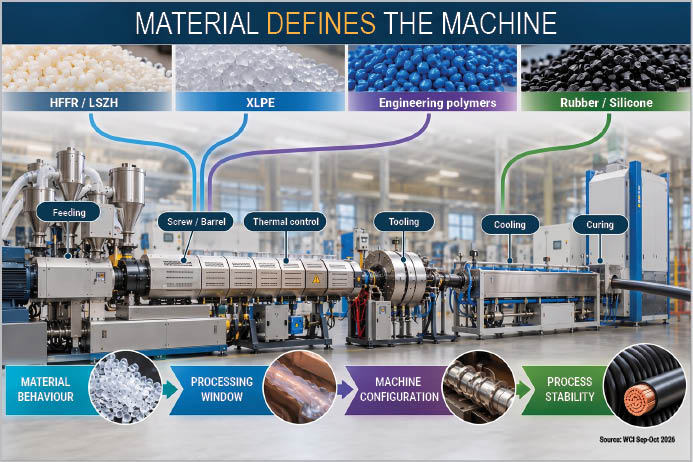
Material characteristics increasingly determine extrusion-system configuration.
HFFR and LSZH compounds are a clear example. Their formulations can contain high levels of mineral fillers, affecting melting, pressure management, thermal behaviour and wear. Davide Costabile, Area Manager, Wire & Cable Division, MFL Group, links this processing window to screw and extruder design, tooling, temperature control, cooling and overall line configuration. “…extrusion equipment can no longer be designed around a single ‘standard’ material,” he says.
Moisture control is another process variable that becomes more important with moisture-sensitive materials. Vijay Chaudhry, Chief Executive Officer, Bry-Air (Asia) Pvt. Ltd., highlights the role of controlled drying and low-dew-point air in achieving consistent material conditions before extrusion, particularly for polymers such as PBT and PA/nylon. For FRLS and ZHFR compounds, he also points to dehumidification as part of material conditioning before processing.
XLPE presents another set of requirements. Dispersion, temperature control and cooling influence the final properties of the material, while thermoset applications bring curing into the machinery equation. Rubber, silicone and other specialised materials similarly require process-specific approaches.
For machinery builders, this makes the extrusion line an engineered process system rather than a generic platform. Screw geometry, feeding characteristics, melt temperature, pressure, tooling and cooling have to work together within the processing window of the material.
Curing technology adds another dimension to the machinery equation. Thermoset, rubber and silicone applications can require different curing approaches, including steam, infrared and continuous vulcanisation systems. The machinery challenge therefore extends beyond melt preparation and shaping to the controlled development of the cable’s final material properties. Reji Koshy Daniel, Executive Director, Royle Extrusion Systems Private Limited, adds: “Cable manufacturers may be wise to discuss their requirements with extrusion system manufacturers who offer all types of curing system solutions.”
This also makes process engineering increasingly important alongside mechanical design. A machine can have sufficient installed capacity, but its commercial performance depends on how consistently it maintains the required process conditions.
Flexibility Has Limits
Manufacturers increasingly want extrusion lines that can accommodate changing products and materials. This is partly an economic requirement. A line that can process several product families can spread capital investment across a broader production base and reduce the risk of equipment becoming underutilised as product demand changes.
Vivek Mehta, Managing Director, Sai Extrumech Pvt. Ltd., points to plants increasingly moving between materials such as PVC, HFFR and XLPE. Vivek Kohli, Director, Supermac Industries (India) Limited, says the company designs lines with configurable single-, dual- and triple-extrusion arrangements, depending on the product and customer requirement.
Flexibility, however, has limits. A line designed to accommodate multiple materials still needs appropriate screws, tooling, temperature settings and downstream configurations. More demanding applications can therefore require dedicated arrangements rather than simply broader machine capability.
Sandip Bhuva, CEO, Rajoo Bausano Extrusion Private Limited, describes movement toward modular and configurable systems. He relates equipment configuration to material, product geometry and production requirements rather than assuming a standard line for every application. Rajoo Bausano’s contribution focuses substantially on compounding extrusion.
Flexibility does not mean that every material can be processed under the same conditions. It means that the machinery can accommodate different defined process windows without compromising stability.
The balance is between platform flexibility and application-specific optimisation. The more specialised the cable, the greater the importance of getting that balance right.
Speed Is Useful Only When the Process Remains Stable
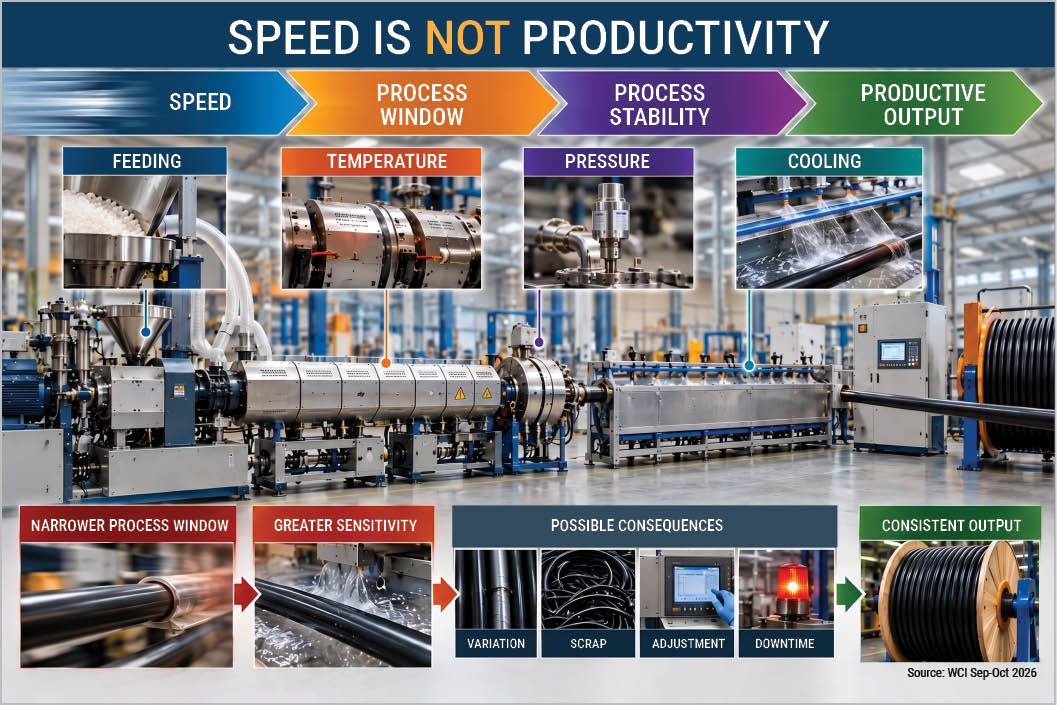
Line speed remains a major performance parameter. The more important distinction is between nominal speed and productive output.
As throughput increases, the available process window can become narrower. Small changes in feeding, melt temperature, pressure or cooling can affect dimensional stability and product quality. The resulting scrap, adjustment time or downtime can offset the additional output obtained from running faster.
Dr. Lahti puts the trade-off directly: “The most common trade-off arises when manufacturers seek higher line speeds without compromising dimensional accuracy, concentricity or insulation quality.” Maillefer’s position is that output stability is a major contributor to production economics. Stable extrusion across the operating range can support higher productivity with lower scrap, fewer operator interventions and stronger overall equipment effectiveness.
Sandip Bhuva makes a similar point from the compounding extrusion side. As throughput increases, the process window narrows, and variations in feeding, temperature, pressure or cooling can influence granule quality.
The same principle applies downstream. A higher production rate has limited value if the resulting product requires greater intervention, produces more scrap or creates additional downtime.
Productivity is therefore increasingly evaluated through the combination of output, quality, availability and resource consumption, rather than through line speed alone.
Higher speed requires coordinated control of the extruder, thermal system, tooling, cooling, cable tension and downstream equipment. Improving one component without maintaining stability across the complete line can simply move the constraint elsewhere.
Measurement Is Becoming Integral To Production
A narrower process window is increasing the importance of measurement and faster correction. Online diameter measurement, wall-thickness monitoring, eccentricity measurement, gravimetric feeding and closed-loop process control are becoming more closely integrated with production.
Sai Extrumech highlights laser-based measurement and feedback as an example. Instead of relying entirely on downstream inspection to identify dimensional drift, online information can detect deviations while production is continuing. Supermac similarly identifies online diameter control and automatic process adjustment as important developments.
That is different from treating automation as a collection of sensors or PLC functions. The value comes when measurement is connected to a control response.
The same approach extends to material feeding and thermal management. Gravimetric systems can improve consistency in material consumption, while process monitoring can identify temperature or pressure changes before they develop into larger quality problems.
For cable manufacturers operating with tighter tolerances, a shorter correction cycle has direct economic value. Less variation can mean lower material loss, fewer interruptions and more consistent output.
Digital Capability Is Ahead of Digital Utilisation
Digitalisation is now embedded in extrusion-equipment development, but its implementation remains uneven.
MFL Group’s Davide Costabile describes the gap clearly: “The gap we still see is not really a lack of technology. It is the ability to turn data into operational decisions.”
Production systems can collect large amounts of information on temperature, pressure, speed, torque, energy consumption, quality and machine performance. The more difficult task is converting that information into decisions on the production floor.
Maillefer’s Dr. Mikko Lahti identifies advanced data acquisition, process monitoring and data-driven optimisation as areas already delivering measurable benefits, while noting that the industry’s ability to fully use available production data remains incomplete.
The immediate value lies less in collecting more data than in making existing data actionable. Predictive maintenance, OEE monitoring, process analysis and quality-deviation detection all depend on the same underlying capability: linking machine information with an understanding of the process.
AI has a role in the machinery discussion, but its application depends on the availability and quality of process data. Davide Costabile and Sandip Bhuva describe AI-based analysis and monitoring capabilities, while Reji Koshy Daniel points to the limited data and experience available for emerging compounds, which makes it harder to define and trust AI-based systems.
The evidence points to a gradual progression from monitoring to interpretation and then to automated correction, rather than a wholesale move to autonomous extrusion.
Operator capability remains part of this equation. The need for training and process knowledge persists even as machine interfaces become more intuitive. Automation can reduce intervention, but it does not remove the need to understand why a process is behaving differently.
The Economics Extend Beyond the Purchase Price
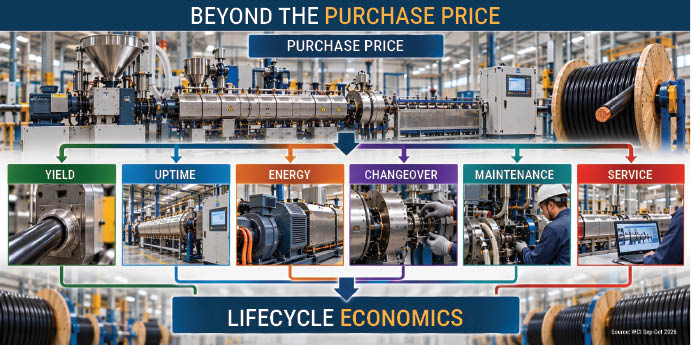
The economics of an extrusion line extend well beyond its purchase price. Total cost of ownership is increasingly associated with scrap, energy consumption, uptime, maintenance, changeover time, spare parts, service support, reliability and machine life.
Costabile describes the investment value of an extrusion line in these terms, with customers examining downtime, maintenance requirements, changeover performance and long-term reliability alongside productivity.
Bhuva identifies output, specific energy consumption, product consistency, availability, changeover time, maintenance, raw-material utilisation, automation and technical support as factors affecting TCO.
This changes the way machine performance should be assessed. A line with a lower purchase price can become more expensive to operate if it generates higher scrap, requires longer changeovers or suffers extended downtime while waiting for parts or service. Conversely, higher initial investment can be justified when it produces measurable gains in yield, uptime, energy use or product consistency.
Royle Extrusion Systems’ emphasis on MTBF and MTTR reinforces this relationship. Reliability is not simply a maintenance attribute. It affects production availability and therefore the economics of the installed asset.
Energy efficiency is part of the same calculation. Sandip Bhuva identifies specific energy consumption as an important operating consideration, while Davide Costabile links energy performance with thermal efficiency, machine loading, start-up losses and stable processing.
This broader view also makes upgradeability relevant. A machine that can be modified as product requirements change can protect the value of the original investment, particularly where product portfolios are evolving.
The commercial value of an extrusion line therefore extends across its operating life. The relevant output is not simply kilograms or metres produced, but conforming product produced consistently and economically.
Applications are Changing Equipment Choices
The diversification of cable applications is reinforcing these requirements. Automotive cables place emphasis on thin-wall insulation, dimensional accuracy and material efficiency. Data communication cables require particularly consistent dimensions and process precision. Renewable energy and EV applications are increasing demand for materials and constructions with specific thermal, electrical and environmental performance requirements.
Railway and building applications are important drivers for LSZH and HFFR processing. Medium- and high-voltage cables bring different requirements around XLPE processing, curing and cleanliness. Silicone and rubber applications introduce their own curing and process-control requirements.
These applications therefore influence more than material selection. They affect screw configuration, crossheads, tooling, cooling, curing, measurement and downstream handling.
Dr. Mikko Lahti describes an increasingly application-oriented approach, with specialised crossheads, optimised extruders, measurement systems and process-specific production concepts. Davide Costabile points to applications ranging from conventional power and low-voltage cables to wind-power and specialised automotive cables, including high-performance PEEK-insulated applications. Sandip Bhuva describes machinery configured around material characteristics, product geometry and production requirements, supported by rheological analysis and process testing.
Application diversification is therefore increasing the number of process configurations that machinery builders need to engineer reliably.
Standardisation Still Has a Place
Greater application complexity does not mean every extrusion line must become increasingly customised.
Rosendahl’s standardised approach to common low-voltage cable applications provides an important counterpoint. Where product requirements are sufficiently repetitive, standardised machinery can reduce engineering complexity and investment requirements while maintaining defined production capability.
This creates two valid equipment strategies. For specialised products, manufacturers may need configurable or highly engineered systems capable of handling demanding materials and tight process windows. For repeatable, high-volume products, standardisation can provide a different route to economic efficiency.
Machine architecture therefore needs to match production requirements rather than treating flexibility or customisation as universal objectives.
Also Read: Wire & Cable India Emagazine Sep-Oct Issue 2026
Managing Complexity Economically
Cable manufacturers are asking lines to handle more materials, more constructions and more demanding applications. They are also asking for higher output, tighter tolerances and lower operating costs.
Machinery development is responding through material-specific screw and tooling design, tighter thermal management, more specialised curing systems, online measurement, closed-loop control, digital monitoring and greater attention to reliability and lifecycle cost.
The resulting equipment is more closely integrated with the process it is expected to perform.
Material behaviour influences the processing window, which influences machine design. Machine design and control influence stability. Stability affects yield, downtime and quality. Together, these factors determine the economics of the line.
The most useful measure of an extrusion system is its ability to maintain stable, repeatable and economically viable production under the material and application conditions for which it is installed.