

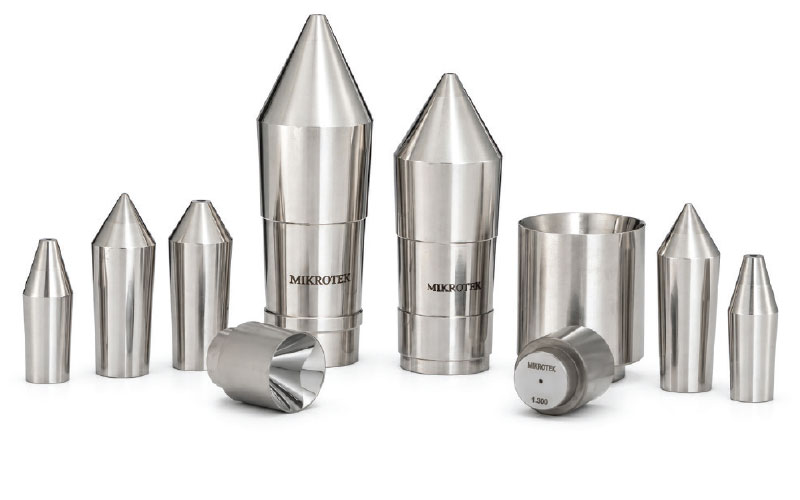
In the wire and cable industry, achieving impeccable insulation quality starts with the precision of extrusion tools that shape every layer of cable insulation. As manufacturers push for faster production speeds, tighter tolerances, and superior product reliability, the role of advanced extrusion tooling becomes increasingly critical to ensure consistent, high-performance cable manufacturing. Built with high-quality materials and precision design, these extrusion tools ensure durability, consistent output, and reliable insulation across cable sizes ranging from 4 mm to 175 mm.
Watch: Top Cable Companies in India
As production speeds increase and cable specifications become more demanding, the precision of extrusion dies, tips and allied tooling has a direct influence on process stability and product quality. A well-designed tooling system ensures controlled polymer flow around the conductor while maintaining the required geometry throughout the extrusion process.
The extrusion die controls the final shape and dimensions of the insulation or jacket, while the tip guides and positions the conductor within the extrusion flow.
Together, they must provide- Accurate conductor centering, uniform insulation thickness, stable polymer flow, consistent dimensions, smooth surface quality and reliable performance at high production speeds. Surface finish is equally important. A precisely finished tooling surface promotes smoother polymer flow and helps minimize material build-up and surface imperfections.
Application-Specific Tooling
Different wire and cable constructions require different tooling solutions. Tooling design may vary according to conductor material and diameter, solid or stranded construction, insulation material, single- or multi-layer extrusion, production speed, dimensional tolerance and surface-quality requirements. Applications involving PVC, PE, XLPE, LSZH and other cable compounds may therefore require application-specific die and tip configurations.
The simplified extrusion tooling process involves the conductor passing through the tip, followed by polymer flow through the die bearing, resulting in the finished insulation. Proper die–tip alignment is therefore essential for maintaining concentricity and consistent insulation coverage.
Also Read: Mikrotek Enamelling Dies: Driving Defect-Free Coating & Superior Insulation Performance
Material Selection and Surface Finish
Tooling material must be selected according to the application, polymer, production speed, wear conditions, and required service life. PCD, tungsten carbide, high speed steel and stainless steel are among the materials used for different extrusion tooling applications.
Material selection should consider not only hardness, but also- wear resistance, toughness, polishability, insulation speed, chemical compatibility, operating conditions and reconditioning potential. Surface finish is equally important. A precisely finished tooling surface promotes smoother polymer flow and helps minimize material build-up and surface imperfections.
Mikrotek’s extrusion tooling solutions are integral to manufacturing a wide array of cables—from power cable manufacturing, building wires, automotive wiring harnesses, EV charging cables, renewable energy cables, control cables, instrumentation cables, telecommunication cables, fiber optic cable manufacturing, aerospace and defence, railway and transportation, and industrial automation.
As the global wire and cable industry advances toward higher standards of quality and manufacturing excellence, the demand for precision-engineered extrusion tooling continues to grow. With a legacy built on innovation, technical expertise, and uncompromising quality, Mikrotek continues to pioneer advancements in cable insulation technology—delivering precision in every layer and performance in every cable.