
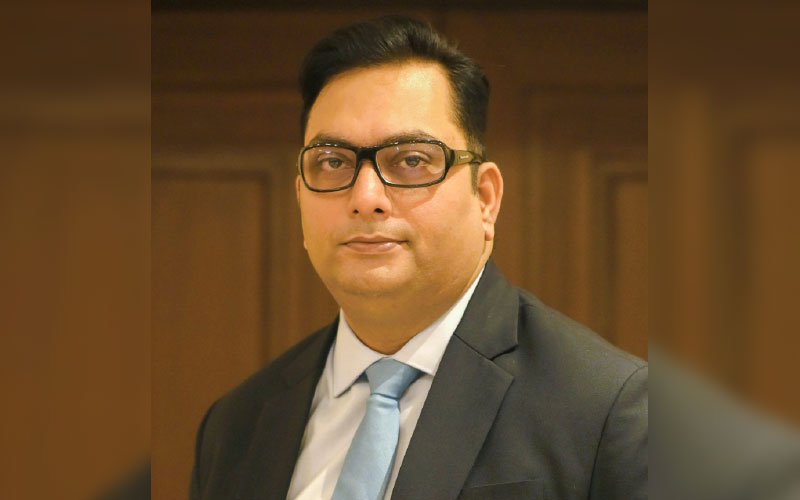
As downstream industries increasingly demand consistency, performance, and application-specific solutions, wire rod manufacturers are shifting toward value-added offerings. In an exclusive interaction with Wire & Cable India, Mr. Ravish Sharma, CEO & Whole Time Director, ESL Steel Limited, highlights how backward integration, stringent process control, and customized metallurgy enable ESL to deliver high-quality wire rods across diverse applications—while positioning itself as a technical partner focused on performance outcomes rather than just commodity supply.
Wire & Cable India: Could you outline your current wire rod portfolio in terms of grades (low carbon, medium carbon, high carbon, special grades) and how these cater to downstream applications such as construction wires, automotive components, and general engineering?
Ravish Sharma: ESL’s wire rod portfolio spans low-carbon commodity grades to high-carbon and customised specialty grades, strategically aligned to serve various segments —supporting both volume continuity and value-led growth. The intent is to demonstrate grade differentiation, application fit, and value-added focus, rather than only commodity supply.
Our special & value-added wire rod grades like Boron, En31, Co2, Em12K caters segments of specialised fasteners, automotive subcomponents, general engineering application & welding electrodes. We have developed customer specific chemistry for large wire producers to downstream process stability, exceed quality expectations and improve yield at downstream.
Our medium and high carbon grade wire rods are used in applications like – wire ropes, tyre reinforcement, automotive cables, suspension springs, construction (LRPC/PC Strands), cables, general engineering, automotive/tractor components. We emphasize carbon uniformity and mechanical consistency. Our strong focus is on drawability, tensile strength & internal cleanliness.
Watch: Top Cable Companies in India
WCI: A large portion of the Indian market still consumes commodity-grade wire rods for basic applications. How does ESL differentiate between commodity and value-added/specialty wire rod offerings in terms of metallurgy, process control, and consistency? Additionally, how do these differences influence performance in downstream wire drawing and end-use applications?
RS: In the Indian market commodity grade wire rods are used for general applications and mainly cost focused whereas value added / specialty wire rods are application specific and used for critical applications. In terms of metallurgy, ESL offers a narrow and very controlled range for carbon & other alloying elements. Provides clean steel and inclusion controls with consistent mechanical properties.
ESL provides process friendly wire rods by maintaining discipline across mill, precision rolling, controlled cooling, reducing surface defects and scale. Our stringent process controls across all levels helps us to achieve consistency in heat-to-heat properties. This allows our customers to standardize their drawing sequence, increase productivity and achieve desired quality in finish wires.
WCI: Which end-use sectors are currently driving demand for your wire rod products—construction, infrastructure, automotive, fasteners, or others? Are you seeing a shift toward higher-grade or application-specific requirements?
RS: Our high carbon grade wire rods are mainly driven by demand in – infrastructure, constructions, railways, power, pre-cast structures, bridges, wire ropes, automotive/industrial springs & various auto cables. Our value added & cold heading quality wire rods are mainly driven by demand in automobile, fasteners, welding electrodes, ball bearing & general engineering applications. ESL is seeing a shift from generic specifications to performance driven and application focused wire rods.

As we are a fully integrated steel plant, our biggest advantage is we have complete control over chemistry, our process route allows us to refine steel and control inclusions, produce application specific chemistry, maintain consistency in heat-to-heat chemistry. Our downstream customers get stable mechanical properties across the coil and they can predict coil-to-coil behavior due to similarity in heats.
WCI: What are the most critical quality parameters in wire rod production—such as chemistry control, surface quality, decarburization, and inclusion control? How do these parameters impact the efficiency and quality outcomes for customers engaged in downstream wire drawing and processing?
RS: Chemistry control sets basic microstructure and strength which provides stable wire drawing, increases productivity, standardised processing and lowers processing cost. Surface quality is one of the first parameter customers feel on the shop floor. High Surface quality enables higher drawing speed, reduces pickling acid consumption or die usage, lowers scrap and provides better finish in downstream products. Inclusion control provides stable & smooth wire drawing, excellent upset ratio while cold heading and provides reliability.
WCI: What specific technologies and process controls have you implemented in your wire rod mill (e.g., controlled rolling, cooling systems, online inspection) to ensure consistent quality? How do these capabilities support the production of wire rods suitable for more demanding downstream applications?
RS: Morgan enhanced cooling system encourages uniform cooling of rods and mechanical properties. Online rod gauges installed at various points enable active monitoring & control of sectional dimensions for narrow tolerance range. Our adjustable controlled cooling conveyors, grade specific cooling processes and monitoring systems allow us to produce application specific wire rods such as springs, PC, LRPC, wire ropes, cold heading quality grade rods with smooth wire drawing. With technology and process control ESL delivers process friendly and application focused wire rods which help customers to optimise productivity, quality.
WCI: As a backward-integrated steel manufacturer, ESL has greater control over raw material inputs and billet quality. How does this integration help in maintaining consistency in wire rod production, especially compared to non-integrated players who depend on external billets?
RS: As we are a fully integrated steel plant, our biggest advantage is we have complete control over chemistry, our process route allows us to refine steel and control inclusions, produce application specific chemistry, maintain consistency in heat-to-heat chemistry. Our downstream customers get stable mechanical properties across the coil and they can predict coil-to-coil behavior due to similarity in heats. They can cater to the requirements of critical value-driven applications with better productivity and desired quality. ESL is acting as a technical partner for our customers rather than just a traditional vendor.
WCI: Wire rod is a relatively margin-sensitive product, especially in commodity segments. How do fluctuations in raw material costs (iron ore, coal, power) impact ESL’s wire rod business, and what strategies are in place to protect margins—particularly when catering to price-sensitive downstream wire manufacturers?
RS: Fluctuations in costs of iron ore, coal/coke, and power have a direct and often immediate impact on margins. As ESL is a fully integrated steel plant our backward integration mitigates the cost volatility. We have better control over cost timings and averaging. Our internal cost control initiatives & energy efficiency improvement, tighter process controls, yield improvement initiatives further support RM fluctuations.
During crucial times our focus is to optimize product mix and more focus on specialty steel products where realization is higher. Our long-term volume-based contracts with downstream wire manufacturers help us in better forecasting, volume assurance & balancing spot variations. Our services to downstream wire manufacturers in terms of consistency in quality, delivery, grade and size optimization to meet customer’s urgency, technical/ application support & positive approach towards new product developments makes ESL a valued partner.
This balanced approach allows ESL to remain competitive with price sensitive wire manufacturers while safeguarding margin cycles.
Also Read: Nirmal Wires Shifts Focus to Custom Steel Wire Solutions
WCI: Going forward, does ESL plan to increase its focus on higher-margin, specialized wire rod grades or explore deeper integration into downstream wire/value-added products? What are the key growth priorities for the wire rod segment within ESL’s broader strategy?
RS: Instead of selling just steel, ESL’s wire rod strategy increasingly revolves around selling a performance outcome, protecting margins through consistency, customisation and customer partnership.
Going forward ESL’s wire rod strategy is clearly focused on value addition. The incremental growth focus shifting towards specialised grades and fulfilling application critical grades. ESL is expected to increase its share in high carbon & alloy grade wire rods, welding electrode segment, fastener quality wire rods & customized chemistry requirements of large wire producers.