
The Indian steel wire industry is steadily moving beyond commodity production toward higher-performance, application-specific products. This is being shaped by tighter metallurgy control and greater process precision. Advanced coatings, automation, and evolving end-use requirements are further redefining manufacturing priorities across the industry.
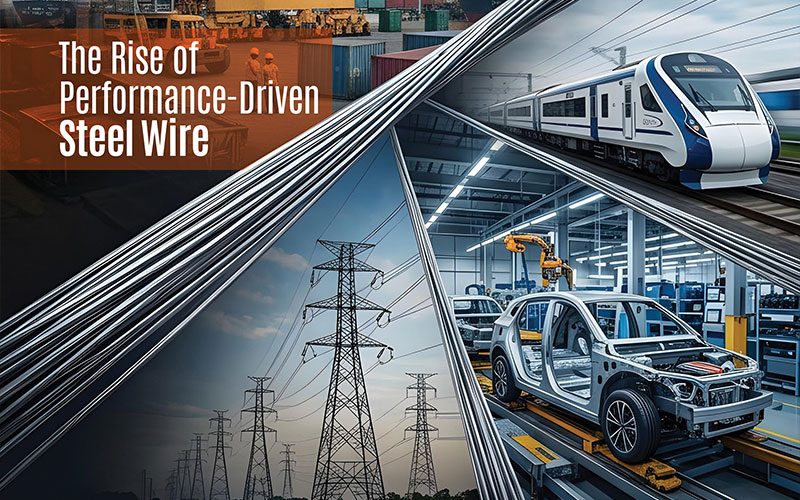
For decades, large portions of the sector remained centered around commodity products such as binding wire, fencing wire, and general-purpose low-carbon drawn wire, where scale and cost competitiveness largely defined market positioning. That structure is gradually changing. Across infrastructure, automotive, engineering, lifting, and transmission applications, demand is increasingly moving toward products that require tighter dimensional tolerances, superior fatigue behavior, higher corrosion resistance, and far greater process consistency.
Steel wire is increasingly expected to deliver higher reliability and longer service life. In many applications today, wire is no longer merely an intermediary input; it is becoming a performance-sensitive material whose reliability directly influences structural life, operational safety, and maintenance cycles. As a result, manufacturers are steadily moving beyond conventional commodity production toward more specialized and application-oriented products supported by tighter metallurgy control, advanced processing technologies, coating systems, and automated quality monitoring.
The Indian steel wire industry, currently estimated at roughly 5.5–6 million tonnes annually, continues to grow alongside infrastructure expansion, railway modernization, automotive production, power transmission investments, and industrial manufacturing. However, the more important transformation now lies not simply in production growth, but in the changing nature of demand itself. Increasingly, competitiveness is being shaped by process capability, consistency, and application-specific performance rather than volume alone.
According to Systematic Group, the company’s focus has increasingly shifted toward “developing application-oriented steel wire solutions rather than only producing commodity wires.” Similarly, Mukand Ltd. emphasizes its concentration on “application-specific, high-performance alloy steel long products” designed for demanding industrial applications.
Watch: Top Cable Companies in India
Beyond Commodity Wire
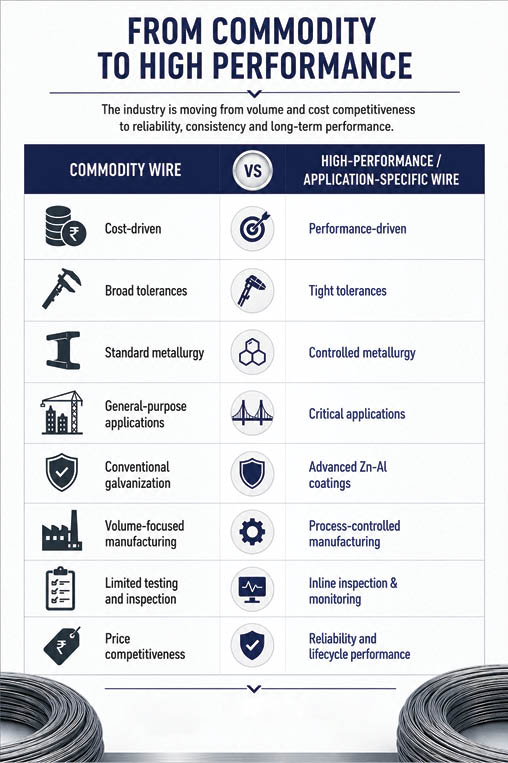
The distinction between commodity wire and specialized wire products has become one of the defining structural divides within the industry. Commodity products continue to occupy a significant share of the market, particularly in general construction and low-end industrial applications where broader tolerances and standard metallurgical specifications remain acceptable. Specialized wire products, however, operate under a fundamentally different manufacturing discipline.
According to Miki Wire Works Pvt. Ltd., “the difference is night and day.” Unlike general-purpose wire products designed primarily around cost and broad adequacy, specialized wires are expected to perform consistently in structurally critical, fatigue-sensitive, or high-cycle operating environments where failure can carry significant operational or safety consequences. The company describes specialty wires as products that “cannot fail” given their use in bridges and railway infrastructure.
This stringent requirement is pushing manufacturers toward tighter control over metallurgy, dimensional consistency, and surface quality. Fatigue resistance, torsional behavior, relaxation characteristics, coating adhesion, and drawability are becoming increasingly important depending on the end-use application. In many cases, downstream customers are no longer evaluating wire products purely on strength or pricing, but on long-term reliability and process consistency.
Tata Steel Limited notes that many specialized products increasingly operate in “mission-critical environments” where even minor inconsistencies can compromise performance. As applications become more demanding, the industry is steadily moving from broad-volume production toward tighter manufacturing discipline and controlled process execution.
Infrastructure Demand Is Reshaping Product Requirements
Infrastructure development has emerged as one of the strongest drivers behind this transition toward higher-performance wire products. Large-scale investments in railways, metro systems, bridges, highways, transmission infrastructure, ports, and precast construction are creating sustained demand for products capable of operating under higher stress loads and more demanding environmental conditions over long service lives.
This is particularly visible in segments such as prestressed concrete (PC) wires, low-relaxation prestressed concrete (LRPC) strands, galvanized transmission wires, and corrosion-resistant reinforcement systems. Unlike conventional construction-oriented wire products, these applications demand much tighter control over tensile behavior, elongation characteristics, relaxation properties, and long-term durability.
Miki Wire Works Pvt. Ltd. highlights growing demand from railway sleepers, dedicated freight corridors, metro rail projects, highways, and precast concrete applications. These segments require wire products capable of maintaining mechanical stability under sustained stress conditions over extended operational lifecycles.
The requirement for higher-performance wire products is also expanding across bridges, elevated corridors, LNG storage facilities, transmission infrastructure, wind energy installations, and nuclear projects. In such applications, lifecycle performance, corrosion resistance, and reliability under cyclic loading conditions are becoming increasingly important alongside strength itself, according to Tata Steel Limited.
Procurement behavior is also changing. Infrastructure owners and EPC contractors are increasingly evaluating lifecycle durability and maintenance implications rather than focusing exclusively on upfront cost, particularly in coastal, high-humidity, or heavy-load operating environments.
Automotive and Engineering Applications Tighten Performance Expectations
The automotive and engineering sectors are similarly pushing the industry toward tighter process control and more demanding technical standards. Applications such as suspension springs, fasteners, tyre reinforcement systems, transmission components, bearings, and industrial machinery increasingly require products capable of sustaining repeated stress cycles while maintaining dimensional precision and mechanical consistency.
This has intensified focus on fatigue resistance, microstructural uniformity, tensile consistency, and surface quality. In many cases, performance consistency has become as important as tensile strength itself. In various engineering applications, even small variations in wire quality can directly affect component reliability, operational life, or machining behavior.
Mukand Ltd. highlights increasing demand for alloy steel wire products tailored for automotive, bearing, and engineering applications where fatigue behavior, wear resistance, and dimensional accuracy are critical. The company’s portfolio spans hundreds of alloy steel grades designed for application-specific performance requirements.
At the same time, automotive lightweighting trends are increasing demand for products capable of delivering higher performance within tighter dimensional and weight constraints. Tata Steel Limited notes growing demand for advanced spring wires designed to improve fatigue life while supporting weight optimization efforts. According to the company, institutional customers across automotive and infrastructure segments are increasingly seeking “specialty features and differentiation.”
These developments are gradually shifting the competitive basis of the industry from broad production capability toward repeatable process precision and application-specific reliability.
Metallurgy and Wire Rod Quality Become Strategic
As downstream wire applications become more performance-sensitive, manufacturers increasingly emphasize that wire quality fundamentally begins at the wire rod stage. The quality of wire rods directly influences downstream drawability, surface finish, fatigue performance, dimensional consistency, and process stability during conversion.
This is making metallurgy control and wire rod consistency increasingly strategic within the steel wire value chain.
ESL Steel Limited emphasizes the importance of “clean steel,” controlled chemistry, inclusion control, and process-friendly wire rods specifically designed for downstream wire applications. Better control over steel chemistry and processing conditions allows downstream manufacturers to achieve greater processing stability and lower rejection rates.
The growing sensitivity of specialized wire applications to metallurgical inconsistencies is reinforcing this trend. Minor variations in sulphur or phosphorus levels, surface defects, or microstructural irregularities can significantly affect drawing behavior, torsion performance, and fatigue resistance.
Asahi Ropes Pvt. Ltd. notes that even relatively small variations in patenting structure or wire rod chemistry can manifest as wire breakages during drawing or reductions in torsional performance. According to the company, relationships between wire manufacturers and wire rod suppliers increasingly need to extend beyond “price negotiation.”
As a result, relationships between wire rod suppliers and downstream manufacturers are increasingly evolving beyond conventional procurement arrangements toward more process-integrated technical partnerships. ESL Steel Limited notes that closer process alignment allows customers to standardize their drawing sequences, improve productivity, and achieve the “desired quality in finish wires.”
Systematic Group notes that there is “increasing discussion within the industry” on aligning domestic wire rod production with “global quality benchmarks” while strengthening coordination between manufacturers, government bodies, and PSUs to build a more stable and competitive supply chain.
Process Control Becomes Increasingly Critical
Perhaps the most significant transformation underway in the industry is the growing importance of process capability itself as a competitive differentiator. As application requirements become tighter, manufacturers are increasingly competing not merely on installed capacity, but on their ability to consistently control manufacturing variables across the entire production cycle.
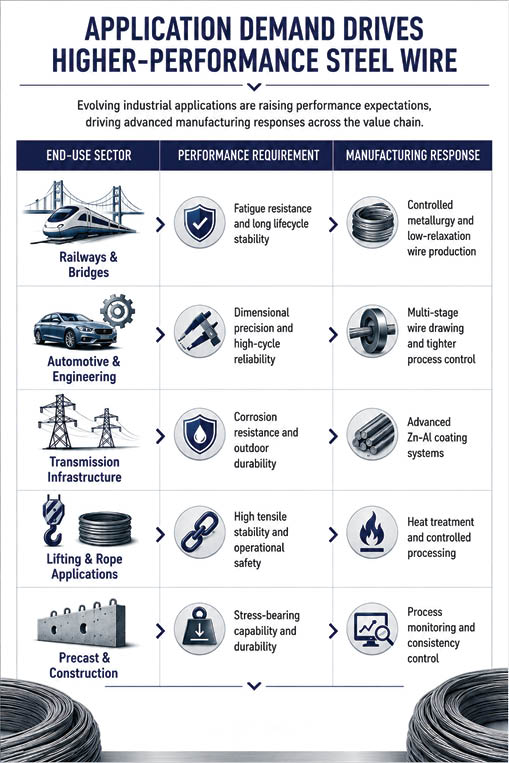
Manufacturers are tightening process control across surface preparation, wire drawing, and heat treatment operations. Greater focus is also being placed on coating consistency, inspection systems, and downstream testing. According to Bansal Wire Industries Limited, recent gains in manufacturing efficiency are increasingly coming from “automation, precision process control, and advanced surface engineering technologies.” The objective is not simply faster production, but tighter repeatability, lower process variation, and more stable downstream performance.
Tata Steel Limited describes extensive deployment of automated process monitoring, optimized multi-pass drawing systems, controlled heat treatment operations, advanced coating lines, and AI-enabled inspection systems designed to improve consistency and reduce defect variability.
Similarly, Miki Wire Works Pvt. Ltd. highlights the use of thermal stabilization systems, automated straight-line wire drawing technologies, and acid-free mechanical descaling processes for high-carbon wire production.
Nirmal Wires Pvt. Ltd. also points to increasing adoption of automation, inline monitoring systems, and laser-based diameter control technologies to maintain tighter dimensional consistency and improve process stability.
Collectively, these developments indicate that the industry’s next phase of competitiveness will increasingly depend on process discipline, repeatability, and manufacturing precision rather than scale expansion alone.
Surface Engineering and Corrosion Resistance Gain Importance
Surface engineering and coating technologies are also becoming increasingly important areas of differentiation, particularly in infrastructure, transmission, marine, and outdoor applications where lifecycle durability has become a major consideration.
Conventional galvanization systems are gradually giving way to more advanced zinc-aluminium coating technologies capable of delivering substantially improved corrosion resistance and longer service life under aggressive environmental conditions.
Coating performance is increasingly influencing lifecycle costs in coastal, high-humidity, and outdoor infrastructure environments.
Nirmal Wires Pvt. Ltd. highlights its NIZNAL® zinc-aluminium coated wire products, which reportedly offer significantly longer operational life compared to conventional galvanized wire products. Similarly, Systematic Group points to increasing demand for Zn-Al coated products designed for harsher outdoor operating conditions and extended lifecycle performance, including its GALVASYS range of alloy-coated wires developed for higher corrosion resistance.
As infrastructure operators increasingly evaluate maintenance costs and lifecycle economics, coating systems themselves are becoming an increasingly important component of overall product value and performance differentiation.
Also Read: Bansal Wire Industries Prioritise Value-Added Growth Amid Rising Demand for Specialised Wires
Toward a More Organized and Process-Driven Industry
The cumulative effect of these changes is steadily reshaping the structure of the Indian steel wire industry. Commodity products will continue to occupy a substantial share of the market, but growth in higher-performance and application-sensitive segments is increasingly favoring manufacturers capable of investing in metallurgy control, automation, testing systems, coating technologies, and process discipline.
Miki Wire Works Pvt. Ltd. believes that “the future belongs to organized, technology-driven manufacturers.”
The industry’s evolution is unlikely to be abrupt or disruptive. Rather, it represents a gradual industrial transition in which reliability, process consistency, lifecycle performance, and application-specific manufacturing are steadily becoming more important than broad-volume production alone.
As infrastructure systems become more demanding, automotive standards tighten, and industrial applications grow increasingly performance-sensitive, Indian steel wire manufacturers are steadily moving up the value chain. The transformation may not always be visible through production volumes alone, but it is increasingly visible in how manufacturers are approaching metallurgy, processing, coatings, automation, and performance engineering across the wire value chain.